

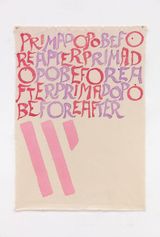
MASSIMODECARLO is pleased to present Giorgio Griffa‘s first solo exhibition in Asia, at the gallery’s Hong Kong space. Conceived as an overview of a practice spanning more than half a century, the exhibition brings together works from the late 1970s to the present, drawn from four of the thirteen cycles that structure the artist’s work.
In Griffa’s painting, no cycle ever truly comes to an end. Each has a starting date but no conclusion. The cycles coexist, intersect and respond to one another, free from any idea of linear progression. Even the Segni primari, with which the artist brought painting back to its most essential elements at the end of the 1960s, remain open to this day.
With the Segni primari, Griffa abandons figuration, frees the canvas from the stretcher and begins painting directly on the floor, using diluted acrylics that soak into the unprimed canvas. In Due segni (1978), Tre segni (1979) and Verticale (1978), a few strokes of colour come to rest on the surface with the patience of a repeated gesture. The artist does not impose a form: he places his hand at the service of colour. He then fixes the work to the wall along its upper edge and lets it hang freely. The creases remain visible, holding the memory of the time the canvas spent folded, stored and unfolded again.
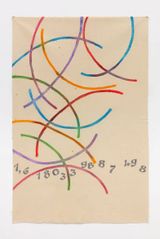
In the 1980s, alongside the signs, expanses of colour enter the work through the Segno e campo cycle. It is a period in which the artist engages openly with the great tradition of painting, and in particular with the legacy of Matisse. Colour no longer traces only a line, but inhabits a region of the surface, leaving the rest to silence. In Campo giallo (1983) and Campo rosso (1986), the signs settle into layers that are read from top to bottom, like a narrative of gestures and different tones. In the 1990s, Griffa begins the cycle Tre linee con arabesco, represented in the exhibition by Tre linee con arabesco n. 6 (1991): here the curve slips in among the straight lines, and each work carries a progressive number marking its place within the cycle.
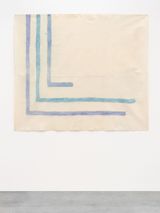
Forty years on, the field reappears in the canvases Griffa is working on today. In the two Campo blu works of 2026, pale blue spreads across dark linen in irregular shapes, crossed by lines that ripple like water. The relationship between sign and space is unchanged, but it is now charged with a new restlessness, akin to Disordine, the artist’s most recent cycle. There, order breaks down not to vanish but to generate new equilibria, in a continuous motion that Griffa sees as inherent in the very nature of the universe.
For the Turin-born artist, this first exhibition in Asia also brings him into contact with the sources of his own thinking. Around 1950, when Griffa was still a boy, the first books on Eastern cultures began to circulate in Italy and across Europe. Among them was Daisetz T. Suzuki’s study of Zen and Japanese culture. Soon afterwards came Griffa’s discovery of the Tao Te Ching. The encounter proved decisive.
The impersonality, indeterminacy and rhythm of his signs owe much to it, as does, above all, the idea of the unfinished. “My debt to Eastern thought lies above all in the fact that it led me to introduce the unfinished,” Griffa explains. His canvases never quite reach completion: signs and fields of colour stop short, leaving room for emptiness and for time to go on flowing.
From the canvases of 1978 to the Campo blu works of 2026, the exhibition reveals the coherence of a trajectory that advances not through ruptures but through accumulation and recurrence. This is painting that renounces narration and representation, letting colour, canvas and time speak for themselves. As early as 1972, Griffa summed this up in a phrase that would become the manifesto of his work: “I don’t represent anything, I paint.”
The exhibition is presented in collaboration with the Italian Cultural Institute of Hong Kong. On the occasion of the opening on 16 October 2026, architect Cesare Griffa, co-founder of the Giorgio Griffa Foundation, will lead a private tour and talk at the gallery.
Giorgio Griffa was born in Turin in 1936 where he still lives and works. He is an Italian painter, from the 60s-70s one of the main international exponents of contemporary pictorial research. Although his work has been associated with Arte Povera, Pittura Analitica and Minimalism, Griffa’s path, while rich in exchanges and friendships, remains mostly solitary and unclassifiable in a specific current.


Operating in Hong Kong since March 2016, MASSIMODECARLO has had a long-lasting involvement in the Asian art market. As a member of the selection committee board of Art Basel Hong Kong, the gallery strives to become part of the city’s ever-growing, bustling cultural landscape. The gallery initially opened in the Pedder Building, relocating in 2022 to the Tai Kwun complex - Center for Heritage and Arts, a historic building home to a wide variety of cultural projects.
A respected voice in contemporary art discourse.
Focusing on ambitious storytelling and insightful art-world commentary. Ocula Magazine publishes in-depth interviews, critical essays and timely analysis on the artists, exhibitions and ideas driving the global art world.
Learn more about Ocula Magazine
Showcasing the best of the art world.
Ocula partners with galleries from around the world to highlight their artists, artworks and exhibitions. Gallery membership is by application and invitation, with each member vetted by an independent panel.
Learn more about Ocula Membership

Specialises in the sale of major artworks.
Led by a team with deep ties to the world’s leading auction houses, galleries and collectors. Ocula’s advisory team offers bespoke services to high-net-worth clients from around the world who are looking to acquire the best of contemporary and modern art.
Learn more about our team and services