





ANDREW CRANSTON
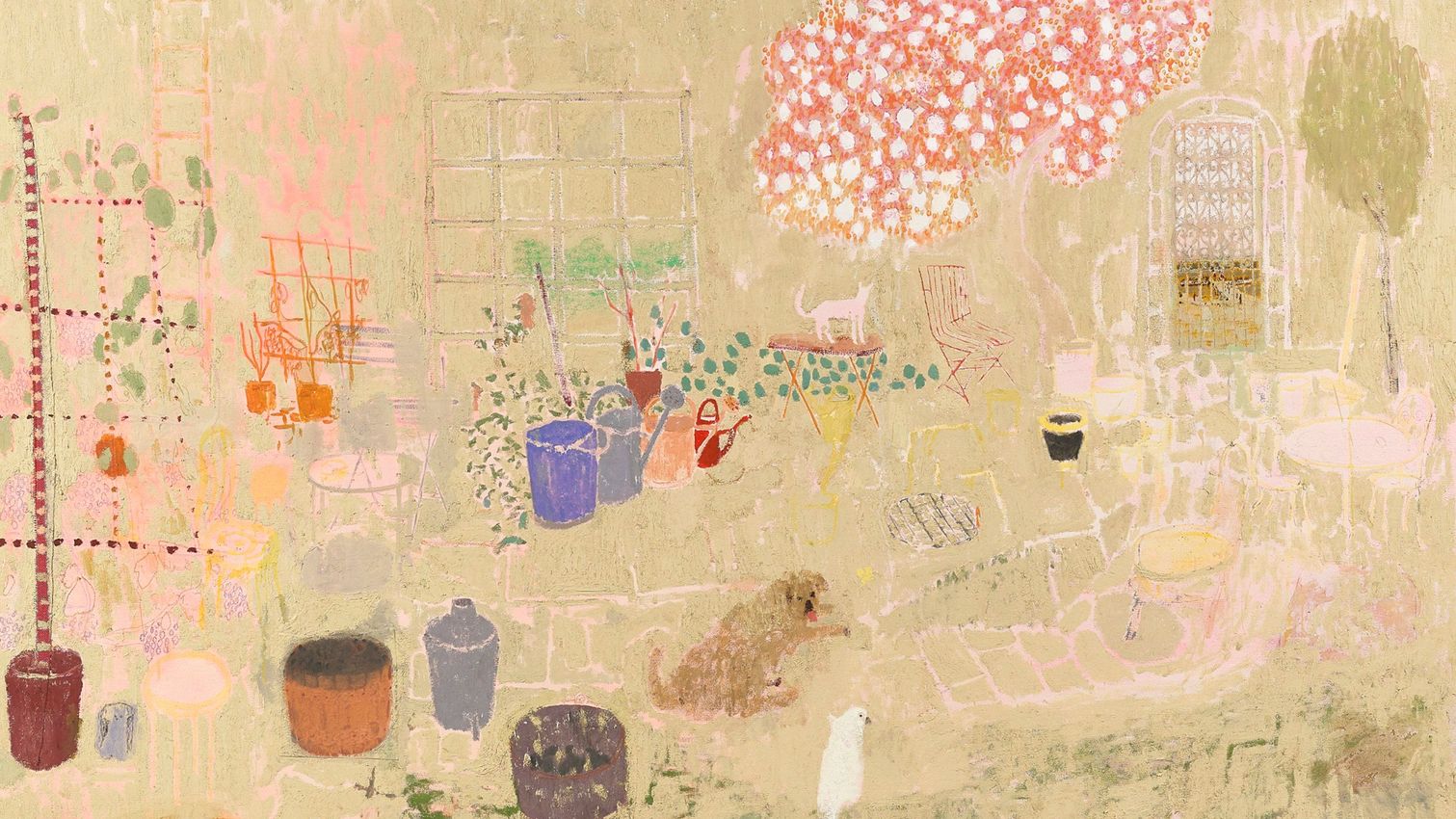
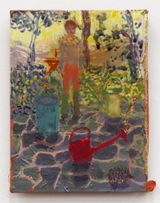
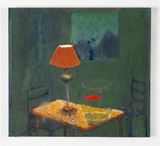
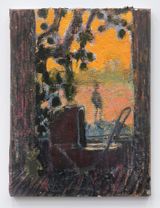
b. 1969, United KingdomAndrew Cranston’s imaginative figurative paintings tell stories through their colour and form: familiar objects and interior set-ups invite the viewer into dreamlike other worlds, where everyday scenes morph into theatrical spaces.
Early Years
Andrew Cranston was born in 1969 in Hawick, in the Scottish Borders. He left school at 15 and took up a YTS placement as a joiner, but left after a year, working in other odd jobs and attending night classes to gain academic qualifications. He remembers being on a walking holiday with a friend in his late teens and seeing rocks in a river that he decided he wanted to photograph. Unable to purchase a disposable camera, he bought a sketchbook and pencils instead. Following a year studying art in Manchester, he returned to Scotland and studied at Gray’s School of Art in Aberdeen, gaining his BA in fine art in 1993. He completed his postgraduate studies at the Royal College of Art—where he was taught by Adrian Berg and Peter Doig—gaining his master’s in painting in 1996.
Andrew Cranston: Artworks
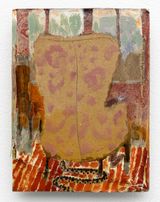
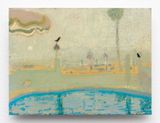
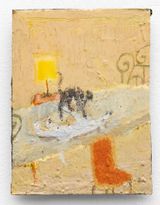
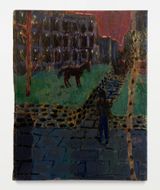
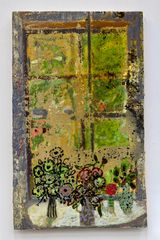
The titles of Andrew Cranston’s artworks are as engaging as their subject matter: Those who hide well, live well (2022), a huge echo a huge echo (2023), Stay with me, my nerves are bad tonight, the midges too (2022), Cat and Cheeseboard (2018). His images evoke a sense of place, whether that’s the everyday life they apparently depict, or the imaginary narratives they conjure. He uses colour and texture to create his scenes, sometimes using a single colour field (red tones, the blues of the sea) or painting on to a non-canvas surface, or coating the picture in varnish.
- In Joyce (2018), a yellow James Joyce is shown standing before the sea. The Irish writer was known for his eyesight problems—does the yellow relate to another visually impaired writer, Jorge Luis Borges, who could see yellow, blue and green, but not black or red? This is an example of a Cranston painting realised on a book cover, which can be seen beneath the paint (the word “painting” appears on the spine).
- Indoor Arctic (2019) demonstrates the humour that flows through many of Cranston’s pieces. It’s a small work featuring a man wrapped up in layers of clothes, standing in a high-ceilinged room with a blue light shining into the space.
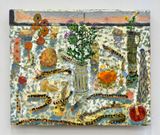
- 2023’s A snake came to my coffee table on a hot, hot day to drink there sees a silvery snake slithering around near Cranston’s son’s cot. This isn’t the only snake in Cranston’s works—the reptiles appeared after Cranston had been painting objects around him, including the flex of a vacuum cleaner, which he decided to make into a snake.
Andrew Cranston: Select Awards
- Apollo Artist of the Year (shortlisted) (2024)
- Visual Arts Award, Hope Scott Trust (Edinburgh) (2015)
- The Arts Foundation Fellowship for Painting (2014)
- Creative Scotland Quality Arts Production Award (2013)
- Scottish Arts Council Artists Award (2009)
- Creative Development Award, Scottish Arts Council (2008)
- Mappin Open Solo Show Award, Mappin Art Gallery, Sheffield (2001)
- NatWest Prize for Art (1993)
Andrew Cranston: Select Exhibitions
Select Solo Exhibitions
- I’m going in a field, Stuart Shave Modern Art, London (2026)
- Thoughts from under the floorboards, Stuart Shave Modern Art, Paris (2024)
- One day this will be a long time ago, Karma, Los Angeles (2024)
- Andrew Cranston: Etchings, Glasgow Print Studio, Glasgow (2024), UK
- What made you stop here? * , The Hepworth Wakefield (2023)
- Never a joiner, Ingleby, Edinburgh (2023)
- If you see something that doesn’t look right, Modern Art, London (2022)
- Waiting for the Bell, Karma, New York City (2021)
- Ingleby Gallery at Frieze New York City (2019)
- But the dream had no sound, Ingleby, Edinburgh (2018)
- If I was a Carpenter and other stories, Wilkinson Gallery, London (2017)
- Henderson Blyth’s Drawer, Look Again: Visual Art and Design Festival, Aberdeen (2016)
- Andrew Cranston: Paintings from a Room, Ingleby, Edinburgh (2016)
- Who is this who is coming? Display Gallery, London (2014)
- What to do after a death in Scotland, Hamish Morrison Galerie, Berlin (2013)
- Im Büro, Hamish Morrison Galerie, Berlin (2010)
- What a Man does in the Privacy of His Own Attic is His Affair, International Project Space, Bourneville College, Birmingham (2009)
- Mappin Open Solo Show, Mappin Art Gallery, Sheffield (2002)
- Stoorsooker, Royal Scottish Academy, Edinburgh (2000)
- Happy Hunting Ground, Peacock Printmakers, Aberdeen (1998)
Select Group Exhibitions
- Roaming the Cosmos of the Heart, H+ Art Museum, Suzhou (2026)
- Songs of Innocence and Experience, Part II, Ingleby, Edinburgh (2026)
- Salon, Lismore Castle Arts (2026)
- Gray’s School of Art: 140 Years—Never make a head bigger than a melon, Aberdeen Art Gallery (2025)
- Dreams of the everyday: paintings by Winifred Nicholson and Andrew Cranston, Pier Arts Centre, Stromness (2025) (and touring)
- Pequeño Formato (Small Format), Galería Elvira González, Madrid (2025)
- Swimming: Curated by Russell Tovey, Grimm, Amsterdam (2024)
- Frontiers: Painting in Scotland Now, Royal Scottish Academy, Edinburgh (2024)
- Ghosts in Sunlight, Thirsk Hall Sculpture Garden, Thirsk (2024)
- The Inner Island, Foundation Carmignac, Ile de Porquerolles (2023)
- The Painted Room, Grimm, Amsterdam (2023)
- To be a giant and keep quiet about it, Margot Samel, New York City (2022)
- Dear John, Adams and Ollman, Portland (2021)
- (Nothing But) Flowers, Karma, New York City (2020)
- The Unseen Masterpiece, Ingleby, Edinburgh (2020)
- Brexit: Mail Art from a Small Island, Sipgate Shows, Düsseldorf (2019)
- Twenty, Ingleby, Edinburgh (2018)
- Zeros to Heroes: The Beta Band Archive, J Hammond Projects, London (2018)
- Outside, Karma, New York City (2016)
- Between the late and Early, Royal Scottish Academy, Edinburgh (2013)
- John Moores Painting Prize, Walker Art Gallery, Liverpool (2012),
- Interieur, Ute Parduhn Gallery, Düsseldorf (2008)
- Sometime Blonde, Rockwell, London (2003)
- In the Summertime, Talbot Rice Gallery, Edinburgh (1999)
Further Reading
- Andrew Cranston’s Instagram
- Studio visit from Ocula (2023)
- 2024 interview from Studio International
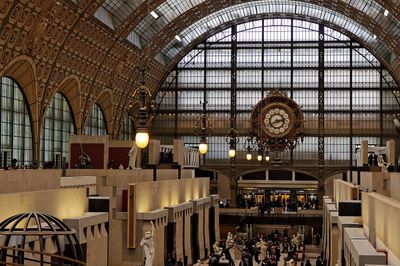
- An afternoon at the Musée d’Orsay from Ocula (2024)
- 2018 conversation between Cranston and Peter Doig
- 2026 interview with AnOther
Andrew Cranston FAQs
What materials and techniques does Andrew Cranston use?
Cranston works on several paintings at once, which allows each piece to develop naturally. He isn’t constrained by one theme or format, allowing himself to explore different ideas. Some paintings allow viewers to see their layers, giving an idea of the order in which he painted them; others feature the join between canvases. He often incorporates layers of varnish. He notably paints on book covers but has also experimented with painting on to coffee-bag netting, where the paint pools in the material’s crevices.
Who are Andrew Cranston’s influences?
The time-frozen essence of Cranston’s works and the stories told by their characters and everyday objects suggests the influence of Pierre Bonnard and Édouard Vuillard. However, he has also spoken about studying the work of Pieter Bruegel and William Scott.
Why does Andrew Cranston paint on book covers?
Cranston often uses the covers of old hardback books as his canvases, which is a reflection of his interests in narrative and literature. He first painted on a book cover when he was in residency in Germany in 2006, having “run out of things to paint” and discovering a pile of books. Sometimes the title of the book can be seen through the paint, such as in Joyce (2018).
Ocula


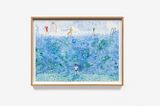

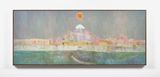

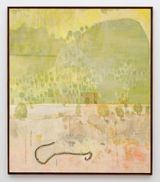













Explore Andrew Cranston's Exhibitions




Andrew Cranston in Ocula Magazine






Explore and Follow Artists Shaping Contemporary Art
A respected voice in contemporary art discourse.
Focusing on ambitious storytelling and insightful art-world commentary. Ocula Magazine publishes in-depth interviews, critical essays and timely analysis on the artists, exhibitions and ideas driving the global art world.
Learn more about Ocula Magazine
Showcasing the best of the art world.
Ocula partners with galleries from around the world to highlight their artists, artworks and exhibitions. Gallery membership is by application and invitation, with each member vetted by an independent panel.
Learn more about Ocula Membership
Specialises in the sale of major artworks.
Led by a team with deep ties to the world’s leading auction houses, galleries and collectors. Ocula’s advisory team offers bespoke services to high-net-worth clients from around the world who are looking to acquire the best of contemporary and modern art.
Learn more about our team and services