





Heba Y. Amin and Maja Figge on Colonial Erasures in Postwar German Film

Heba Y. Amin. Courtesy the artist. Photo: Sebastian Böttcher.


The following conversation between artist Heba Y. Amin and film scholar Maja Figge addresses how German colonial narratives propagated through 1950s German films, while introducing Amin’s exhibition at Zilberman in Berlin: When I see the future, I close my eyes: Chapter II (1 May–30 July 2022), curated by Anthony Downey.1
When I see the future explores how colonial violence is engendered through the material and immaterial occupation of future realities and looks at narratives relating to the German Afrika Korps and their lingering presence in northern Egypt, with a focus on the millions of landmines planted by Field Marshal Erwin Rommel’s army during the World War II campaign in El Alamein, Egypt.

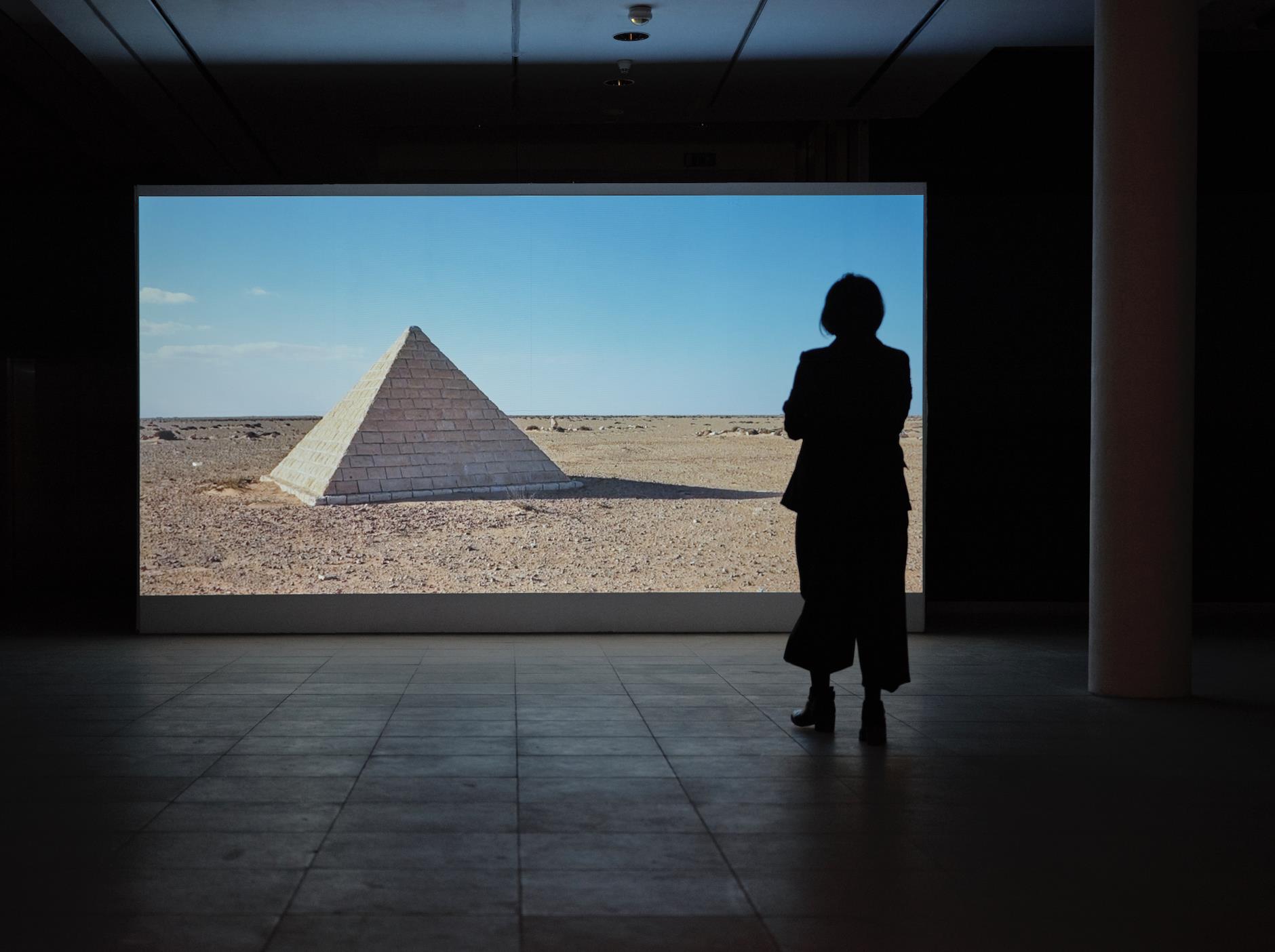
During her fieldwork in what remains one of the most landmine-infested regions in the world, Amin came across a peculiar pyramid built by Luftwaffe fighter pilots to commemorate World War II German fighter pilot Hans-Joachim Marseille.
By creating a replica of the Nazi-era memorial and bringing it back to Germany, the artist inverts the historical framing of these events and focuses on how European propaganda, perpetuated by mainstream films, continues to disavow responsibility for the technofossils that remain in the aftermath of colonial violence.

Drawing from Figge’s research on 1950s West German films, the following panel addressed how postwar films like Der Stern von Afrika (The Star of Africa), Alfred Weidenmann’s 1957 biopic about Marseille, helped perpetuate the heroic image of the German Afrika Korps by conveniently writing the colonial and Nazi context out of the film’s narrative.
Echoing these findings, Amin’s exhibition at Zilberman includes an interview with Cuban-German celebrity Roberto Blanco, who began his career as Marseille’s butler in the 1957 film, long before his success in German schlager [pop] music.
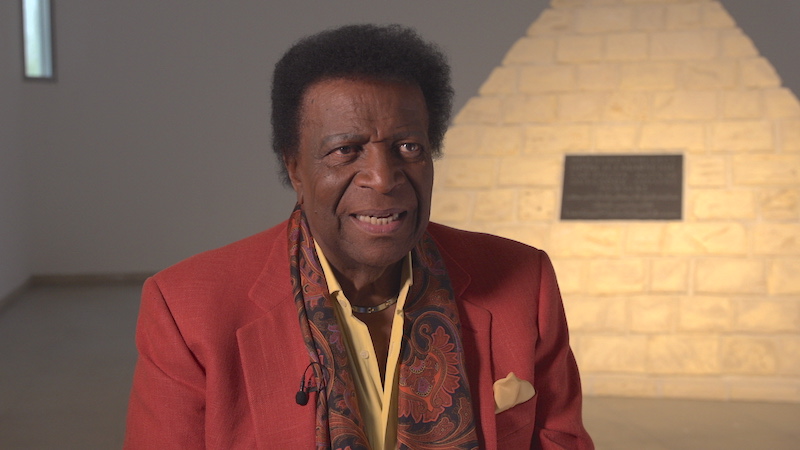
As noted in Figge’s research, his character, Mathias, is based on Corporal Mathew Letuku, who was a prisoner of war from South Africa fighting for the South African Union Defense Force (UDF). Unsurprisingly, Letuku’s reports differ greatly from those in the German media at the time, and how he came to be represented in the film was, likewise, at odds with his personal recollections.
Indeed, Letuku’s experience of the years spent in captivity until 1945, alongside that of 14,583 other South African soldiers taken in as prisoners of war in Germany and Italy in 1942, was effectively written out of the film’s narrative, while Letuku was reduced to an entertaining ‘sidekick’.
In the following conversation that took place in June 2022, Heba Y. Amin and Maja Figge elaborate on such epistemological violence toward Black and Brown bodies within German historical discourse, including erasures and omissions that have yet to be accounted for.

HYA: I’m very excited today to engage in this conversation with film scholar Maja Figge about the 1957 film Der Stern von Afrika, which relates to one of my artistic works from the exhibition: a replica of a World War II memorial in northern Egypt dedicated to a German fighter pilot named Hans-Joachim Marseille.
We will talk about the colonial context of World War II and how the German Afrika Korps’ heroisation can be attributed to films like Der Stern von Afrika. By situating itself as an anti-war film, the filmmaker’s attempt to rewrite history is particularly evident in the context of the rebranding of postwar Germany, particularly by whitewashing crimes committed by the German Afrika Korps on the African continent.
Maja, you have written a book about German films from the 1950s and their role in rewriting German identity. Can you tell us about it?
MF:
My book is called Deutschsein (wieder-)herstellen – Weißsein und Männlichkeit im bundesdeutschen Kino der fünfziger Jahre (transcript Verlag, 2015), or Reconstructing Germanness – Whiteness and Masculinity in 1950s West German Cinema.
The main argument is about how cinema of the 1950s in West Germany established a narrative that tried to distance itself from the Nazi past, especially from the racism and antisemitism of the racial state. At the same time, by re-introducing colonial and racist anti-Black imagery in a recorded way, these films attempted to cover Nazi crimes with imagery that drew from a German colonial imaginary.
Ironically, this attempt was aimed at re-establishing a sense of Germanness that was non-racist and pure on moral terms, while putting forward the narrative of Entschuldung as a way of getting rid of guilt. In this book, I try to show how the films helped to establish, not only the myth of the absence of racism in West Germany, but a new kind of memory politics.
HYA: This is a key point in the context of my work. When I see the future at Zilberman deals with representation propagated by the colonial imaginary and how images are instrumentalised to circumvent responsibility from violence.
Alfred Weidenmann’s Der Stern von Afrika, does exactly this—it attempts to whitewash violence by extracting everything problematic about it. While the story is situated in North Africa and profiles the German Afrika Korps, there is little mention of the Nazis or the colonial context of World War II.
Could you speak more about this, and how the film’s protagonist, Hans-Joachim Marseilles, is presented as the ideal Aryan; a blonde, almost Nordic, sporty fighter pilot, who is given the nickname ‘Der Stern von Afrika’ because of his aerial skills? How is that kind of mythology perpetuated by the film?
MF: The film was made when the Bundeswehr armed forces were first established; its role was to gain support for this critical moment. In establishing this notion of a ‘citizen in uniform’, it draws from the story of Marseille, who was already a star under National Socialism.
“Cinema of the 1950s in West Germany established a narrative that tried to distance itself from the Nazi past, especially from the racism and antisemitism of the racial state.
Even Joachim Hansen, the actor who plays Marseille in the biopic, had a trading card of Marseille above his bed when he was a kid. Hansen was especially cast for his appearance, being blonde and very tall—a Nordic type, which was underlined by his screen name ‘Hansen’.
The film shows the sportive side of aerial warfare and establishes the character as a hero, which is how he is remembered today. To differentiate him from the Nazis, he is portrayed as a rebellious character who causes trouble and breaks the rules. This image is supported by the aesthetics of the aerial fight, which, through its specific cinematography, constitutes Marseille as a literal star in the sky.

HYA: Your book addresses the aesthetic spectacle of the aerial gaze and how aerial cinematography, as employed in the film, is an extension of the perspective of warfare, considering that from its very inception, aerial photography was about visualising empty landscapes, free for the taking.
We now know that the visual erasure of Black and Brown bodies from their native lands was a strategic move for the colonial project. The film implements this very logic by heroising and aestheticising warfare without portraying its repercussions on Indigenous people.
As such, the story of World War II on the African continent has always been a European narrative, which effectively erased the colonial context and the colonised people who fought for a war that wasn’t theirs. Can you talk about the strategies the film uses to perpetuate that kind of propaganda?
MF:
First, the desert as terra nullius [nobody’s land] is a very welcoming scene to establish this colonial gaze when it comes to the cinematic perspective of aerial reconnaissance. I’m referring here to Paul Virilio’s book War and Cinema. The Logistics of Perception (2009).
We’re seeing a specific technique that imitates cinematic technologies that were only invented some years before and used in the bombings of the German air force, the Luftwaffe, during World War II: the concordance between camera, eye, and weapon. Even as there are no carpet bombardments in the film, it stages the elegant aerial duels in a similar way. In repeated sequences, we see a closeup of Marseille’s face and then a subjective shot through the reticle; the camera is linked to the perspective of the shooting, as we see how the British planes are shot. Then the camera follows the burning plane as it crashes into the supposedly empty desert. An aesthetic of the sublime—understood as the mediated view from above—is thus established and Marseille becomes the star of Africa.

The aerial duel is very typical for the war-film genre structuring the narrative. It can be traced back to D.W. Griffith’s invention of continuity editing and cross-cutting in his 1915 film, The Birth of a Nation, which was propaganda for the white supremacist Ku Klux Klan.
Moreover, the fighter pilots of the Jagdgeschwader 27 are represented as a group of young, sportive guys who are hard-working, adventure-seeking, fun-loving, and eventually have to die for their service. There are stories about fighter pilots and how they weren’t real Nazis but young men who loved listening to jazz. Also, Marseille supposedly went to a specific jazz bar here, in Berlin, called the Sherbini Bar, which was run by Egyptians.
Perhaps this is a good moment to bring in the role of Roberto Blanco, or the character he played, because it is crucial for understanding the displacement that takes place in the aftermath of World War II.

Although the main goal of the Africa campaign was to support Italy in its colonial endeavour against Britain, until late 1942, there were still colonial revisionist plans and hopes for a Deutsch-Mittelafrika (German Central Africa).
Instead of addressing the historical circumstances, the film introduces a Black character named Mathias, played by Roberto Blanco, who is gifted to Marseille by his comrades. His role was to entertain the soldiers, which brings in the history of colonial enslavement—particularly, the traces of German participation in the slave trade and the euphemism of ‘gifting’ Africans.

HYA: Der Stern von Afrika introduces Mathias as the sidekick who sings, dances, and brings light to an otherwise heavy film about death. It’s also Roberto Blanco’s first role as an entertainer as a teenager.
At the time, his father, who was also a performer, discouraged him from pursuing a career in entertainment, but Blanco was inevitably discovered on a flight from Spain to Germany while visiting him. Director Alfred Weidenmann was charmed by his charisma and offered him the role of Mathias, which would launch his career.
As it turns out, Mathias is based on a South African prisoner of war named Matthew Letuku, who was captured in Libya, and was allegedly handpicked and gifted to Marseille for his birthday.
Marseille was also a fan of jazz music and frequented jazz clubs in Berlin; an important detail because it relates to how Black actors were instrumentalised in similar kinds of films. Can you talk more about that?
MF:
When Mathias is introduced in the film, the scene opens and you see his shirtless body—Roberto Blanco’s Black body, dancing and singing. In my book, I elaborate on how the Black body is filmed in opposition to Marseille, the white star. Mathias’ role was to entertain Marseille and his comrades, he plays records, cooks, cleans, dances; he represents life, or rather vitality, in the situation of pending death they are all facing.
While Marseille leaves to receive his medals in Berlin and Rome, from Hitler and Mussolini respectively, supposedly his colleagues from the fighter squadron (Jagdgeschwader) wanted to present him with a gift, so they handpicked Letuku from the war camps.
In June 1942, Letuku was captured in Tobruk, Libya, with other soldiers of the Non-European Army Services of the UDF. According to an email exchange between Letuku and Christian Möller, who let me read his unpublished research paper on Letuku, written in the late 1990s, Letuku actually did the things depicted in the film—singing, playing records, cleaning—but his befriending Marseille is a myth.

Between 1975 and 2021 there was an air force casern named after Marseille in Schleswig-Holstein, Germany. Interestingly, when a name change was proposed, some people protested the change and argued that Marseille was a good guy because he befriended Letuku and ‘they were really close.’ But Letuku was Marseille’s captive, even if only for four weeks. Marseille later died in a plane crash.
Letuku was at risk and had limited agency. But you could also say that there are similarities between his character and Roberto Blanco regarding the exotic, racist tropes that are being projected onto both, and how they are reduced to spectacle.
HYA: It goes beyond the film, too, given Matthew Letuku’s historicisation is inherently problematic. Manfred Rommel, the former mayor of Stuttgart and the son of Erwin Rommel, played a significant role in attempting to rewrite that narrative. In 1984, the mayor invited Letuku to the 16th Federal Meeting of the ‘Verband Deutsches Afrika-Korps’ to meet and ‘reminisce’ with his former captors.
Such events tried to frame the German Afrika Korps as ‘the good Nazis’ that weren’t engaged in atrocities or colonial ambitions. Indeed, this grossly imbalanced power dynamic and Letuku’s lack of agency are not even considered.
MF: It’s interesting to note that Letuku was from South Africa but he was educated in a German missionary school, so he could speak German. Perhaps, this is why he was handpicked for Marseille. However, as far as I know, it was uncommon for officers of the German Luftwaffe or ground forces in North Africa to have servants.
After Marseille’s death, Letuku stayed as a servant to another pilot on the fighter squadron and travelled with them around Europe until 1944. They treated him very badly at times—there are accounts that they would lock him up for days with no food or water while they went out to have fun.

When the Allies landed in Normandy in June 1944, Letuku was left behind and imprisoned in a war camp, first in Austria, and later in France, where, again, he faced the fear of death. This embodied narrative of violence is simply disregarded in the German narrative.
Alongside Letuku, there were many Black, South African soldiers interned not only as prisoners in war camps but also in concentration camps. Indeed, Roberto Blanco’s character in the film does not allude to any of this. I think their experience of violence hasn’t been acknowledged enough within German historical discourse. There wasn’t a general policy on how Black people were treated, either; it was rather ambivalent and changed throughout the Nazi era.

HYA: Presumably, they didn’t pose a threat because they were already dehumanised. The parallel between Letuku and Blanco is interesting, not because their experiences were similar by any means, but because both were instrumentalised by the German entertainment industry to portray a façade against racism, which, ironically, further perpetuated blatant racist tropes.
When I first presented the memorial’s replica in Germany, at the Center for Persecuted Arts [Zentrum für verfolgte Künste] in Solingen, we invited Roberto Blanco to the opening on a whim. It was such a surprise when he agreed.
I conducted an interview with him in front of the pyramid and asked him about his role as the ‘fun-loving’ butler. He was a young guy reading a script and didn’t know that the character he played was based on a real person who was a prisoner of war. During the interview, you see his perception shifting.
Roberto Blanco has an incredible biographical story most Germans are unaware of because they only know him from his career as a schlager musician. But Der Stern von Afrika was the reason he became famous in Germany. When he shot to stardom through this film, he started his career as a jazz musician and one of his first gigs was touring with Josephine Baker.
Then, he shifts to schlager music and suddenly becomes the Black figure Germans want him to be, this projected idea of a Black man. This is the role he plays for the rest of his life, as the most celebrated Black person in the German cultural sphere, and the basis on which Germans say, ‘We’re not racist.’
Like Mathias, Blanco became an incredibly successful entertainer, but one could say, in this incredibly problematic way.
MF: Historically, Black music in West Germany is discursively either considered a threat or something that can be appropriated in diverse ways. There’s this 1950s context of dealing with Black music—not only jazz, but gospel and rock.
“There are stories about fighter pilots and how they weren’t real Nazis but young men who loved listening to jazz.
We have different discourses on Black music in Germany that can somehow negotiate racism at different stages of German history. But it’s even more ambivalent than that. African American musicians came to West Germany and Austria after the war because these were places where they could work as musicians. Even though they fled the Jim Crow politics and segregation, they were still exoticised for their work.

HYA: In your chapter, you discuss how the experience of Black prisoners of war is one of the least processed histories of National Socialism to date. Why do you think that’s the case?
MF:
For a long time, research on Black Germans and people of African descent in German history, and especially Nazi history, had been limited. This started to change in the 1980s when Black scholars started reconstructing the long history of Black people living in Germany.
Likewise, World War II’s impact in Germany has been framed within a European or transatlantic perspective for a long time. This overlooked the war’s impact on the Global South, as well as the participation of colonial soldiers such as Letuku. This narrative has only started to change in the last 15 years.
HYA: Of course, we’re finally at the point of addressing this idea of multidirectional memory and bringing the German colonial context back into the frame.
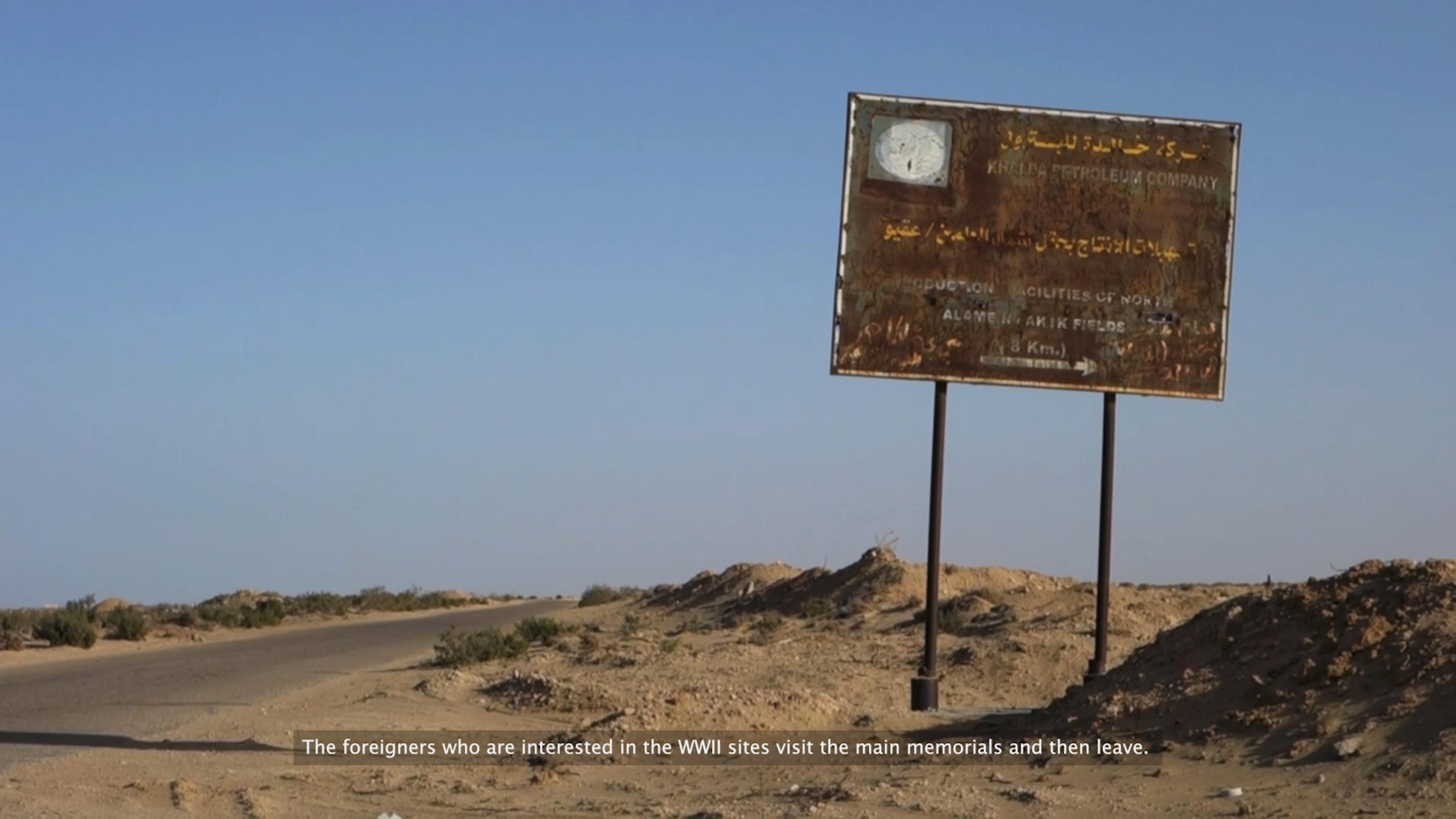
Returning to the historicisation of World War II and subsequent reparations that excluded crimes that happened elsewhere, one of the peculiar things I came across during my fieldwork in northern Egypt is a memorial for Erwin Rommel.
Rommel’s son, who was the mayor of Stuttgart, donated his father’s belongings to the Egyptian government so that he could be memorialised elsewhere. Again, I see this as an act of fabricating heroism, while washing one’s hands of wrongdoing.
A couple of years ago, you were also contacted by the person responsible for the educational program of the Military History Museum in Berlin-Gatow, which happens to have the empennage of Marseille’s plane from when he crashed in 1942. What did he tell you?
MF: The empennage is interesting because Marseille marked off his successful shots on its back. Many museum visitors take selfies with it, which opens another world of Marseille fandom and perpetuates his heroic legacy today, mostly on online sites dedicated to WWII fighter pilots or platforms such as YouTube. —[O]
1 Originally launched in 2020 at The Mosaic Rooms in London, When I see the future, I close my eyes is an interdisciplinary collaborative platform by Heba Y. Amin and Anthony Downey that explores art and exhibition-making as a methodology for new and ongoing research. The research platform reflects on technology’s colonial histories and its role in determining models of extraction and Western visual regimes with a focus on broadening conversations surrounding emerging forms of digital authoritarianism, the evolution of machine vision, and technologies that support asymmetric warfare.
Main image: Heba Y. Amin. Courtesy the artist. Photo: Sebastian Böttcher.


A respected voice in contemporary art discourse.
Focusing on ambitious storytelling and insightful art-world commentary. Ocula Magazine publishes in-depth interviews, critical essays and timely analysis on the artists, exhibitions and ideas driving the global art world.
Learn more about Ocula Magazine
Showcasing the best of the art world.
Ocula partners with galleries from around the world to highlight their artists, artworks and exhibitions. Gallery membership is by application and invitation, with each member vetted by an independent panel.
Learn more about Ocula Membership
Specialises in the sale of major artworks.
Led by a team with deep ties to the world’s leading auction houses, galleries and collectors. Ocula’s advisory team offers bespoke services to high-net-worth clients from around the world who are looking to acquire the best of contemporary and modern art.
Learn more about our team and services