

LUCAS ARRUDA
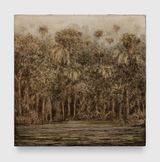
b. 1983, BrazilLucas Arruda’s detailed compositions may appear to depict specific environments, but they are built from memory and intuition rather than as a reproduction of a scene. His subtle artworks straddle abstraction and figuration and are notably often grouped into the Deserto-Modelo (Model of Desert) series.
Early Years
Lucas Arruda was born in 1983 in São Paulo. He painted every day as a child—speaking in 2017, he said: “I was quite a hyperactive child, so my parents enrolled me in an art school for children where I experimented with different media.” When he enrolled in Faculdade Santa Marcelina art college in São Paulo, painting was not fashionable, but he and his contemporaries “reclaimed” the practice. He graduated with a BFA in 2009.
Lucas Arruda: Artworks
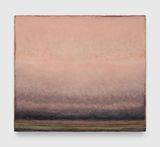
Arruda’s artistic practice balances colour and light to suggest faint horizons, luminosity and a vastness of landscape. He often establishes the horizon line first, working instinctively to fuse sky and sea and to establish a temporal relationship between the viewer and the painting. He frequently works in small formats—“The space I’m suggesting inside the canvas wants to be bigger than the edges,” he said in 2025, talking about creating a “sense of intimacy about paintings that want to be bigger than the limits of the canvas”.
- The majority of Lucas Arruda’s artworks, whether depicting the jungle, landscape, seascape or abstraction, are titled Untitled (from the Deserto-Modelo series). However, the words “landscape” and “seascape” are disputed by Arruda—he famously said in a 2017 interview: “The only reason to call my works landscapes is cultural: it’s simply that viewers automatically register my format as a landscape, although none of the images can be traced to a geographic location. It’s the idea of landscape as a structure, rather than a real place.” The repetition of the title underlines the continuity and connectedness of Aruda’s artistic practice.
Talking about the idea of desert, Arruda said in 2015: “In a desert you don’t know if it’s the start or the end of the world. It’s a place man can’t survive, an empty place, not anything, a metaphysical place, because you have no presence of time, but an existential quality. For me, it’s the only place where you could have freedom, an experience of death as an experience of freedom, and then return home safely.”
- Arruda has also produced images on 35mm transparencies (slides). Inspired by an art teacher using a slide projector, he became interested in the idea of light coming from the back of the image. Projecting the painted transparencies creates a different relationship between viewer and artwork than looking at a painted canvas. In addition, working on such a small scale meant that Arruda left more of the finished image to chance because it wasn’t always easy for him to see what he was doing.
Lucas Arruda: Select Exhibitions
Select Solo Exhibitions
- Lucas Arruda: Deserto-Modelo, Winsing Art Place, Taipei (2026)
- Lucas Arruda: Eclipse, Mendes Wood DM, São Paulo (2025)
- Lucas Arruda: Qu’importe le paysage, Musée d’Orsay, Paris (2025)
- Lucas Arruda: Assum Preto, David Zwirner, New York City (2024)
- Lucas Arruda: Lugar sem Lugar, Fundação Iberê Camargo, Porto Alegre (2021) (and touring)
- Lucas Arruda, New Century Art Foundation | Pond Society, Shanghai (2020)
- Lucas Arruda: Deserto-Modelo, David Zwirner, New York City (2019)
- Lucas Arruda‚ Neutral Corner, Mendes Wood DM, Brussels (2018)
- Lucas Arruda, David Zwirner, London (2017)
- Lucas Arruda: Desert Model, Frederic Snitzer, Miami (2012)
- Lucas Arruda: III Mostra do Programa de Exposições, Centro Cultural São Paulo, São Paulo (2011)
- Lucas Arruda: Deserto-Modelo, 713 Arte Contemporáneo, Buenos Aires (2010) (and touring)
- Lucas Arruda: Obras Recentes, Mendes Wood DM, São Paulo (2010)
Select Group Exhibitions
- Affirmation Room, Mendes Wood DM, New York City (2026)
- The New Vision: Monet and the Contemporary Gaze, Pola Museum of Art, Hakone (2026)
- Collected with Vision. Private Collections in Dialogue with the Old Masters, Royal Museum of Fine Arts in Antwerp (2025)
- Fukei-Ga (Landscape Painting), Taka Ishii Gallery, Tokyo (2024)
- Honey, I Rearranged the Collection, Fondation Beyeler, Basel (2024)
- I See No Difference Between a Handshake and a Poem, Mendes Wood DM, Paris (2023)
- Seismic Movements, Dhaka Art Summit (2020)
- David Zwirner: 25 Years, David Zwirner, New York City (2018)
- Cry of Liberty, 1st International Biennale of Asunción, Asunción (2015)
- Os Primeiros 10 Anos, Instituto Tomie Ohtake, São Paulo (2012)
- De Passagem, Rhys Mendes, São Paulo (2009)
- 40º Salão de Arte Contemporânea de Piracicaba (2008)
Further Reading
- Lucas Arruda’s Instagram
- Artist profile page at David Zwirner
- Artist profile page at Mendes Wood DM
- 2017 interview from Studio International
- 2025 interview from Art Basel
- 2025 conversation with Lucas Arruda
- 2025 interview in Numéro
Lucas Arruda FAQs
Does Lucas Arruda paint en plein air?
No—even though his paintings are based on environments near São Paulo, Lucas Arruda works in his studio, building up each picture from memory.
Do all Lucas Arruda’s paintings have the same title?
Almost all Lucas Arruda’s artworks are called Untitled (from the Deserto-Modelo series), a title that comes from the Brazilian poet João Cabral de Melo Neto. In a 2015 interview, Arruda explained: “It’s the final line of one of his poems: ‘We chose to build an enormous model.’ This word, translated as ‘model’, could be understood as a pattern, or a new system, or an idealistic desert. It makes sense for me, because it brings attention to the civilisation, the repetition and development... The works all deal with the same issue, and there’s a kind of a pattern of which things show.”
What materials and techniques does Lucas Arruda use?
Arruda’s techniques vary depending on whether he’s producing abstractions or landscapes. To make his monochromatic works, he starts with pre-dyed canvases and builds layers of oil paint, which can take months, creating luminosity using complementary colours. He also incorporates beeswax into the paint. Landscapes are often produced wet-on-wet in intensive painting sessions.
Ocula





Explore Lucas Arruda's Exhibitions






Explore and Follow Artists Shaping Contemporary Art
A respected voice in contemporary art discourse.
Focusing on ambitious storytelling and insightful art-world commentary. Ocula Magazine publishes in-depth interviews, critical essays and timely analysis on the artists, exhibitions and ideas driving the global art world.
Learn more about Ocula Magazine
Showcasing the best of the art world.
Ocula partners with galleries from around the world to highlight their artists, artworks and exhibitions. Gallery membership is by application and invitation, with each member vetted by an independent panel.
Learn more about Ocula Membership
Specialises in the sale of major artworks.
Led by a team with deep ties to the world’s leading auction houses, galleries and collectors. Ocula’s advisory team offers bespoke services to high-net-worth clients from around the world who are looking to acquire the best of contemporary and modern art.
Learn more about our team and services