Almine Rech Shanghai is pleased to present Rudolf Polanszky‘s second solo exhibition at the gallery, on view from December 10, 2021 to January 27, 2022.
APEIRON
‘What is free in a work of art, is only the moment in which it is not yet comprehended.’ – Rudolf Polanszky
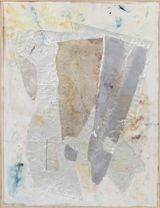
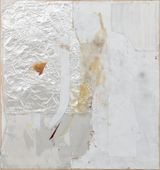
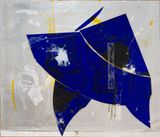
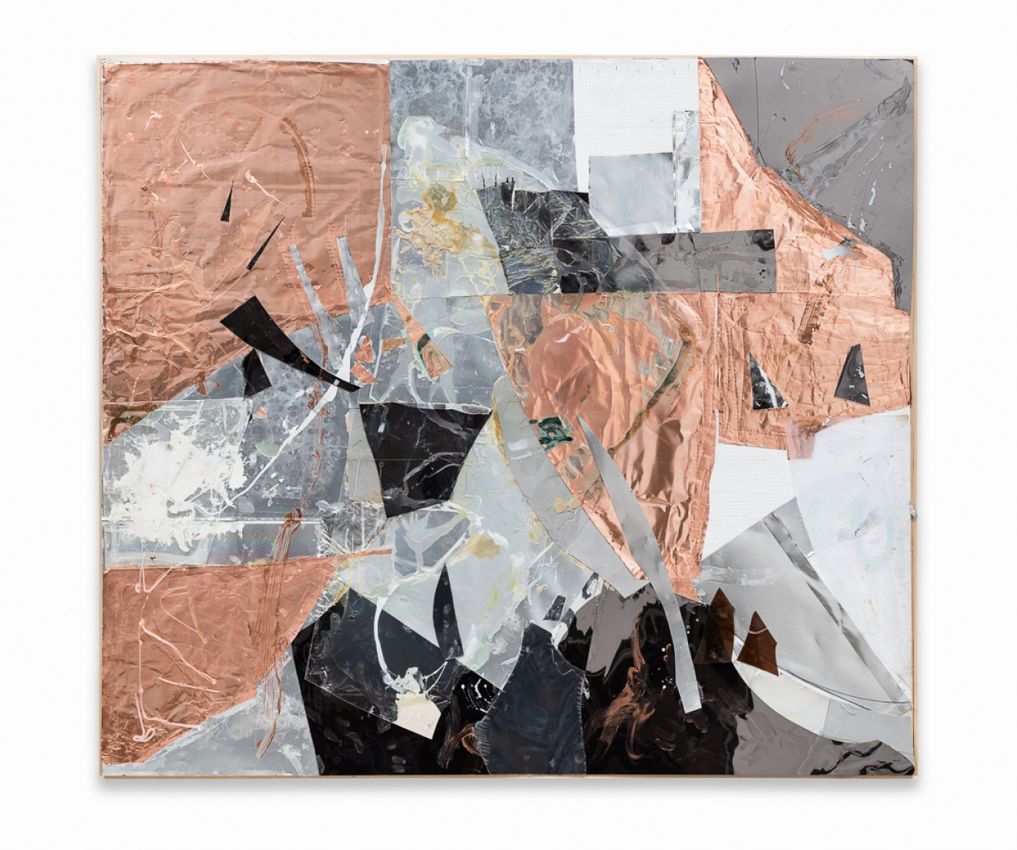
Apeiron, the title of Rudolf Polanszky’s exhibition, mirrors his ‘ad hoc synthesis approach’ of building and dissolving purely abstract forms. With a selection of recent works, drawn from his ‘Reconstructions’ series, Polansky further implodes the Modernist palimpsest via his hybrid paintings and sculpture. Along with his films, music and documented performances, Polansky’s body of work finds inspiration from mathematical metaphysics, rather than the canon of art history.
Apeiron, according to the Greek philosopher Anaximander, is the source of everything, a boundless force which having emerged from nothing, is inevitably drawn to reconciliation in the guise of the infinite void of its origin. Experiencing Polanszky’s work brings an awareness of perceptual balancing, provoked by its relative elusive visualization or adherence towards any ‘adapted meaning’.
By consciously bypassing Modernist influences, these methodologies affect his choice of scrap materials, picked from the flotsam and jetsam of Polanszky’s studio environment in Vienna. Artificial compounds including acrylic mirrors, silicone, industrial glue, epoxy, resins, copper foil and gossamer mesh, are also subjected to chance patina by exposure to the elements, encounters with animals or organic matter.
Enhanced by chiaroscuro reflections from the silver, copper & dark mirrors, the parts are distinguishable by their decoded status and hesitant assignment. The strata of the Reconstructions, their material disarray subject to alchemic states, refract light in other ways than reflection. Liquid transformations of a transparent nature are recorded by spectral zones of solidified resins, glue and insular pigments, all semi-isolated, transforming unstable structures into a temporality that by their inherent self-referential formation alludes to a potential state of rest or stability. The parameters of the work’s Philosophical Reductivism could result in an inhibiting Minimalism, but encountering the ‘Reconstructions’ is a paramount experience, via Polansky’s exposition of non-oriented diverseness of Phenomena.
The interplay between parts and wholeness, as seen in the potential Gestalt of the Reconstruction/ Rorschach Transformations (2010) are echoed in three dimensions by the Half Sculptures / Hovering Fragments (2017–2020). The sculptures function like the mysterious abstract background in Rembrandt’s, Self Portrait with Two Circles (which does not contain even one whole circle); essential fragments to support concepts of a whole, and vice-versa.
Another clue as to the artist’s method may be sought in the ‘Reconstructions / Choros’ series, an allusion to the Greek word for a place of music or dance. Each section in these works contain shapes of copper mirror, warming the chrome to a shimmering frequency, contrapuntal with the depth of the dark mirrors or neutrality from the silver. The reference may be in the fugue-like interplay of contrasting elemental colours and chance geometry, retrograde combinations that have been subjected to intuitive mathematic transformation.
As a deconstructive compositional element, counterpoint surpasses dichotomy, creating a plethora of tones and overtones—boundless and infinite by its variant re-invention, or Reconstruction. In Polansky’s The Musical Ape (1980–1983), the artist denotated sound and image with a paradoxical dissected self-portrait that did not split (which would have required two half images). What appeared instead was two wholes of a hypothetical being (composed by doubling the left and the right sides of his face), much like a Double-Helix without chemical connotations.
The evolution from the existential slapstick of The Musical Ape enhanced with the boundless and infinite possibilities suggested by the Reconstructions / Choros, flourish with echoes of the sublime.
– Steven Pollock, curator and writer


Almine Rech opened its doors on April 1st, 1997 in the 13th arrondissement in Paris. The gallery was founded on an axis of California Minimal, Perceptual art and Conceptual art, representing artists such as James Turrell, John McCracken and Joseph Kosuth.

A respected voice in contemporary art discourse.
Focusing on ambitious storytelling and insightful art-world commentary. Ocula Magazine publishes in-depth interviews, critical essays and timely analysis on the artists, exhibitions and ideas driving the global art world.
Learn more about Ocula Magazine
Showcasing the best of the art world.
Ocula partners with galleries from around the world to highlight their artists, artworks and exhibitions. Gallery membership is by application and invitation, with each member vetted by an independent panel.
Learn more about Ocula Membership

Specialises in the sale of major artworks.
Led by a team with deep ties to the world’s leading auction houses, galleries and collectors. Ocula’s advisory team offers bespoke services to high-net-worth clients from around the world who are looking to acquire the best of contemporary and modern art.
Learn more about our team and services