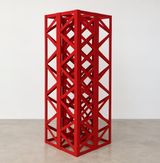
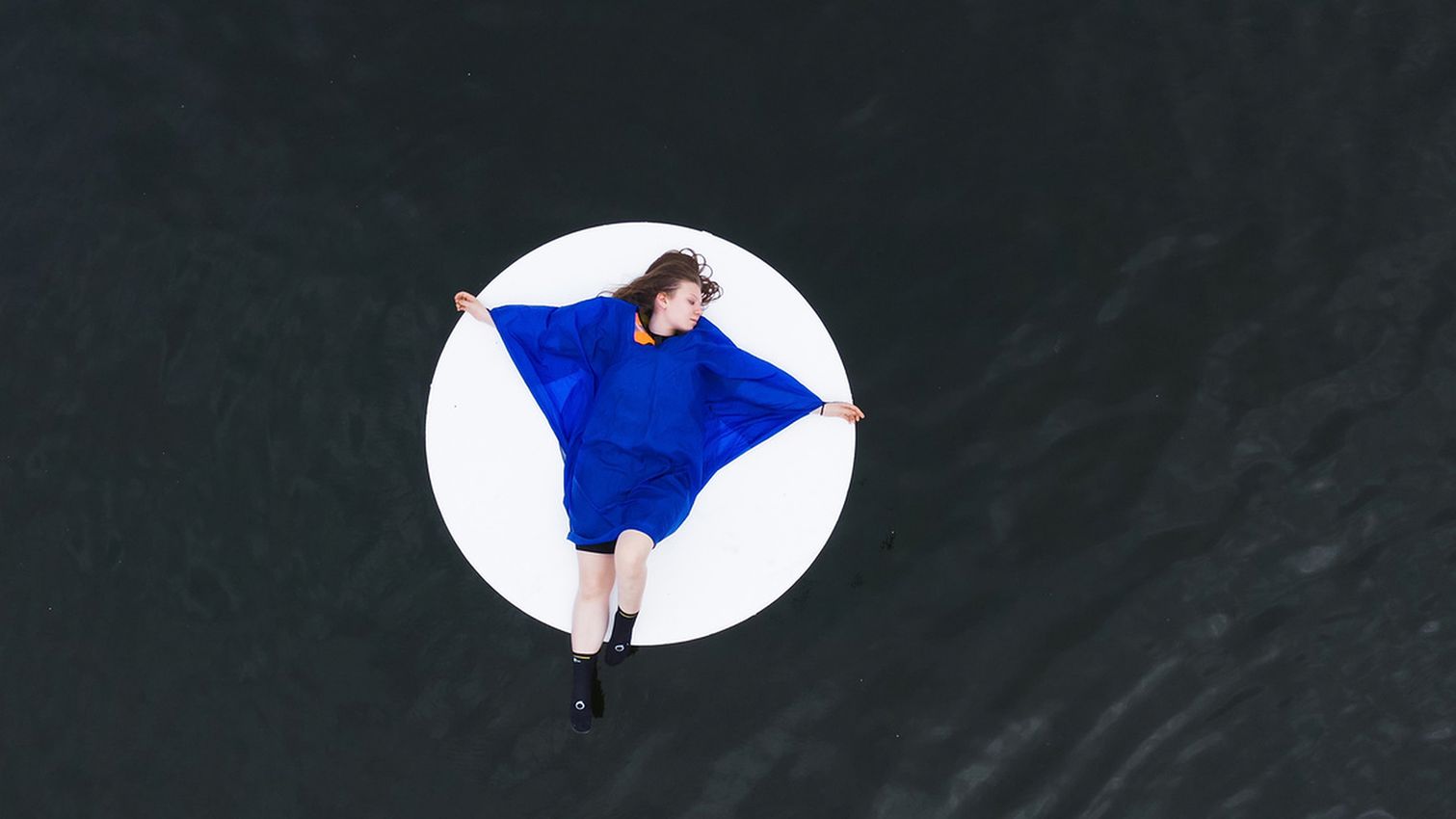
Baró O Contemporary presents From Zero: A Living Archive, a solo exhibition by Rasheed Araeen. Curated by Esmeralda Gómez Galera and opening during the inaugural edition of Frieze Abu Dhabi, the exhibition brings together around fifteen works spanning painting, drawing, recent sculpture and archival material, including Chakras (1969–1970), one of the artist’s most significant early works. In February 1970, Araeen invited people to throw sixteen red wooden discs into the water at St Katharine Docks and photographed their drift for two weeks as some floated out into the Thames. Presented as an installation of discs and photographs, the work embodies what Araeen describes as its central idea: “to break symmetry”.
The exhibition unfolds in two sections. Open Structures presents paintings, sculptures and drawings rooted in the modular, geometric language Araeen began developing in London in the 1960s. Living Archive gathers photographs, performance documentation, unrealised projects and issues of Third Text, the journal Araeen founded in 1987, as an integral part of his work. “Araeen’s work cannot be understood as a closed historical narrative,” says curator Esmeralda Gómez Galera. “I_t remains an ongoing practice whose past continues to generate futures that are still taking shape_.”
Trained as an engineer before turning to art, Araeen has long conceived artistic practice as the construction of open systems, driven by participation, collective agency and a utopian impulse towards social transformation. Many of his projects remained unrealised, not because they were incomplete, but because the social, political or institutional conditions they required never fully materialised. Shown alongside his writing and editorial work, these proposals reveal a body of work in which artistic form and critical thought have always been inseparable.
Araeen’s connection with the region runs deep. He has credited the Gulf, rather than Britain, with the turning point in the recognition of his work, following his 2014 exhibition at Sharjah Art Foundation. In 2021, he staged an edition of Shamiyaana in Abu Dhabi, a communal dining space built on his idea that sharing food is itself a creative act, and his work is held in the collection of the Guggenheim Abu Dhabi.
Rasheed Araeen’s innovative approach to Minimalism grew out of his background in civil engineering. When he realized that engineering could not fulfill his creative ambitions, he exchanged its structured discipline for the expressive freedom of a full-time art practice. Drawing on his technical training, Araeen began making “structures” — open, modular works designed to be rearranged. Although working in London, far from the New York center of Minimalist art, he developed a language that echoed artists such as Donald Judd. Yet, there are important differences. As art critic Jean Fisher observed, the distinction lies between “an instrumental, abstract-logical regulation of the world and an organic one.”


A respected voice in contemporary art discourse.
Focusing on ambitious storytelling and insightful art-world commentary. Ocula Magazine publishes in-depth interviews, critical essays and timely analysis on the artists, exhibitions and ideas driving the global art world.
Learn more about Ocula Magazine
Showcasing the best of the art world.
Ocula partners with galleries from around the world to highlight their artists, artworks and exhibitions. Gallery membership is by application and invitation, with each member vetted by an independent panel.
Learn more about Ocula Membership

Specialises in the sale of major artworks.
Led by a team with deep ties to the world’s leading auction houses, galleries and collectors. Ocula’s advisory team offers bespoke services to high-net-worth clients from around the world who are looking to acquire the best of contemporary and modern art.
Learn more about our team and services