




DOROTHEA ROCKBURNE
b. 1932, CanadaDorothea Rockburne is a Canadian-American abstract artist known for mathematically structured paintings, works on paper, and site-specific installations that connect mathematics, geometry, astronomy, and philosophy to materials. In 2026, the Guggenheim announced it had acquired works by Rockburne for its collection.
Drawing on her studies at Black Mountain College and long engagement with set theory and topology, she folds, scores, stains, and layers paper, board, and paint to visualise complex systems. Celebrated with major exhibitions at The Museum of Modern Art in New York and Dia Art Foundation, and with work recently acquired by the Solomon R. Guggenheim Museum, Rockburne lives and works in New York City, where she has been a key figure in contemporary art since the 1960s.
Early life and Education of Dorothea Rockburne
Dorothea Rockburne was born in Montréal, Canada, in 1932 and grew up in a Catholic working-class family. Encouraged by early drawing classes at the Montréal Museum of Fine Arts, she left Canada in the early 1950s to study at Black Mountain College in North Carolina.
At Black Mountain College, Rockburne studied painting with Franz Kline, Philip Guston, and Jack Tworkov and took mathematics with Max Dehn, an experience that became foundational to her later practice. After moving to New York in the 1950s, she became part of a close community of artists and dancers, including members of Judson Dance Theater, and established her long-term base in the city.
Dorothea Rockburne Artworks and Style
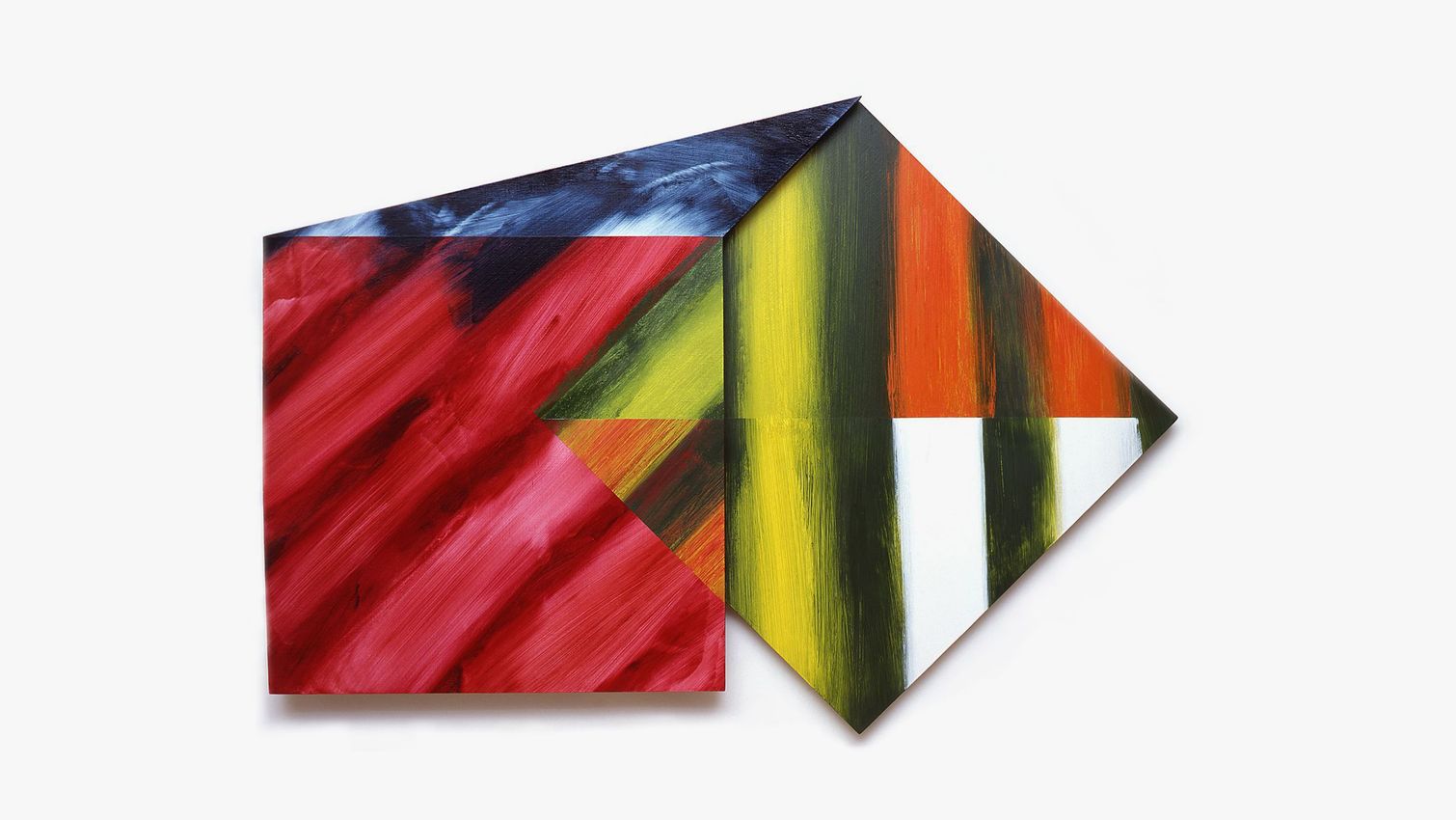
Dorothea Rockburne’s artworks combine rigorous mathematical structures with an intuitive, sometimes tactile use of paper, industrial materials, and paint, producing abstract compositions that feel both austere and sensuous. Throughout her career she has used set theory, topology, and astronomy as underlying frameworks for folded, scored, and layered surfaces that suggest movement through space.
From the 1960s onward, Rockburne developed a distinctive approach that treated paper as both a surface and a sculptural material, often manipulating it before marking it. Her works frequently evolve in serial groups or systems, where a single operation—folding, cutting, staining, or overlaying—generates complex visual variations. The resulting images oscillate between diagram and painting, evoking constellations, architectural plans, and cosmic maps without depicting them directly.
Early works and developments, 1960s–1970s
In the late 1960s and early 1970s, Dorothea Rockburne produced works that aligned with Minimalism and Conceptual art while remaining rooted in drawing and calculation. Series such as Set, Locus, and Drawing Which Makes Itself used actions like folding, tearing, and scoring to enact mathematical relationships, often leaving the process visible in creases and stains.
Working with inexpensive materials—newsprint, chipboard, crude oil, and carbon paper—Rockburne emphasised process, gravity, and chance alongside strict rule-based structures. Her works from this period, often installed directly on the wall, challenged conventional boundaries between painting, drawing, and sculpture.
Mature practice and key series, 1980s–2000s
From the 1980s, Rockburne shifted towards more overtly painterly compositions, incorporating rich colour and oil paint while maintaining underlying geometric systems. Series such as Golden Section, Egyptian Paintings, and works exploring the ‘divine proportion’ expand her interest in proportional systems, astronomy, and the history of mathematics. Her Egyptian Painting, Scribe (1979), a key work from this period, was acquired by the Solomon R. Guggenheim Museum in 2025 as part of the institution’s effort to strengthen its holdings of Minimalism and Conceptual art and build a more comprehensive understanding of women artists working in abstraction.
She also began working at larger scales, creating murals and installations that envelop viewers in mathematically organised fields of colour and line. Institutional recognition deepened in these decades, with acquisitions by major museums and invitations to develop projects that responded to specific architectural spaces.
Recent projects and ongoing themes, 2000s–
In the 21st century, Dorothea Rockburne has continued to develop new series that draw on astronomy, physics, and the night sky, often referencing constellations and celestial mapping. Her ongoing work includes paintings and works on paper that layer mathematical diagrams with atmospheric colour, suggesting cosmic phenomena while remaining resolutely abstract.
Major exhibitions at Dia:Beacon and a focused show of drawing at MoMA have cemented Rockburne’s status as a key figure in post-war abstract art, influencing younger generations interested in systems-based and process-driven practices. Even into her nineties she continues to work in New York, emphasising the experiential, almost spiritual dimension of mathematical structures.
Public Commissions by Dorothea Rockburne
- 1984–1985 – Northern Sky and Southern Sky, murals for the lobby of the former AT&T (later Sony) Building, 550 Madison Avenue, New York, USA.
- 1992 – Ceiling mural for the Holy Trinity Greek Orthodox Cathedral, New York, USA.
- 2000 – Site-specific installation for the Neuberger Museum of Art, Purchase, New York, USA.
Awards and honours of Dorothea Rockburne
- 2017 – Inducted into the National Academy of Design, New York, USA.
- 2016 – Anonymous Was A Woman Award, USA.
- 2008 – Francis J. Greenburger Award, Art Omi, New York, USA.
- 2006 – Lifetime Achievement Award, Women’s Caucus for Art, USA.
- 1999 – Rome Prize Fellowship, American Academy in Rome, Italy.
- 1992 – Guggenheim Fellowship, John Simon Guggenheim Memorial Foundation, USA.
- 1986 – National Endowment for the Arts Fellowship in Painting, USA.
Exhibitions of Dorothea Rockburne
Dorothea Rockburne has exhibited widely across North America and Europe, with major institutional solos and significant inclusion in thematic group exhibitions on post-war abstraction, Minimalism, and women artists.
Select solo exhibitions
- 2017 – Dorothea Rockburne, Dia:Beacon, Beacon, New York, USA.
- 2013 – Dorothea Rockburne: Drawing Which Makes Itself, The Museum of Modern Art, New York, USA.
- 2003 – Dorothea Rockburne: In My Mind’s Eye, Guild Hall Museum, East Hampton, New York, USA.
- 2002 – Dorothea Rockburne: Astronomy Drawings, The Drawing Center, New York, USA.
- 1987 – Dorothea Rockburne, The Brooklyn Museum, New York, USA.
- 1985 – Dorothea Rockburne, The Museum of Contemporary Art, Los Angeles, USA.
- 1977 – Dorothea Rockburne, Albright-Knox Art Gallery (now Buffalo AKG Art Museum), Buffalo, New York, USA.
Select group exhibitions
- 2018 – Epic Abstraction: Pollock to Herrera, The Metropolitan Museum of Art, New York, USA.
- 2016 – Making Space: Women Artists and Postwar Abstraction, The Museum of Modern Art, New York, USA.
- 2015 – Revolution in the Making: Abstract Sculpture by Women, 1947–2016, Hauser & Wirth, Los Angeles, USA.
- 2010 – On Line: Drawing Through the Twentieth Century, The Museum of Modern Art, New York, USA.
- 1993 – American Abstraction in the Late Twentieth Century, Solomon R. Guggenheim Museum, New York, USA.
- 1970 – Information, The Museum of Modern Art, New York, USA.
Website, Instagram, and further reading
Dorothea Rockburne’s official website provides a detailed overview of her artworks, exhibitions, commissions, and writings. Additional images and updates are available through her representing galleries, including Van Doren Waxter and David Nolan Gallery.
For institutional context, see Dorothea Rockburne’s artist pages at The Museum of Modern Art and the National Museum of Women in the Arts. Following the Solomon R. Guggenheim Museum‘s 2025 acquisition of Egyptian Painting, Scribe (1979), readers can also explore the museum’s online collection to view this work alongside other holdings. Readers can also explore in-depth interviews and essays, such as the profile on UVA Arts and interviews on Artnet News and Vogue, for further insight into her thinking. You can view exhibitions featuring Dorothea Rockburne on Ocula by browsing contemporary art gallery presentations and institutional shows that include her work.
About this profile
This profile of Dorothea Rockburne has been edited by Ocula‘s editors, drawing on verified institutional and gallery sources, including major museum collections and the artist’s official website. It is intended as an accessible, up-to-date overview for readers interested in contemporary abstract art and its histories.
Dorothea Rockburne FAQs
Who is Dorothea Rockburne?
Dorothea Rockburne is a Canadian-American abstract artist whose mathematically structured paintings, works on paper, and installations link geometry and astronomy to everyday materials, making her a key figure in post-war contemporary art. Born in Montréal in 1932 and based in New York since the 1950s, she studied at Black Mountain College and has exhibited at institutions including MoMA and Dia:Beacon.
What type of art does Dorothea Rockburne make?
Dorothea Rockburne makes abstract artworks that use mathematical concepts, folding, geometry, and proportional systems to structure paintings, drawings, and installations. Working with paper, chipboard, oil paint, and industrial materials, she creates series that visualise set theory, topology, and celestial mapping through scored, layered, and stained surfaces.
Where did Dorothea Rockburne study?
Dorothea Rockburne studied at Black Mountain College in North Carolina, where she combined painting with intensive classes in mathematics. At the college she learned from artists such as Franz Kline and Philip Guston and mathematician Max Dehn, whose teachings on topology and set theory shaped her later practice in New York.
What are key themes in Dorothea Rockburne’s artworks?
Key themes in Dorothea Rockburne’s artworks include mathematics, astronomy, proportional systems, and the relationship between immaterial concepts and tangible materials. Across different series she translates set theory, geometry, and celestial mapping into folded, scored, and painted structures that explore how abstract ideas can be experienced visually and spatially.
Why does Dorothea Rockburne use mathematics in her art?
Dorothea Rockburne uses mathematics in her art because she sees set theory, topology, and geometry as expressive tools that can structure visual experience and convey complex ideas about space, time, and perception. Her studies with mathematician Max Dehn at Black Mountain College introduced her to advanced concepts that she later translated into folding, scoring, and proportional systems in her paintings and works on paper. Rockburne has often described mathematics as a kind of ‘inner language’, allowing her to build artworks that feel both precise and intuitive.
Who influenced Dorothea Rockburne?
Dorothea Rockburne was deeply influenced by her teachers at Black Mountain College, especially mathematician Max Dehn, as well as painters Franz Kline, Philip Guston, and Jack Tworkov. Her work was also shaped by friendships and collaborations in New York with dancers and artists around Judson Dance Theater, and by the experimental approaches of peers including Robert Rauschenberg. Rockburne has cited Dehn’s teaching as crucial to her lifelong engagement with mathematical structures in art.
Did Dorothea Rockburne work with Robert Rauschenberg?
Dorothea Rockburne worked for Robert Rauschenberg after moving to New York, gaining close-up experience of his experimental studio practice and materials. This period helped her understand how everyday and industrial materials could be used in rigorous, conceptually driven ways, even as she developed a very different, mathematically grounded language of abstraction.
What was it like for Dorothea Rockburne as a woman artist in the 1960s?
Dorothea Rockburne has spoken about the challenges of being a woman artist and single mother in the 1960s, working in a male-dominated New York art world while supporting herself and her daughter. She often notes that her contributions were overlooked for decades, despite her involvement with key movements and communities, and that recent exhibitions and acquisitions have helped redress this imbalance.
Is Dorothea Rockburne still working?
Dorothea Rockburne is still working in her nineties, continuing to produce paintings and works on paper that extend her longstanding engagement with mathematics and astronomy. Recent interviews and exhibitions highlight her active studio practice in New York and the ongoing relevance of her ideas for younger generations of artists.
How old is Dorothea Rockburne?
Dorothea Rockburne was born in 1932 in Montréal, Canada, making her in her mid-nineties today. Her long career spans from the experimental atmosphere of Black Mountain College and 1960s New York through to renewed institutional attention and major acquisitions in the 2010s and 2020s.
Ocula | 2026


Explore and Follow Artists Shaping Contemporary Art
A respected voice in contemporary art discourse.
Focusing on ambitious storytelling and insightful art-world commentary. Ocula Magazine publishes in-depth interviews, critical essays and timely analysis on the artists, exhibitions and ideas driving the global art world.
Learn more about Ocula Magazine
Showcasing the best of the art world.
Ocula partners with galleries from around the world to highlight their artists, artworks and exhibitions. Gallery membership is by application and invitation, with each member vetted by an independent panel.
Learn more about Ocula Membership
Specialises in the sale of major artworks.
Led by a team with deep ties to the world’s leading auction houses, galleries and collectors. Ocula’s advisory team offers bespoke services to high-net-worth clients from around the world who are looking to acquire the best of contemporary and modern art.
Learn more about our team and services