




JONATHAN GARDNER
b. 1982, United StatesWith a distinctive blend of modernist references and surreal figuration, American contemporary artist Jonathan Gardner creates stylised paintings that reimagine the classical nude and still life through a lens of formal restraint and psychological ambiguity.
Early Years
Jonathan Gardner was born in 1982 in Lexington, Kentucky. He earned his BFA from the School of the Art Institute of Chicago in 2004 and later completed his MFA at Bard College in New York in 2010. Gardner now lives and works in New York City. His rigorous art education and immersion in postwar American and European painting traditions inform his tightly composed artworks, which often draw upon the visual languages of Surrealism, Cubism, and modernist masters such as Balthus, Piero della Francesca, and Fernand Léger.
Artworks
Jonathan Gardner’s artworks blend stylised figuration, dreamlike compositions, and references to art history, creating a unique visual language that occupies the space between the classical and the contemporary. His painting practice is rooted in precision and balance, often echoing the calm structure of early modernist art while introducing a flat, enigmatic quality that gives his figures and interiors an uncanny stillness.
Iconic Style and Thematic Concision
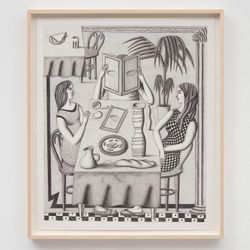
Gardner’s distinct artistic style is defined by flattened picture planes, frontal perspectives, and smooth, unmodulated colour fields. His paintings often present composed, serene figures in tightly framed interior scenes, drawing comparisons to the works of Léger, Balthus, and Piero della Francesca. Yet Gardner’s contemporary artworks carry a conceptual twist: the characters appear suspended in time, emotionally opaque, and often locked in ambiguous interactions with objects or environments. This restrained surrealism lends his art a formal elegance, while quietly unsettling narrative cues—mirrored reflections, recurring props, or off-kilter gazes—imbue the paintings with subtle psychological complexity.
Female Figures and the Gaze
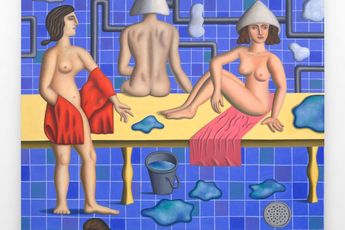
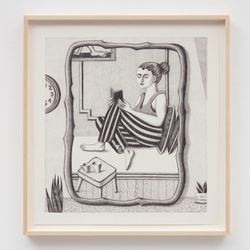
Much of Gardner’s contemporary art practice centres on the portrayal of the female figure. These recurring characters—often nude, self-contained, and inscrutable—occupy symmetrical compositions that foreground stillness and ambiguity. In artworks such as Sunbather (2017), The Reader (2020), and Woman with Plant (2021), Gardner constructs scenarios that resist narrative resolution. His figures exude agency not through movement or expression, but through their compositional dominance and the withholding of emotion. By avoiding eroticism or sentimentality, Gardner offers a quietly critical engagement with the historical use of the female nude in art, destabilising expectations around beauty, objecthood, and the gaze.
Object and Space
Gardner’s still lifes and interiors are formal studies in repetition, pattern, and surface. Recurring motifs—striped curtains, potted plants, lemons, books, and framed pictures—create visual echo chambers that heighten the decorative qualities of his paintings. In works such as Interior with Dog (2019) and Still Life with Mirror (2022), the domestic realm becomes a stage where the real and the artificial intermingle. Spatial cues are deliberately ambiguous: a mirror might reflect the wrong angle; a window may open onto blankness. These elements are not merely backdrops, but compositional anchors, reinforcing the artist’s interest in order, symmetry, and the psychological potential of objects within the artwork.
Exhibitions
Jonathan Gardner has been the subject of both solo exhibitions and group exhibitions at important institutions. A selection of important exhibitions are provided below.
Solo Exhibitions
- Dusk, Casey Kaplan, New York (2023)
- Jonathan Gardner, Almine Rech Gallery, Paris (2021)
- Jonathan Gardner, Jason Haam, Seoul (2021)
- Desert Wind, Casey Kaplan, New York (2019)
- Nudes, Corbett vs. Dempsey, Chicago (2013)
Group Exhibitions
- 2024 Collection Curatorial Exhibition: Map Reading of Painting, Daegu Art Museum, South Korea (2024)
- We Paint!, Palais des Études des Beaux-Arts, Paris (2022)
- Small Painting, Corbett vs. Dempsey, Chicago (2019)
- Surrreal, König Galerie, Berlin (2016)
- Inside Arrangement, Mary Mary, Glasgow (2014)
Jonathan Gardner’s Instagram can be found here.
Critical Reception
Jonathan Gardner’s work has been featured in respected art publications including ARTnews, Juxtapoz, and The New York Times.
Jonathan Gardner FAQs
What style of painting is Jonathan Gardner known for?
Jonathan Gardner is known for his distinctive style of contemporary painting that fuses figurative art with formal precision and surreal restraint. His flat, frontal compositions often feature stylised figures and interiors rendered in muted tones and clean lines. This aesthetic—at once classical and postmodern—blends influences from modernist painting, such as Cubism and Surrealism, with a contemporary sensibility. Gardner’s artworks are noted for their psychological ambiguity and compositional harmony, which together create a uniquely contemplative and refined body of work.
What influences Jonathan Gardner’s art?
Jonathan Gardner’s art is heavily influenced by early modernist painters, particularly Balthus, Fernand Léger, and Piero della Francesca. He draws on their compositional rigour, use of stylised figures, and symbolic, often dreamlike settings. His paintings also reflect the influence of Surrealism and Italian Renaissance art, as well as 20th-century graphic design and illustration. Gardner’s work integrates these historical references into a contemporary framework, using them as visual and conceptual tools to explore stillness, symmetry, and the psychology of images within contemporary art.
Has Jonathan Gardner’s work entered public collections?
Gardner’s artworks are included in several private and institutional collections, including the Zabludowicz Collection and the ICA Miami.
Ocula | 2025



Representative Artworks

View story
View story
View story



Explore and Follow Artists Shaping Contemporary Art
A respected voice in contemporary art discourse.
Focusing on ambitious storytelling and insightful art-world commentary. Ocula Magazine publishes in-depth interviews, critical essays and timely analysis on the artists, exhibitions and ideas driving the global art world.
Learn more about Ocula Magazine
Showcasing the best of the art world.
Ocula partners with galleries from around the world to highlight their artists, artworks and exhibitions. Gallery membership is by application and invitation, with each member vetted by an independent panel.
Learn more about Ocula Membership
Specialises in the sale of major artworks.
Led by a team with deep ties to the world’s leading auction houses, galleries and collectors. Ocula’s advisory team offers bespoke services to high-net-worth clients from around the world who are looking to acquire the best of contemporary and modern art.
Learn more about our team and services