



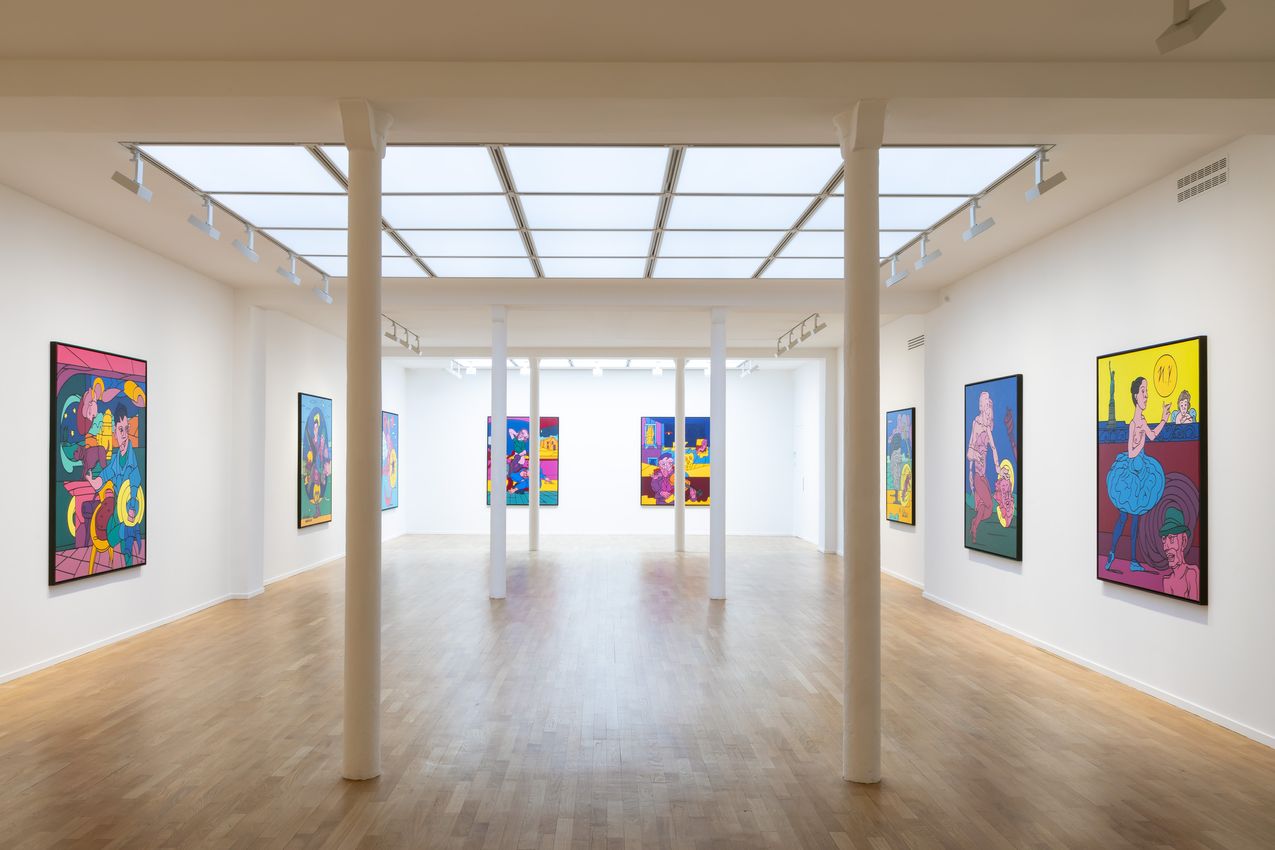
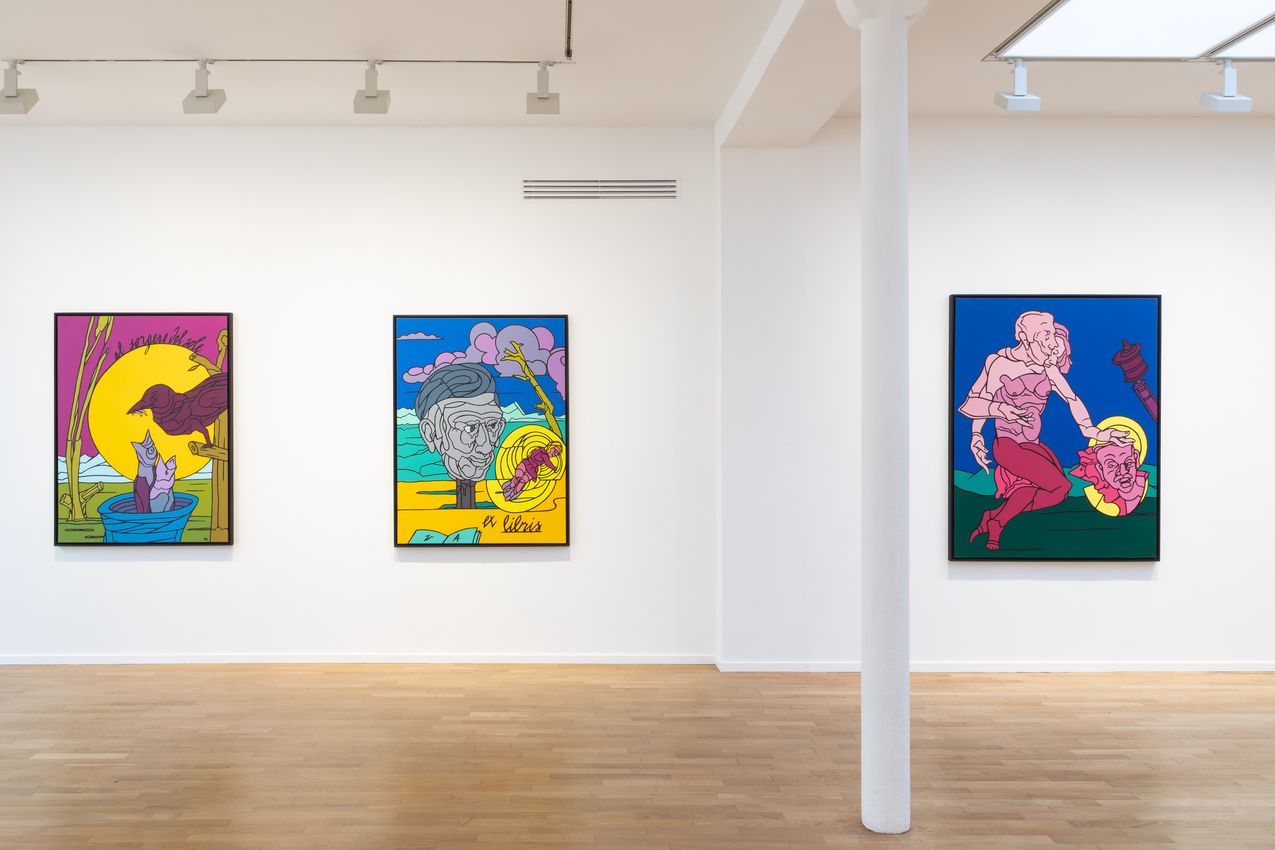
At 87, Valerio Adami is unveiling a new series of introspective and poignant canvases at Templon, the result of over two years of work. The exhibition plunges visitors into the artist’s striking universe, a world of vivid colours, yet more thoughtful than ever, haunted by the artist-philosopher’s elegant hand-writing.
Although long associated with Narrative Figuration, here Valerio Adami evokes the neo-classical drawing tradition, returning to his roots when he studied at the Accademia di belle arti di Brera a Milano. He created most of the dozen previously unseen new works in his Montmartre studio. They feature complex compositions where his famous wavy black line encircles and dissects each shape as the nomadic artist continues to explore his favourite themes: travel, music, literature and theatre. While some pieces have autobiographical touches or suggest vignettes from daily life, others pay explicit tribute to figures he admires, such as a work dedicated to the great poet Walt Whitman and another to Shakespeare’s Hamlet.
Now more than ever, Valerio Adami defines his practices as a ‘philosophical questioning of the verb.’ Enigmatic and accomplished, his painting defies the laws of perspective by multiplying planes and vanishing lines. The bright, unusual colours contrast with the apparent melancholy of the characters who populate his work. The painter seeks to use these distortions to give rise to new meanings. As he explains: ‘Therein lies the mystery and magic of painting: the creation of a myth, of this conflict between the temporal and the timeless.’
Born in 1935 in Bologna (Italy), Valerio Adami lives in Paris and Meina (Italy). He began exhibiting his work internationally in 1958, including at Documenta III in Germany (1964), the Jewish Museum in New York (1968), Musée d’Art Moderne de la Ville de Paris (1970), Centre Georges Pompidou in Paris (1985) and Tel Aviv Museum in Israel (1996). He took part in the major exhibition on Narrative Figuration at the Grand Palais in Paris in 2008 and exhibited at the Boca Raton Museum of Art in Florida in 2010. A major retrospective of his work was held in 2015 to mark his 80th birthday, travelling from Turin to Mantua then Perpignan. 2016 saw the Vienna Secession exhibit his early drawings, his oils on canvas on show at the Chapelle Saint-Sauveur in Saint-Malo, and the Transfigurations exhibition at the Musée de l’Hospice de Saint Roch in Issoudun. The Musée Jean Cocteau in Menton held a major retrospective of his work in 2018.
Valerio Adami’s work also features in numerous museum collections in Europe and the United States, including at the Musée National d’Art Moderne, Centre Georges Pompidou, Paris; Fonds National d’Art Contemporain, Paris; Musée d’Art Moderne de la Ville de Paris, Paris; Fondation Maeght, Saint-Paul-de-Vence; Musée des Beaux-Arts, Brussels; Rotterdam Museum, Rotterdam; Amos Anderson Art Museum, Helsinki; Museo d’Arte Moderna, Rome; Frissiras Museum, Athens; Fondaccion Miro, Barcelona; Museu Coleção Berardo, Lisbon; Museum of Modern Art, Minneapolis; Museum of Modern Art, Pittsburg, and Museum of Art, Tel Aviv.
Born in 1935 in Bologna, Valerio Adami is a leading figure in the Narrative Figuration movement. His acrylic paintings are characterised by blocks of colour outlined in black evoking the themes of travel, music, literature and theatre. The notion of mystery is expressed in the many literary references that populate the paintings, a notion that always plays a central role in his work, which he defines as a philosophical questioning.


The gallery was founded in 1966 by Daniel Templon, who was then only 21. It first opened rue Bonaparte, in Saint-Germain-des-Prés in Paris, before moving in 1972 to its current location, rue Beaubourg, in the Marais, close to the Pompidou Centre, which opened in 1977. Daniel Templon first gained recognition by exhibiting conceptual and minimal artists such as Martin Barré, Christian Boltanski, Donald Judd, Joseph Kosuth, Richard Serra. In the seventies and eighties, Daniel Templon was one of the pioneers of the contemporary art and introduced many important American artists to the French public: Dan Flavin, Ellsworth Kelly, Willem de Kooning, Frank Stella, Andy Warhol. The gallery quickly became one of the references in contemporary art in France. In 1972, Daniel Templon and Catherine Millet co-founded the monthly art magazine ART PRESS.

A respected voice in contemporary art discourse.
Focusing on ambitious storytelling and insightful art-world commentary. Ocula Magazine publishes in-depth interviews, critical essays and timely analysis on the artists, exhibitions and ideas driving the global art world.
Learn more about Ocula Magazine
Showcasing the best of the art world.
Ocula partners with galleries from around the world to highlight their artists, artworks and exhibitions. Gallery membership is by application and invitation, with each member vetted by an independent panel.
Learn more about Ocula Membership

Specialises in the sale of major artworks.
Led by a team with deep ties to the world’s leading auction houses, galleries and collectors. Ocula’s advisory team offers bespoke services to high-net-worth clients from around the world who are looking to acquire the best of contemporary and modern art.
Learn more about our team and services
