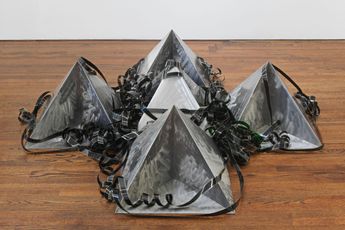
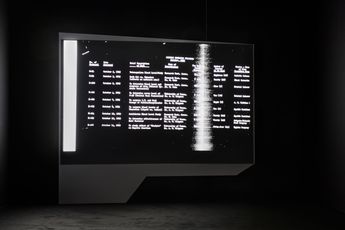
In 1987, and according to American artist Gretchen Bender, it took no more than ten minutes for an image to become neutralised and fed into an all-consuming flow of data–a ‘cannibalistic river’.2 Some 30 years later, that lag has contracted to a point of near simultaneity. Clipping the Din bridges two generations of artists who examine power as it is exercised through the mediated, neutralised and overproduced image.
In the 1980s, technological innovations in video and television enabled home editing, tape recording, projecting and local network broadcasting. Many artists–some using DIY strategies, others working in commercial production studios–were given to mimicking media to subvert dominant discourses. The appeal: watching the ‘détourned’ image reenter the stream.
Today, the instantaneous absorption of meaning into content renders modes of détournement, mimicry, mirroring and acceleration inherently anticipated. The truant image inevitably feeds back into the very structure it criticises; racialised and gendered overproductions of representation amass to a point of nonvisibility; signification gives way to ambivalence.
The artworks in this exhibition redirect the noise of this feedback, non-visibility, and ambivalence. Some operate surreptitiously–in the guise of dominant media–others more candidly. If there is a shared methodology here, it is in they way these works isolate, suspend and recontextualise not only images, text and sound, but the networks of value, desire, exchange and representation through which those materials perform.
Text by Daniel Baumann, Kathrin Bentele and Matthew Hanson. Courtesy Galerie Krinzinger.


Galerie Krinzinger was founded in 1971. Since then at least 400 solo, group and topic shows have been organised. The main issue of the gallery program results on one side from international performance art and body related art (Chris Burden, Mike Kelley, Paul McCarthy, Nancy Rubins) based originally on Viennese actionism (Günter Brus, Otto Muehl, Hermann Nitsch, Rudolf Schwarzkogler).

A respected voice in contemporary art discourse.
Focusing on ambitious storytelling and insightful art-world commentary. Ocula Magazine publishes in-depth interviews, critical essays and timely analysis on the artists, exhibitions and ideas driving the global art world.
Learn more about Ocula Magazine
Showcasing the best of the art world.
Ocula partners with galleries from around the world to highlight their artists, artworks and exhibitions. Gallery membership is by application and invitation, with each member vetted by an independent panel.
Learn more about Ocula Membership

Specialises in the sale of major artworks.
Led by a team with deep ties to the world’s leading auction houses, galleries and collectors. Ocula’s advisory team offers bespoke services to high-net-worth clients from around the world who are looking to acquire the best of contemporary and modern art.
Learn more about our team and services