





Screen Time
Twenty years after the death of the technology‑manipulating Korean artist Nam June Paik, his work is more relevant than ever. Shanyu Zhong asks the curator of a Tokyo retrospective to talk her through the most ground‑breaking pieces. Save to My OculaNam June Paik was born in 1932 to a wealthy textile manufacturing family in Korea while the country was still under oppressive Japanese rule. In 1950, a teenaged Paik and his family fled the onslaught of the Korean War and established themselves in Japan. At the University of Tokyo, he studied aesthetics and graduated in 1956 with a thesis on Austrian-American composer and music theorist Arnold Schoenberg. Later that year, he left home again, this time for West Germany, where he entered the world of experimental music. He met members of Fluxus, the group of avant-garde artists interested in chance rather than polished works, and struck up a friendship with the composer John Cage.
Those early experiences of imperial systems of control, which sought to suppress the Korean language, and his exposure to experimental art scenes are perhaps what instilled in Paik such sensitivity to forms of manipulation and an interest in acts of rebellion. He would later draw a connection between authoritarianism and one-way communication. “Television is a dictatorial medium,” he notably said. “I think talking back is what democracy means.” In his late twenties, Paik began experimenting with video and television sets, one of the first artists to do so. An early screen-based work was Zen for TV (1963), a television Paik rewired so that the image appeared as a single line of light in the centre of the screen, concentrating the gaze.
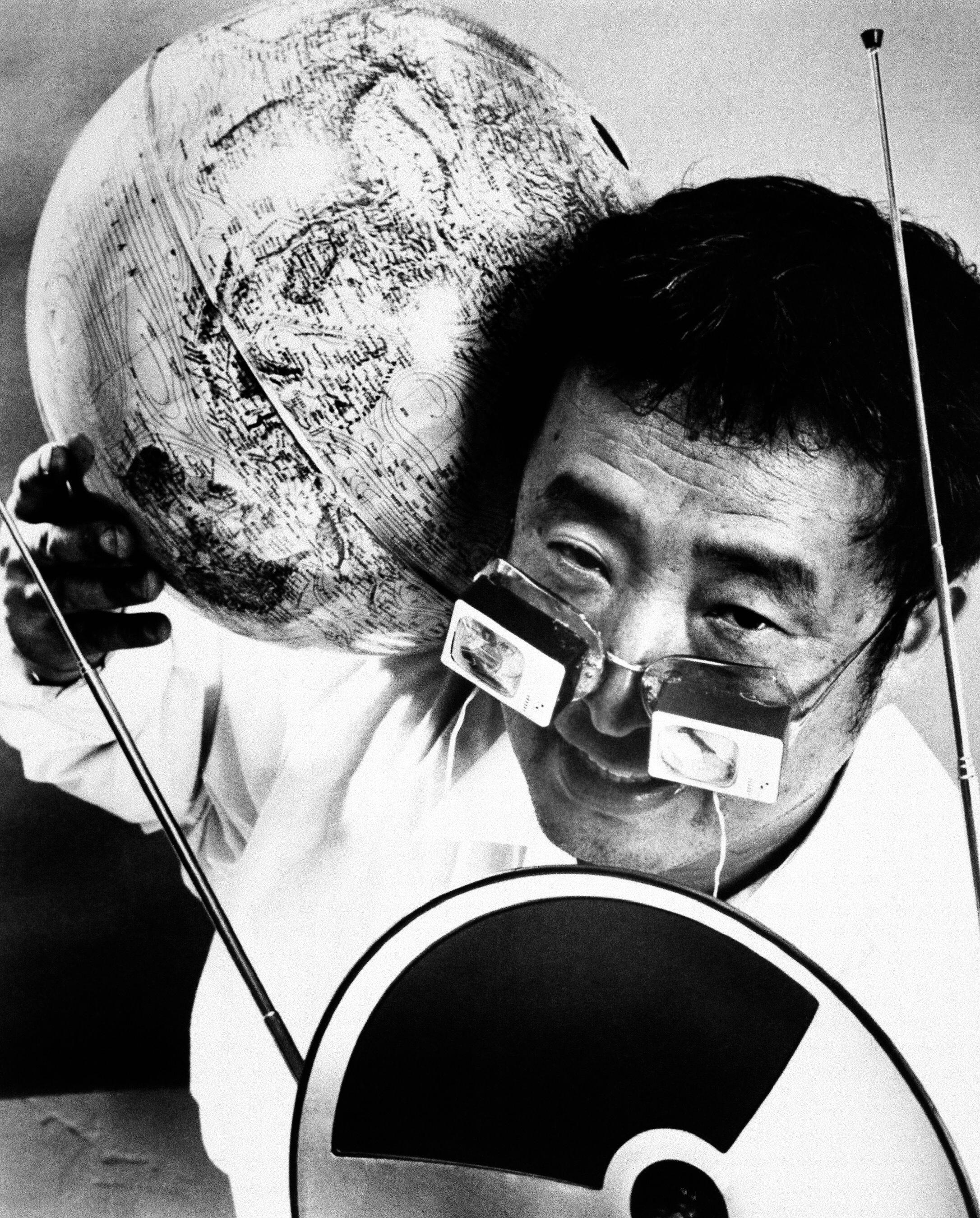
Moving from Germany to New York City, the displaced artist did not return to his homeland for more than three decades. When he finally did, in 1984, he returned with some of the most radical artistic ideas of his time, and with a network that created new paths of cultural exchange. It was Paik who then helped open up South Korea’s art scene to an international audience, later establishing the Gwangju Biennale and the Korean Pavilion at the Venice Biennale.
Twenty years after his death, Paik’s influence is being celebrated with a retrospective at Watari-UM in Tokyo. The museum’s founding director Shizuko Watari met Paik at documenta 6 in 1977 and presented his first solo exhibition in Japan at Galerie Watari the following year. Curated by Shizuko’s grandson, Hikaru Watari, Nam June Paik: Jugemu draws from the museum’s collection, asking how works made from ageing technologies, living plants and personal memories might continue to change—and live—with time.
“What mattered was not the technology itself, but what he could express through it”
Below, Watari reflects on five works from the exhibition representing different periods, scale, and media from the exhibition. His selection looks beyond Paik’s familiar designation as the “father of video art”, revealing the performer and thinker behind the technology, and an artist preoccupied with friendship, ecology and time.
Hand and Faces (1961)
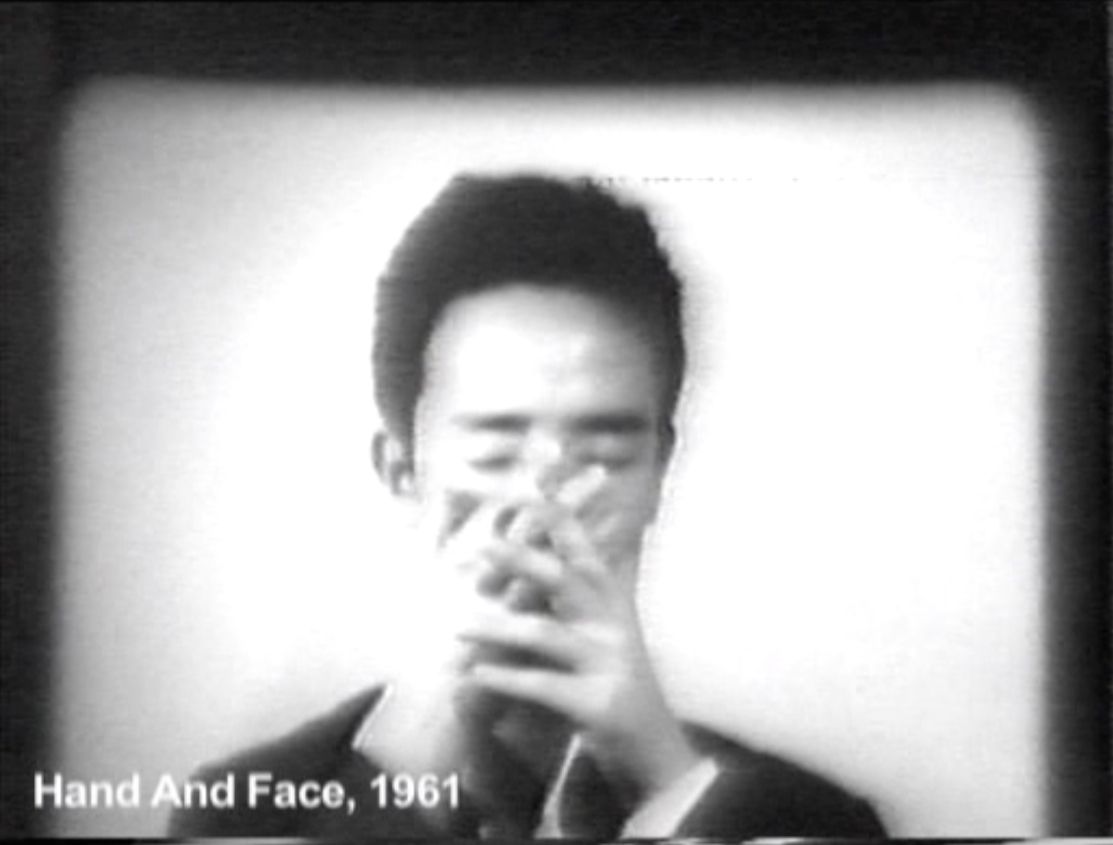
Hand and Faces is the earliest work in the exhibition. Over one minute and 44 seconds of black-and-white footage, Paik moves his hands and face within the tight frame of the video, repeating gestures that appear strange and faintly absurd. I thought this quality would leave a strong impression even on people who know nothing about Paik.
This was conceived as a performance for the camera, rather than the documentation of an existing action. It was shot not on video, but probably on 8mm or 16mm film.
For Paik, technology was a tool. What mattered was not the technology itself, but what he could express through it. Here, the camera does more than document: its framing turns a simple performance into an experiment in how media can alter perception. That impulse to intervene in the image would become central to his later work with television.
Flying Heart (Kokoro ga Tobu) (1988)
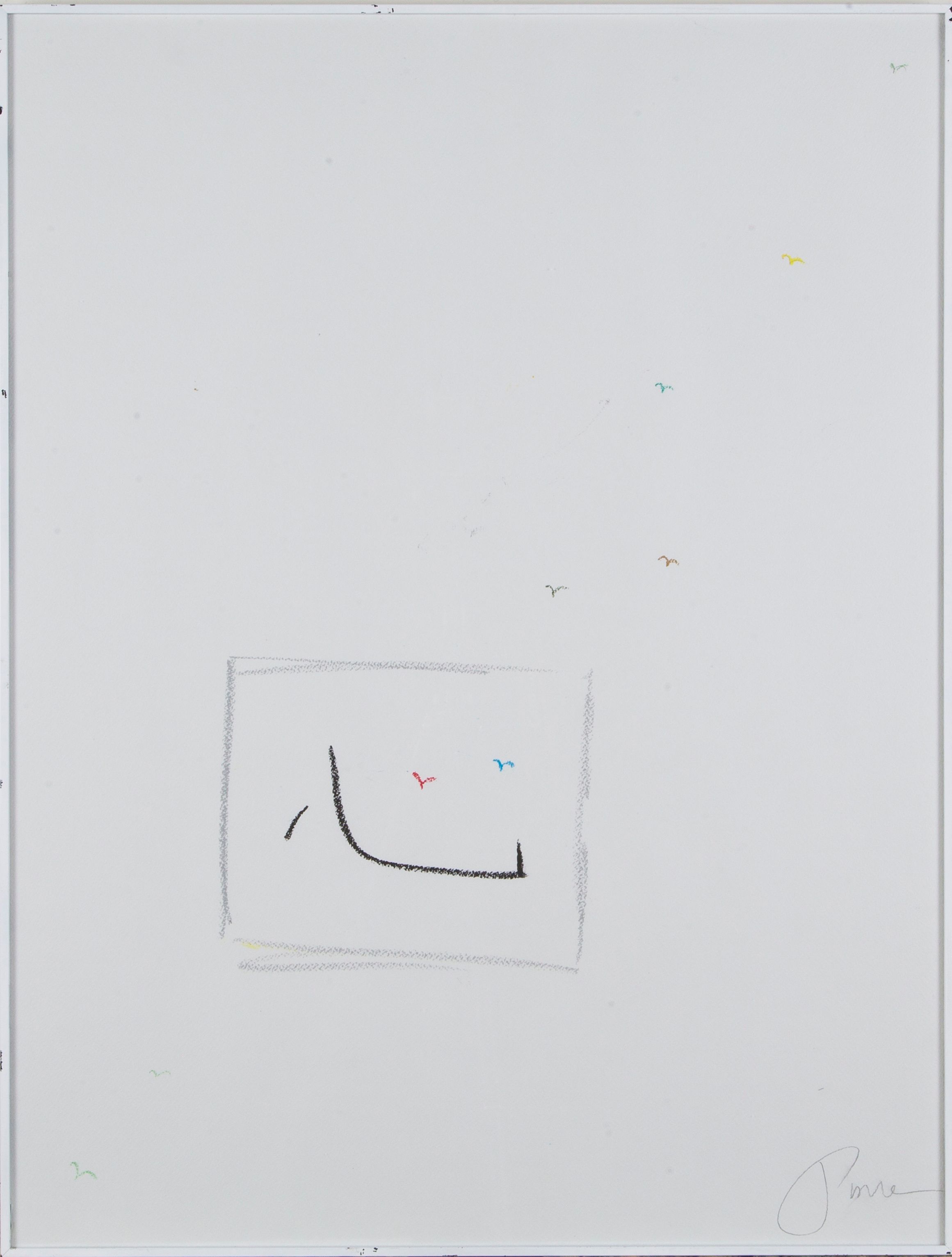
Drawn in pastel on paper, Flying Heart depicts a heart that appears to be taking flight like a bird. There is a lightness and humour to the image. The Japanese title also recalls the expression kokoro ga haneru: the heart leaps. The Wataris remember speaking with Paik, mainly in Japanese, and being continually surprised by the breadth of his vocabulary and wordplay. He also spoke Korean, Chinese, English and German, much as Paik himself moved between different cultural settings. Paik returned repeatedly to the heart as a motif.
Forest of Cage / Revelation of the Forest (1993)
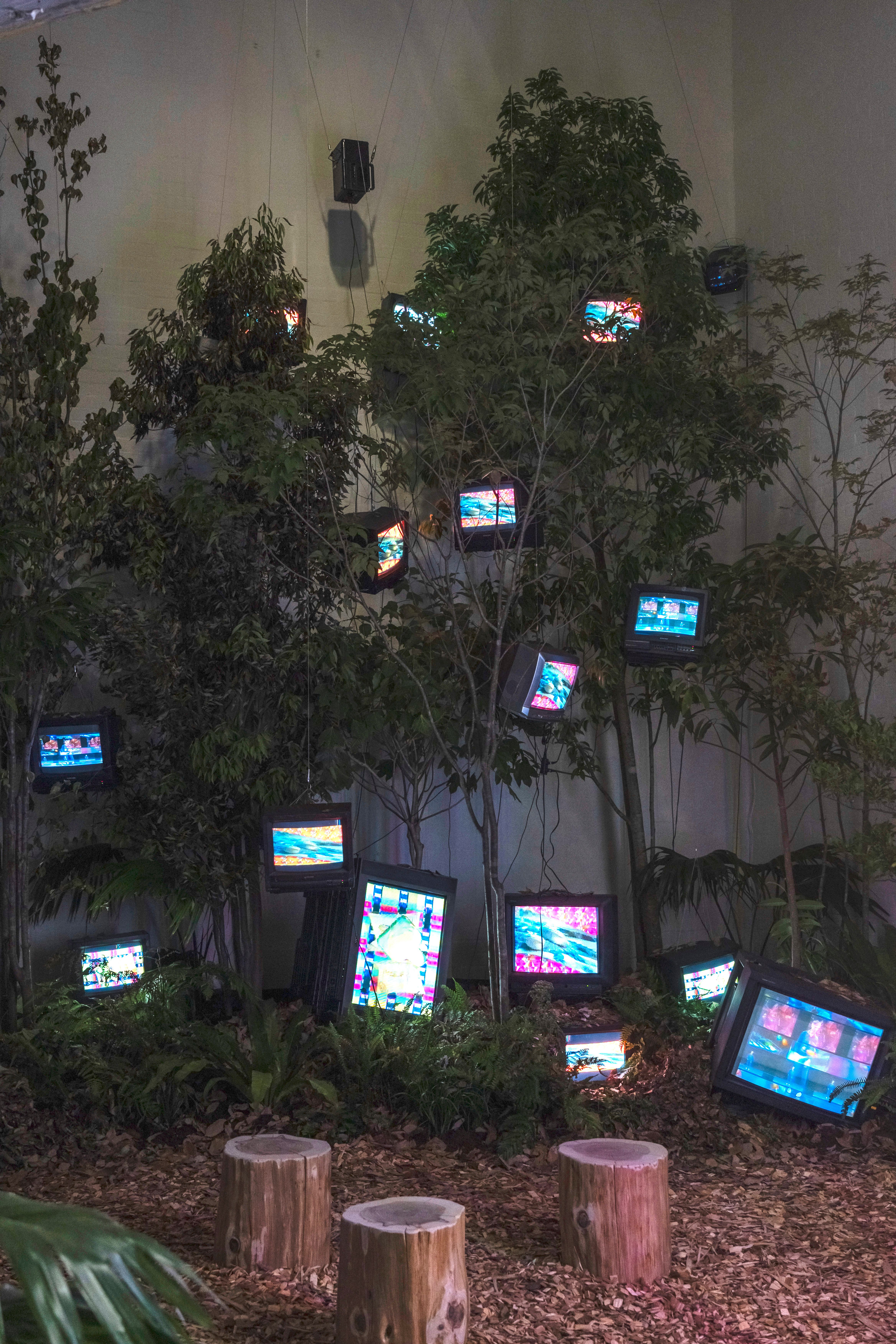
This was made for Paik’s 1993 exhibition Paik’s Earth Theory at Watari-UM. It was dedicated to the experimental composer John Cage, who had died the previous year. For the present exhibition, we have reconstructed it, expanding the forest across the museum’s entire second floor.
Paik admired Cage deeply. His encounter with Cage’s music affected him so profoundly that it helped him decide to live as an artist, rather than continue solely as a musician. Materially, the work turns Paik’s earlier TV Garden (1974), televisions embedded among living plants, upright to make use of Watari-UM’s seven-metre ceiling.
By the 1990s, several of Paik’s close friends had died, so new footage could no longer be made with them. Paik knew that Cage had once given a poetry reading at Watari-UM and wanted to see the recording. He re-edited that footage to complete the work, and I believe the title emerged through this process.
The monitors show Cage reading poetry and speaking in an interview. The soundtrack also includes the Okinawan folk song Chinsagu nu Hana (Impatiens), sung by Misako Koja and others, to an accompaniment by Ryuichi Sakamoto.
Paik understood a work as something that could grow through the processes he called feedback and feed-forth. The present is where both processes can be observed; this, for Paik, opened on to the infinite. Destruction and regeneration, decomposition and reconstruction also occur continuously in nature. In a forest, the remains of one animal pass into other animals, microorganisms and plants, from which new life emerges. The cycle is the same, even if its sense of time differs from ours.
In expanding Forest of Cage / Revelation of the Forest, I wanted to evoke this randomness in the passage of time, and a cycle that is simultaneously finite and infinite. I have not told anyone this before, but Feed Back and Feed Forth is also the exhibition’s unofficial subtitle.
TV Egg (1982)
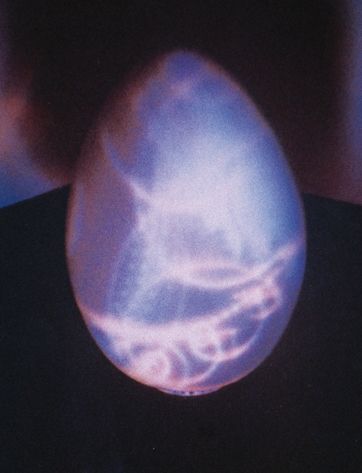
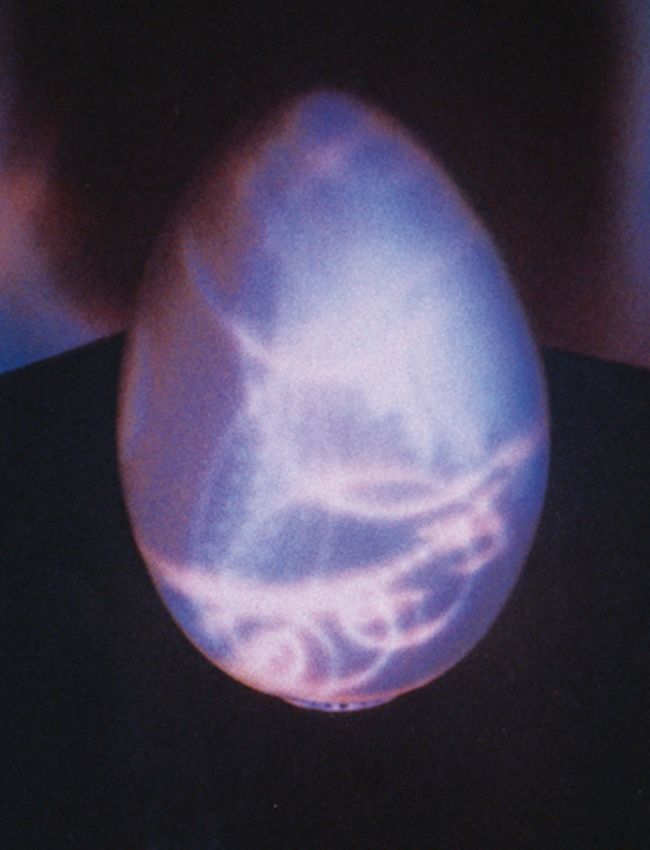
In TV Egg, an image from a cathode-ray tube (CRT) is projected through a lens on to a glass egg. The CRT, normally used for viewing images, is turned into a projector, while the egg becomes its screen. Almost none of the moving image is clearly visible on the glass. I find beauty in this idea, in the challenge Paik set himself and in the faint trace of an image that reaches the egg.
In this exhibition, TV Egg sits at the threshold of the expanded Forest of Cage / Revelation of the Forest. As a symbol of biological beginnings and infinity, the egg marks the beginning of the forest. The egg has always perplexed us: which came first, the chicken or the egg? In ancient mythologies, the cosmic egg appears as the origin of the universe; in Christianity, the Easter egg signifies resurrection.
Many of Paik’s performances involved the destruction of television sets and other equipment. Today, by contrast, a culture has formed around repairing CRTs and other obsolete technologies. Even within art, there is increasing attention to preserving and continuing to use old media.
The gesture of destruction has also turned into another gesture: repair. Perhaps he foresaw the whole cycle when he chose the egg.
New Candle (1993)
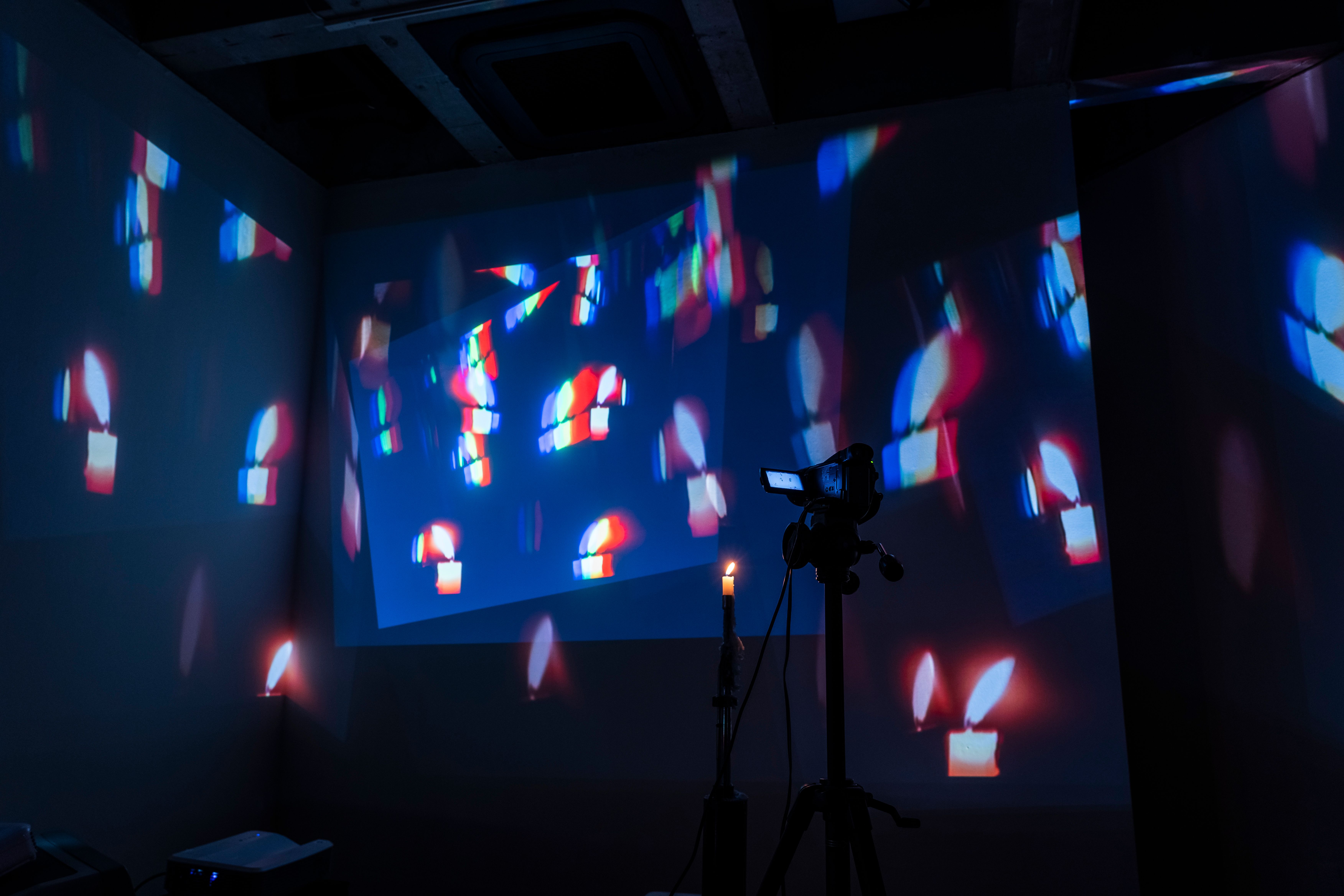
In New Candle, a video camera records the flame of a single candle in real time. Four projectors separate that live image into red, green and blue. The projections are recaptured by the camera, and feedback multiplies the flame.
During an earlier installation, a damaged component and a slight movement of the candle unexpectedly made one flame appear as 30. Paik was extraordinarily quick-minded. When something unexpected happened, he would investigate its cause; if he found the result interesting, he would first understand it and then make it reproducible within the work. Chance was never simply left to chance.
In 1993, Paik represented Germany at the Venice Biennale alongside Hans Haacke, with the German Pavilion receiving the Golden Lion. That same year, as environmental questions were beginning to receive sustained public attention, the exhibition Paik’s Earth Theory brought together three strands: ecology and recycling; new works responding to Watari-UM’s triangular architecture and high ceilings; and remakings of earlier works, including New Candle, which developed from Candle TV (1980).
Paik was 61 at the time and had begun speaking about the possibility of his own death. He had also lost several close friends in succession, including Joseph Beuys, John Cage and Charlotte Moorman. These experiences came together with his concerns about the environment. Returning to existing works, he remade, adjusted and extended them into new forms. —[O]
Nam June Paik | The 20th anniversary of his passing (until 23 November) at Watari-Um, Tokyo
Main image: Nam June Paik, TV EGG (1982). Part of “Nam June Paik: Jugemu | The 20th anniversary of his passing”, Watari-um, Tokyo.





A respected voice in contemporary art discourse.
Focusing on ambitious storytelling and insightful art-world commentary. Ocula Magazine publishes in-depth interviews, critical essays and timely analysis on the artists, exhibitions and ideas driving the global art world.
Learn more about Ocula Magazine
Showcasing the best of the art world.
Ocula partners with galleries from around the world to highlight their artists, artworks and exhibitions. Gallery membership is by application and invitation, with each member vetted by an independent panel.
Learn more about Ocula Membership
Specialises in the sale of major artworks.
Led by a team with deep ties to the world’s leading auction houses, galleries and collectors. Ocula’s advisory team offers bespoke services to high-net-worth clients from around the world who are looking to acquire the best of contemporary and modern art.
Learn more about our team and services