





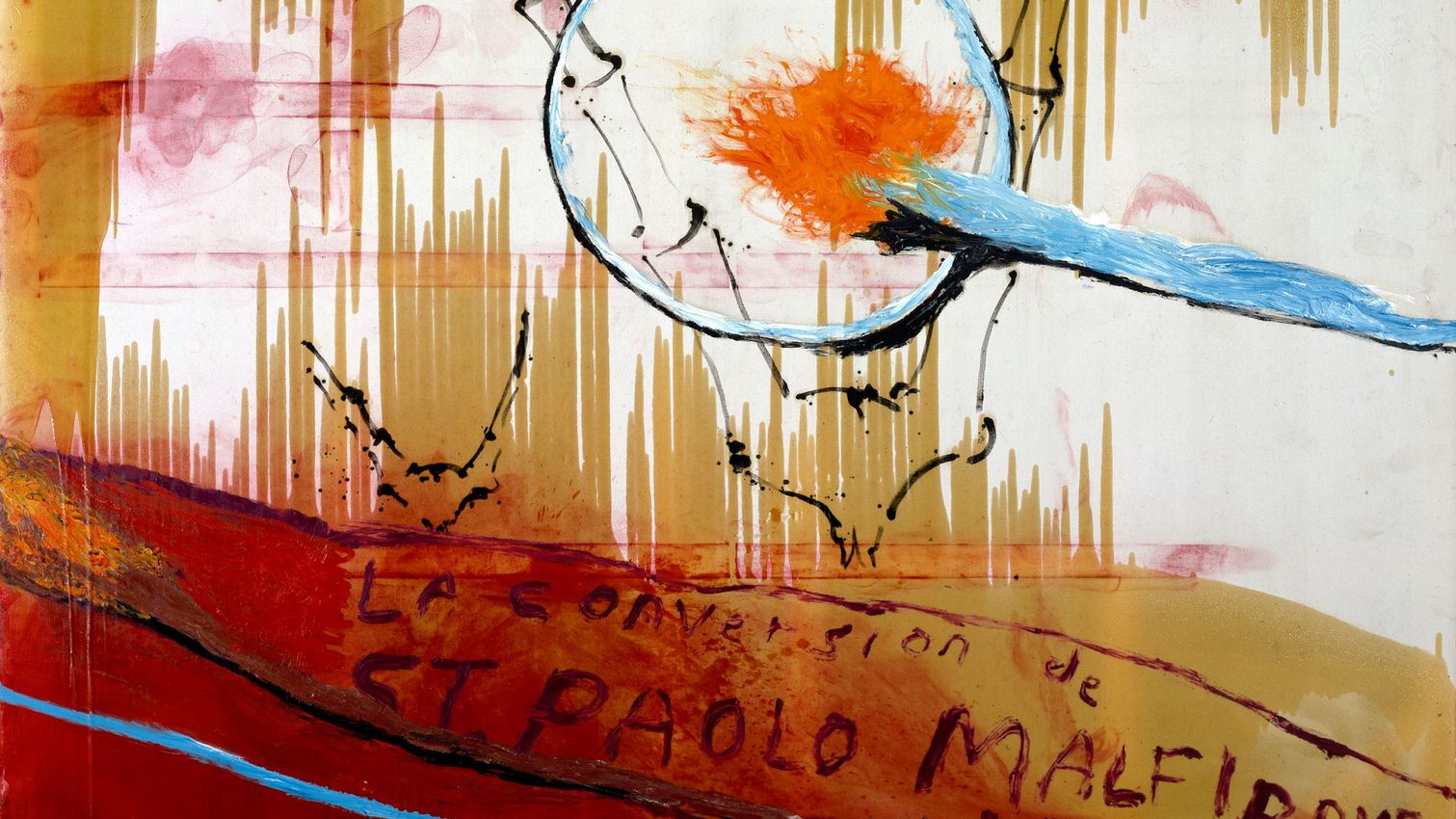
JULIAN SCHNABEL
b. 1951, United StatesA defining figure of contemporary art since the 1980s, Julian Schnabel is celebrated for his large-scale, emotionally charged artworks and for his crossover success as an award-winning filmmaker.
Early Years
Julian Schnabel was born in Brooklyn in 1951 and raised in Brownsville, Texas. His early surroundings left an indelible mark on his aesthetic, particularly the rich visual culture of Mexico, where he frequently travelled as a youth. He studied at the University of Houston before receiving his MFA from the School of Visual Arts in New York in 1973.
In the late 1970s and early 1980s, Schnabel emerged as one of the key figures of the Neo-Expressionist movement. Alongside artists such as Jean-Michel Basquiat and Anselm Kiefer, he pushed against the cool minimalism of the previous decade in favour of gestural mark-making, bold materiality, and painterly exuberance. Schnabel continues to live and work in New York and Montauk, where his home-cum-studio is a converted 17,000-square-foot former stable.
Artworks
Known for his maximalist approach and experimentation with materials, Julian Schnabel creates artworks that fuse painting, sculpture, and collage into emotionally charged visual fields. His works often incorporate unconventional materials such as broken crockery, velvet, tarpaulin, and photographic imagery.
Plate Paintings
Julian Schnabel’s Plate Paintings, created between 1978 and the mid-1980s, catapulted him into art world fame. These monumental works, composed of broken ceramic plates affixed to wood and overpainted with figuration and text, shattered the formalist limits of painting. Works like The Patients and the Doctors (1978) aggressively confronted minimalist conventions, suggesting both violence and vitality in their jagged surfaces. These artworks weren’t merely visual; they were physical experiences—paintings that spilled into sculptural relief. Their radical materiality and expressive boldness embodied Schnabel’s ambition to reinvest painting with historical gravity, emotional excess, and mythic scale, helping define the Neo-Expressionist movement in contemporary art.
Paintings on Velvet and Other Materials
In the 1980s and 1990s, Schnabel began painting on unusual supports such as velvet, sailcloth, and tarpaulin—surfaces that imbued his works with historical resonance and material density. His velvet paintings, in particular, carried a rich, theatrical mood that recalled religious iconography, Renaissance portraiture, and bohemian decadence. These works fused abstract expressionism with cultural quotation, often combining bold brushstrokes with ghostly, semi-legible imagery. For example, Rebirth of Painting (1984) evoked a mythic energy, with visual references ranging from Spanish bullfighting to Catholic martyrdom. Through these layered surfaces, Schnabel built a visual language that felt simultaneously personal and universal, past-looking yet defiantly contemporary.
The New York Art Scene
Julian Schnabel’s rise in the late 1970s coincided with a fertile period in the New York art scene, centred around spaces like Mary Boone Gallery and the Mudd Club, and artists like Jean-Michel Basquiat, Keith Haring, and Cindy Sherman. Schnabel’s embrace of monumental scale and expressive gesture ran counter to the cool, conceptual tendencies of the previous decade. His circle included musicians, filmmakers, and writers, and this cross-disciplinary energy charged his paintings with cinematic and poetic sensibilities. As the art world became increasingly commercial, Schnabel embodied a flamboyant, media-savvy persona that provoked critics but cemented his celebrity. He was both a painter and a provocateur.
Awards and Accolades
- Paez Medal of Art, New York (2019)
- Best director at 2007 Cannes Film Festival
- Golden Globe for best director (2007)
- Independent Spirit Awards for best director (2007)
Exhibitions
Julian Schnabel has been the subject of both solo and group exhibitions at important institutions. A selection of important exhibitions are provided below.
Solo Exhibitions
- Orsay vu par Schnabel, Musée d’Orsay, Paris (2018)
- Julian Schnabel: Symbols of Actual Life, the Legion of Honor, San Francisco (2018)
- Plate Paintings 1978-86, Aspen Art Museum, Aspen (2016)
- Portrait of Olatz, NSU Art Museum Fort Lauderdale, Fort Lauderdale (2015)
- An Artist Has A Past (Puffy Clouds and Strong Cocktails): 15 Paintings Over The Last Decade, Dallas Contemporary, Dallas (2014)
- Julian Schnabel: Paintings 1975–1986, Whitechapel Art Gallery, London (1986). Travelled to: Musée National d’Art Moderne, Centre Georges Pompidou, Paris (1987); Städtische Kunsthalle Düsseldorf, Germany (1987); Whitney Museum of American Art, New York; San Francisco Museum of Modern Art, California (1988); and Museum of Fine Arts, Houston (1988).
- Julian Schnabel, Stedelijk Museum, Amsterdam (1982). Travelled to Tate Gallery, London; Los Angeles County Museum of Art; and Akron Art Museum (1983)
Group Exhibitions
- Orsay through the Eyes of Julian Schnabel, Musée d’Orsay, Paris (2019)
- Fast Forward: Painting from the 1980s, Whitney Museum of American Art, New York (2017)
- Regarding Warhol: Sixty Artists, Fifty Years, The Metropolitan Museum of Art, New York (2012)
- 50th Venice Biennale: Dreams and Conflicts - The Dictatorship of the Viewer, Italy (2003)
- The American Century: Art & Culture 1950-2000, Whitney Museum of American Art, New York (2000)
Critical Reception
Julian Schnabel’s art has been widely reviewed in major art publications and critical platforms. His work has been featured in Artnet News, Cultured Mag, and The Financial Times.
Julian Schnabel FAQs
What is Julian Schnabel best known for?
Julian Schnabel is best known for his Plate Paintings—monumental works made from broken ceramic plates embedded in thick paint and resin. These provocative, tactile paintings challenged the conventions of flat, minimalist abstraction in the late 1970s and early 1980s. Schnabel’s daring use of unconventional materials and raw emotional intensity made him a central figure in the Neo-Expressionist movement. Beyond painting, he is also widely recognised for his acclaimed work as a film director, adding to his cultural significance.
What are Julian Schnabel’s most preeminent film works?
Julian Schnabel has directed several critically acclaimed films that echo the poetic and expressive sensibility of his visual art. His best-known works include The Diving Bell and the Butterfly (2007), which won Best Director at Cannes and earned four Academy Award nominations, and Before Night Falls (2000), which brought Javier Bardem an Oscar nomination. Other notable titles include Basquiat (1996), a fictionalised biopic of his late friend Jean-Michel Basquiat, and At Eternity’s Gate (2018), starring Willem Dafoe as Vincent van Gogh.
How has Julian Schnabel influenced contemporary art today?
Julian Schnabel has profoundly influenced contemporary art by reasserting the expressive power of painting at a time when conceptualism and minimalism dominated. His unapologetically grand gestures, use of unconventional materials, and cinematic approach to composition helped redefine what painting could be in the postmodern era. By bridging visual art with film, literature, and music, Schnabel also broadened the role of the contemporary artist. His career encouraged a generation to embrace personal mythology, material experimentation, and the performative dimensions of artistic identity.
Ocula | 2025

View Julian Schnabel's Artworks




















Explore Julian Schnabel's Exhibitions









Explore and Follow Artists Shaping Contemporary Art
A respected voice in contemporary art discourse.
Focusing on ambitious storytelling and insightful art-world commentary. Ocula Magazine publishes in-depth interviews, critical essays and timely analysis on the artists, exhibitions and ideas driving the global art world.
Learn more about Ocula Magazine
Showcasing the best of the art world.
Ocula partners with galleries from around the world to highlight their artists, artworks and exhibitions. Gallery membership is by application and invitation, with each member vetted by an independent panel.
Learn more about Ocula Membership
Specialises in the sale of major artworks.
Led by a team with deep ties to the world’s leading auction houses, galleries and collectors. Ocula’s advisory team offers bespoke services to high-net-worth clients from around the world who are looking to acquire the best of contemporary and modern art.
Learn more about our team and services