Longing will present new paintings and works on paper by Samuel Levi Jones that see the artist continue to develop his practice of abstraction as a means of transformation. The exhibition critiques authoritative systems, featuring works made from pulped and deconstructed materials that hold an institutional history, including law and history books, encyclopedias, print portfolios, and US flags. Jones’s use of pulped US flags in the painting god and country (2023) prompts an inquiry into the varied histories they represent as patriotic symbols, while the use of deconstructed print portfolios—sourced from the gallery’s own archive—in a selection of new works creates space for a critique of the practices that created the exclusive Western cannon of Art History. As the artist explains, his practice is driven by ‘a desire to create a space where information, that encompasses all, coexists, without fear, so that the pendulum stops its violent swing from one extreme perspective and back again.’
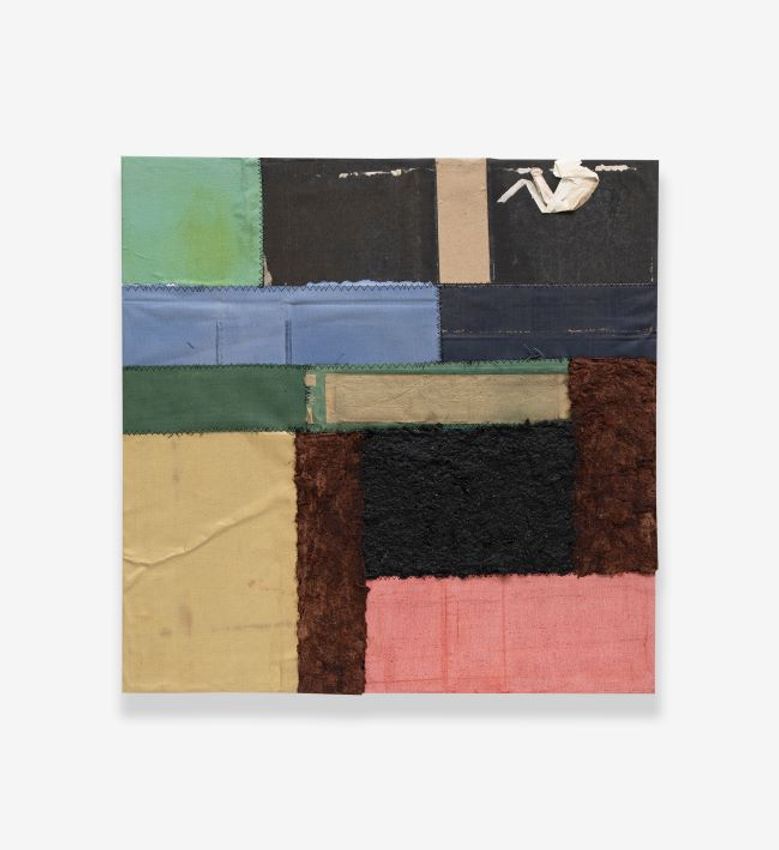
New paintings made from book covers are obscured to varying degrees; in a selection of works, only glimpses of book spines peak through from behind a layer of pulp. In the painting Macon Bolling Allen (2023), Jones covers the canvas with deconstructed law book covers stitched together into a geometric arrangement, punctuated by a single black rectangle. Composed of pulped Indiana history books, a reference to the artist’s home-state, this rectangle is demonstrative of a recurring motif that has recently emerged in the artist’s practice. Visually, the forms recall an early work by Jones, 48 Portraits (Underexposed) (2012), which is comprised of a grid of portraits printed on recycled encyclopedia paper. For the artist, the recurring rectangles that populate recent works, though non-representational, remain portraits, highlighting a common failure to acknowledge people and histories that have been underexposed or overlooked and sparking conversations about willful ignorance and the ways in which it pervades society.
A pair of new works on paper made during the artist’s recent residency at Dieu Donné, the hand papermaking studio in Brooklyn, New York, will be on view. Comprised of pulped encyclopedias and law books, cotton, and abaca, the fluid, watery lines of handmade pulp are punctuated with partial book spines and rectangles of pulped book covers that seem to disperse into a space that transcends history and time.
Samuel Levi Jones is inspired by questions of authority, representation, and recorded history. The artist is known for challenging historical and contemporary power structures through the act of taking apart “source” material, generating new perspectives from which to grapple with society’s ongoing ignorance and apathy. Jones’s practice centers on physically undoing objects associated with systems of power and control, often rearranging deconstructed books into grid-like compositions that expose their flaws and question their assumed command of the truth. As he explains, “I am ultimately thinking about information that is selectively left out.” His works examine urgent questions of how oppression is embedded in systems of law enforcement and education, as well as industries in medicine, athletics, and fine art.
Solo exhibitions include The Empire is Falling at The Dayton Contemporary, Ohio; Left of Center at the Indianapolis Museum of Art at Newfields, Indiana; and Unbound, Studio Museum in Harlem, New York, New York. Recent museum exhibitions include Art of California: Greater than the Sum, SFMOMA, San Francisco, California; Duro Olowu: Seeing Chicago, Museum of Contemporary Art, Chicago; Infinite Blue at the Brooklyn Museum, New York; and Solidary & Solitary: The Joyner/Giuffrida Collection at the Smart Museum at the University of Chicago, Illinois. His work can be found in museum and public collections such as the San Francisco Museum of Modern Art, California; Art Institute of Chicago, Illinois; Los Angeles County Museum of Art, California; The Studio Museum in Harlem, New York; Whitney Museum of American Art, New York; Dallas Museum of Art, Dallas, Texas and Seattle Art Museum, Seattle, Washington. In 2014, Jones was the recipient of the Joyce Alexander Wein Artist Prize, an annual award presented by The Studio Museum in Harlem, whose past recipients include prominent artists such as Leslie Hewitt, Glenn Ligon, and Lorna Simpson.
Jones was born in Marion, Indiana, in 1978, and lives and works in Indianapolis, Indiana.
Samuel Levi Jones creates work that is informed by early documentary methods of representation and historical source material. Jones’ practice involves investigating power and equality struggles of the past then reimagining new scenarios and new works based off of the analysis of primary source materials.


A respected voice in contemporary art discourse.
Focusing on ambitious storytelling and insightful art-world commentary. Ocula Magazine publishes in-depth interviews, critical essays and timely analysis on the artists, exhibitions and ideas driving the global art world.
Learn more about Ocula Magazine
Showcasing the best of the art world.
Ocula partners with galleries from around the world to highlight their artists, artworks and exhibitions. Gallery membership is by application and invitation, with each member vetted by an independent panel.
Learn more about Ocula Membership

Specialises in the sale of major artworks.
Led by a team with deep ties to the world’s leading auction houses, galleries and collectors. Ocula’s advisory team offers bespoke services to high-net-worth clients from around the world who are looking to acquire the best of contemporary and modern art.
Learn more about our team and services