





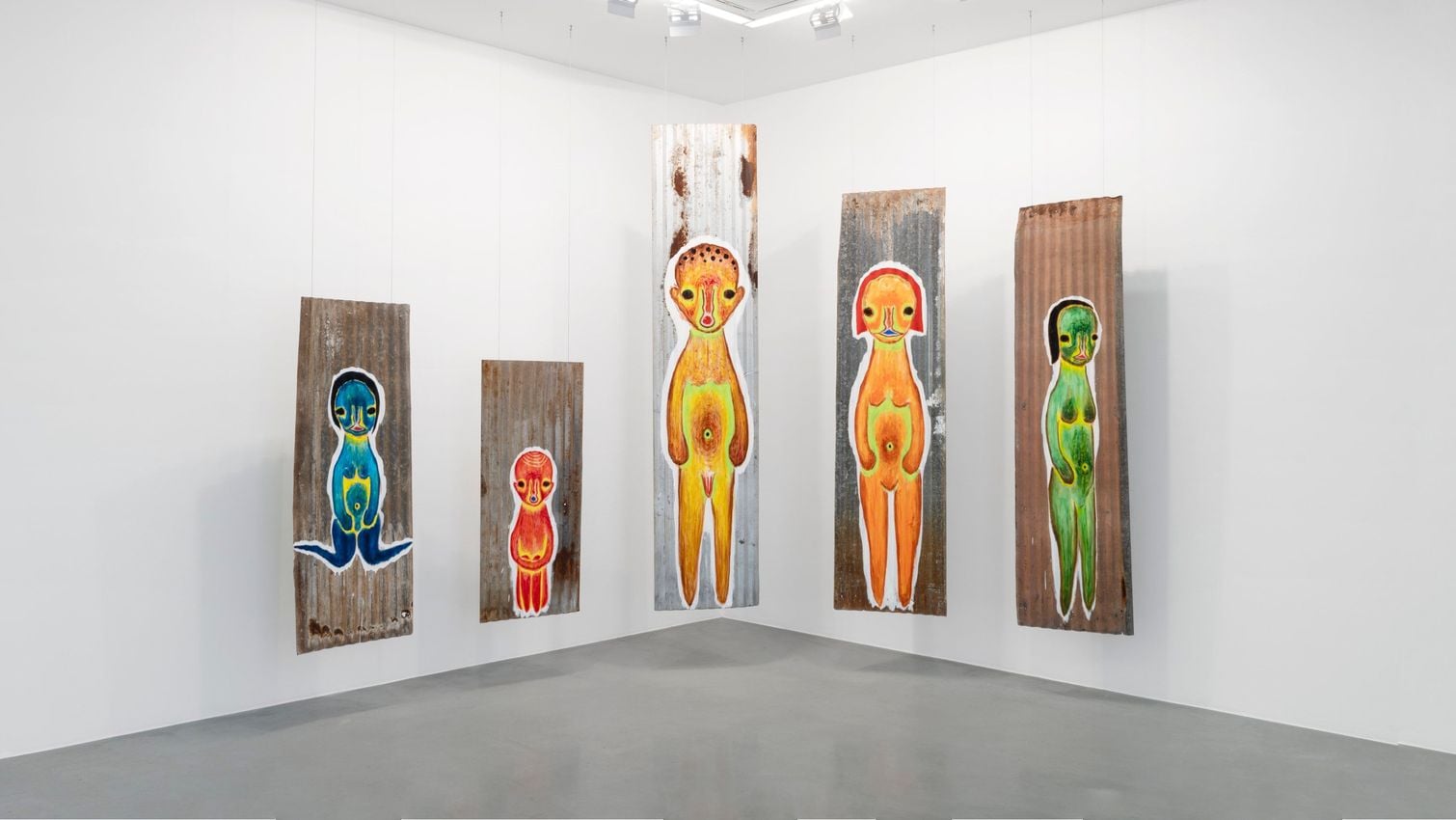
IZUMI KATO
b. 1969, JapanIzumi Kato is a leading Japanese contemporary artist whose practice, which combines paintings and sculpture, brings to life enigmatic, otherworldly figures that seem to exist between the ancient and the futuristic.
Renowned for applying paint directly with his hands and for his hand-chiseled wooden sculptures, Kato’s practice draws on Japanese myth, animism, and his own intuitive approach to form, earning him international acclaim and inclusion in major exhibitions such as the Venice Biennale.
Early Years
Kato was born in Shimane Prefecture, Japan—a region rich in myth and Shinto tradition—in 1969. He graduated from the Department of Oil Painting at Musashino Art University, Tokyo, in 1992. Before launching his artistic career, Kato worked as a manual labourer, an experience that influenced his physical, hands-on approach to art. He currently lives and works between Tokyo and Hong Kong.
Izumi Kato Artworks
Izumi Kato’s contemporary art practice is defined by his creation of surreal, embryonic humanoid figures through painting, sculpture, and installation. His works inhabit a liminal space between the physical and spiritual, the human and the otherworldly, often referencing Japanese folklore, shamanism, and the primal origins of life.
Painting with Hands and Primal Forms
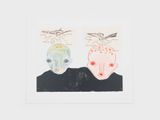
Rejecting the conventional brush, Kato applies pigment directly to canvas with his hands, creating bold, simplified figures with bulbous heads, elongated limbs, and penetrating eyes. These forms, often reminiscent of embryos or ancient spirits, are rendered with smooth, uninterrupted lines and vibrant, clashing colours. Kato’s early works were more abstract, but since the late 1990s, his focus has shifted to figurative, mythic beings that evoke both universality and ambiguity.
Sculpture and Material Experimentation
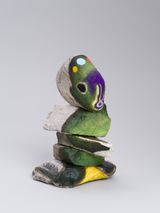
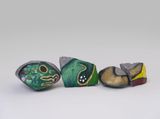
Kato began making sculptures in 2005, initially to overcome creative blocks. His sculptures, often made from soft camphor wood, stone, or soft vinyl, retain visible tool marks and cracks, highlighting the artist’s physical engagement with his materials. These three-dimensional figures, like his paintings, appear as hybrids—part human, part spirit, part ancestor—reflecting both Japanese popular culture and ancient mythology.
Installations and Expanding Practice
Kato’s installations often feature groups of his figures arranged in immersive environments, inviting viewers into a world that is at once playful and uncanny. He continues to experiment with materials, incorporating textiles, plastic, aluminium, and bronze, and has developed a ‘supernatural pantheon’ of figures that allows him to explore a wide range of emotions and narratives.
Select Public Commissions
- Installation at Charleston, UK (2025)
- Large-scale wooden sculptures at Hara Museum of Contemporary Art, Tokyo.
Izumi Kato Prize
The Izumi Kato Prize presented in collaboration with Fundación Casa Wabi, Mexico, was established in 2023 to support young Japanese artists.
Exhibitions
Izumi Kato has been the subject of both solo and group exhibitions at important galleries and institutions. Below is a selection of important exhibitions.
Solo Exhibitions
- Izumi Kato at Charleston, Charleston, UK (2025)
- Parasitic Plastic Models, Watari Museum of Contemporary Art, Tokyo (2022–2023)
- STAND BY YOU, SCAD Museum of Art, Savannah, USA (2021–2022)
- LIKE A ROLLING SNOWBALL, Hara Museum of Contemporary Art, Tokyo/Gunma (2019–2020)
- Izumi Kato, Fundación Casa Wabi, Puerto Escondido, Mexico (2019)
- Izumi Kato, Red Brick Art Museum, Beijing, China (2018)
Group Exhibitions
- 52nd Venice Biennale, Italy (2007)
- Little Boy: The Arts of Japan’s Exploding Subculture, Japan Society, New York (2005)
- Visceral Sensation – Voices So Far, So Near, Museum of Contemporary Art Tokyo
- Moscow Museum of Modern Art, Russia
- Seoul National University, South Korea
Kato’s works are held in major public collections, including the Hara Museum of Contemporary Art (Tokyo), Museum of Contemporary Art Tokyo, The National Museum of Art (Osaka), and Long Museum (Shanghai).
Website
Izumi Kato’s website can be found here.
Izumi Kato FAQs
Where can I see Izumi Kato’s art?
Izumi Kato’s artworks are in the collections of the Hara Museum of Contemporary Art (Tokyo), Museum of Contemporary Art Tokyo, The National Museum of Art (Osaka), and Long Museum (Shanghai). His work has been exhibited at Charleston (UK), Watari Museum of Contemporary Art (Tokyo), SCAD Museum of Art (Savannah), and the Venice Biennale.
What is Izumi Kato best known for?
He is best known for his surreal paintings and sculptures of humanoid figures that evoke ancient spirits, embryos, and mythological beings, created using hand-applied pigment and hand-chiselled wood.
What inspires Izumi Kato’s art?
Kato draws inspiration from Japanese mythology, shamanism, animism, and his upbringing in Shimane Prefecture, as well as modern influences like Francis Bacon and Van Gogh.
What is the Izumi Kato Prize?
He established the Izumi Kato Prize with Fundación Casa Wabi to support young Japanese artists. His work has been widely recognised through major institutional exhibitions and biennials.
Are there any interesting facts about Izumi Kato?
Kato began his art career at age 30 after working as a manual labourer. His sculpture Untitled 2004 became the original visual inspiration for the internet phenomenon ‘SCP-173’. His name is pronounced ‘Ee-zoo-mee Kah-toh’
Ocula | 2025







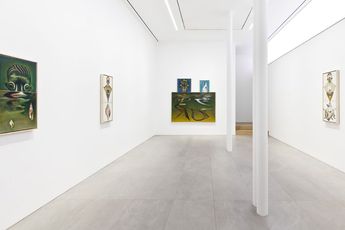
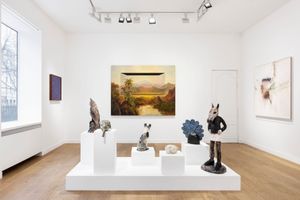
Explore Izumi Kato's Exhibitions





Explore and Follow Artists Shaping Contemporary Art
A respected voice in contemporary art discourse.
Focusing on ambitious storytelling and insightful art-world commentary. Ocula Magazine publishes in-depth interviews, critical essays and timely analysis on the artists, exhibitions and ideas driving the global art world.
Learn more about Ocula Magazine
Showcasing the best of the art world.
Ocula partners with galleries from around the world to highlight their artists, artworks and exhibitions. Gallery membership is by application and invitation, with each member vetted by an independent panel.
Learn more about Ocula Membership
Specialises in the sale of major artworks.
Led by a team with deep ties to the world’s leading auction houses, galleries and collectors. Ocula’s advisory team offers bespoke services to high-net-worth clients from around the world who are looking to acquire the best of contemporary and modern art.
Learn more about our team and services