Press Release

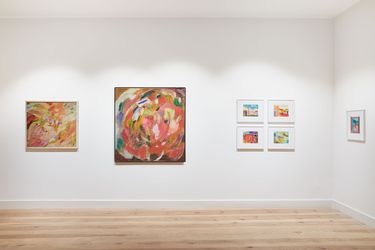
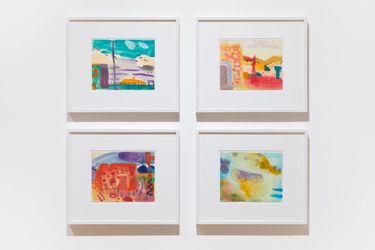
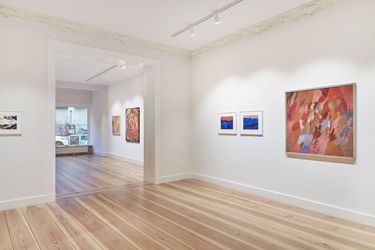
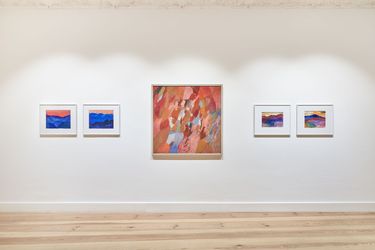
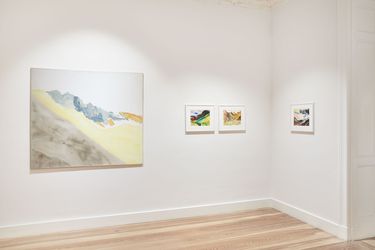
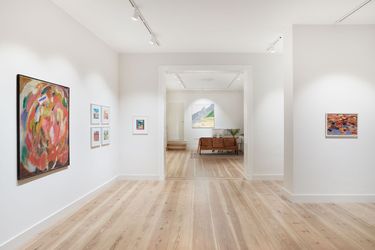
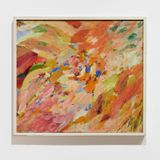
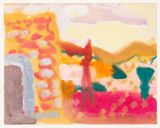
Galerie Albrecht is pleased to present the artist Sigrid Kopfermann for the first time in her native city Berlin. Kopfermann is one of the eminent women painters of the post-war period, and one of the few female artists to take the step towards abstraction and participate in this global language emerging at that time. This show presents paintings and watercolours from the 1950s to 1970s.

Currently, her works can be seen in the exhibition InformELLE: Künstlerinnen der 1950er/60er Jahre at Neue Galerie in Kassel. This exhibition aims to ‘pay homage to sixteen of [art informel’s] leading proponents’, a movement that ‘appears to be dominated primarily by art produced by male artists’ (quoted from the exhibition announcement of Hessen Kassel Heritage).

Sigrid Kopfermann’s oeuvre went through several different phases. After a figurative start in the 1940s, time spent abroad opened up for her the path towards abstraction. In her vivid, colourful works created on Ibiza in 1954–55, there is still a balance between abstraction and figuration. Over the further course of her artistic career, the paintings became more dynamic, the paint application transparent, and the underlying figurative notion can only be deduced from the titles.

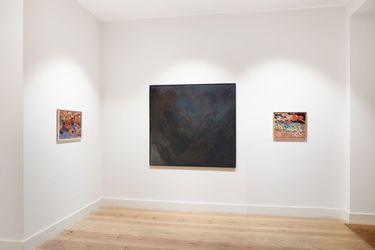
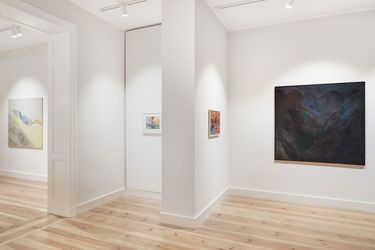
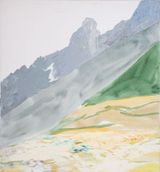
Kopfermann uses oils and watercolours in a flowing manner, and her works are characterised by an airiness and light colours. This is especially true of the airy watercolours that are created with a light touch; but in her paintings, too, she leaves open spaces and uses the brush very lightly. The paintings seem concentrated and yet serenely animated, sometimes veritably boisterous. This is countered by a darkness such as black landscapes and night paintings. In addition to the paintings and watercolours characterised by light and colours, this show includes a mysterious nocturnal mountain landscape.

Mountains and roses are frequently recurrent subjects with Kopfermann. She spent time in the Maritime Alps, further trips took her to Italy, France, and North, Central, and South America. Travelling inspired her and helped her over creative crises; new and unfamiliar environments inspired her to leave the studio and work directly in front of the motif.

Sigrid Kopfermann (born in Berlin in 1923 – died in Düsseldorf in 2011) studied from 1941–45 at the Staatliche Hochschule für Kunsterziehung; her teachers were Willy Jäckel and Bernhard Dörries. With the support from people like Werner Schmalenbach, the director of Kunstsammlung Nordrhein-Westfalen, and the art historian Wieland Schmied, she managed to establish herself on the art market quite early on. From 1965 onwards, she lived with Otto Fuhrmann in Düsseldorf. After his death, she established the Kopfermann-Fuhrmann Foundation.

The artist received important awards, including the Böttcherstraße Kunstpreis Bremen. From 1949 to 1991, her works were continuously exhibited. She had solo exhibitions at numerous institutions, including Kunstverein Hannover (1959), Kunsthalle Wilhelmshaven (1969), Goethehaus New York (1969) Städtische Galerie Schweinfurt (1990), Kunstpalast Düsseldorf, and Kunsthaus Nürnberg (1991), as well as at the galleries Brusberg Hannover (1962), Kabinett Bekker vom Rath in Frankfurt (1962, 1985, 1989), Günther Franke, Munich (1966, 1970). Group exhibitions took her works to the Musée d’art moderne de Paris (1959, 1965), to Galerie Buchholz in Bogota (1959), the Museo de Arte Moderna de Rio de Janeiro (1960), to Bristol UK (1962), New York (1965), and Vaud in Switzerland (1965). Her works can be found in more than 25 museum and renowned private collections, including Sprengel Museum Hannover, Kunstmuseum Düsseldorf, Kurpfälzisches Museum Heidelberg, Städtisches Museum Oldenburg, Sammlung Sprengel, Sammlung Bahlsen und Sammlung Beindorff, Hannover, Bundesrat and Bundestag, and the Collection of the Federal Republic of Germany, Bonn. Between 1949 and 1989, Sigrid Kopfermann received 24 commissions for art in public space.

Read More

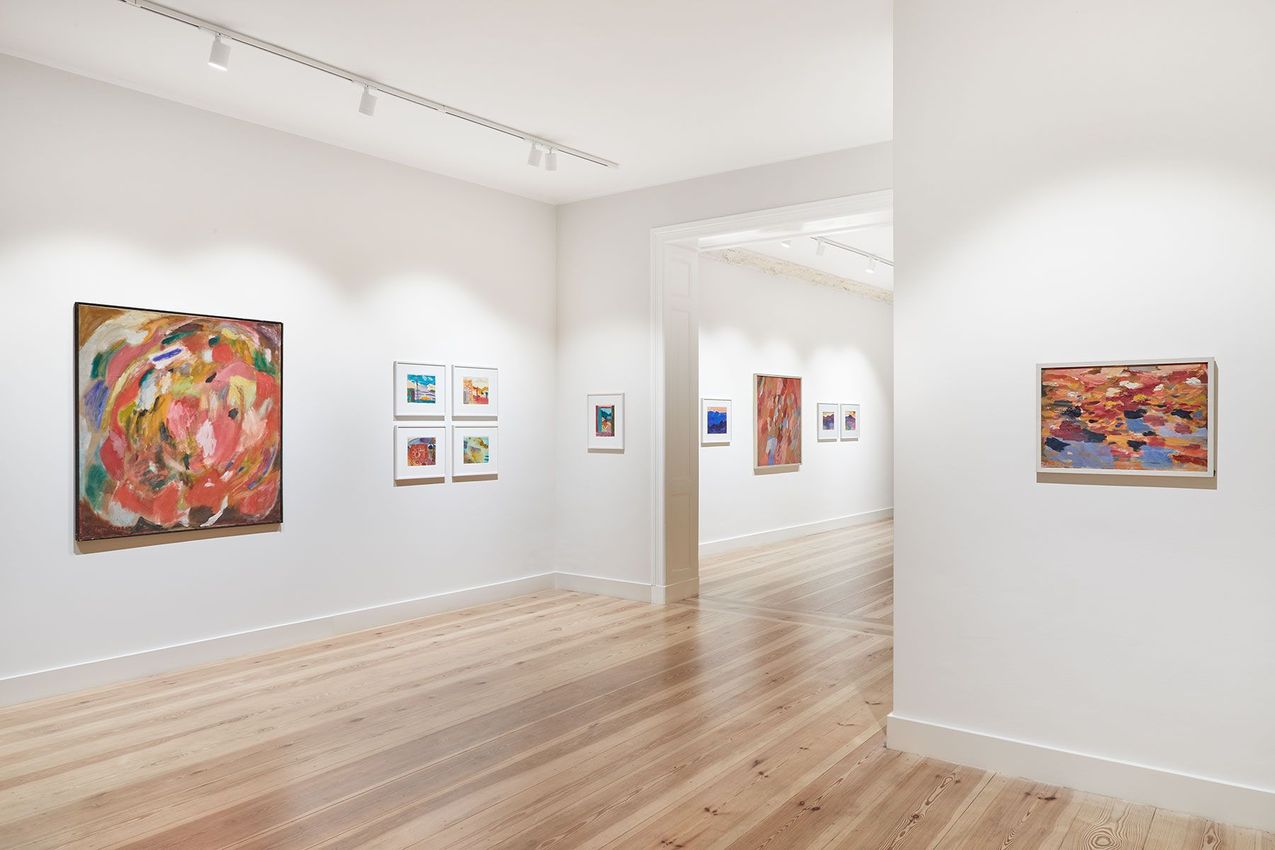
Installation Views

About the Artist

Sigrid Kopfermann (born in Berlin in 1923 – died in Düsseldorf in 2011) studied from 1941–45 at the Staatliche Hochschule für Kunsterziehung; her teachers were Willy Jäckel and Bernhard Dörries. With the support from people like Werner Schmalenbach, the director of Kunstsammlung Nordrhein-Westfalen, and the art historian Wieland Schmied, she managed to establish herself on the art market quite early on. From 1965 onwards, she lived with Otto Fuhrmann in Düsseldorf. After his death, she established the Kopfermann-Fuhrmann Foundation.

View Artist Profile Sigrid Kopfermann contemporary artist
About the Gallery

Established by Susanne Albrecht in 1986 off the heels of her studies in philosophy, art history, and Italian philology at Freie Universität Berlin and Ludwig-Maximilians-Universität München, Galerie Albrecht represents young European and Asian artists as well as influential established European and American post-War and contemporary artists.

View Gallery Profile
Address
Bleibtreustr. 48
Berlin
Germany
Opening Hours
Tuesday–Saturday, 12pm–6pm
(1)
Berlin Bleibtreustr. 48
Galerie Albrecht
Bleibtreustr. 48, Berlin, Germany

Opening hours
Tuesday–Saturday, 12pm–6pm
The art world in focus