





CHRISTINA QUARLES
b. 1985, United StatesChristina Quarles’ bright, captivating work question our assumptions about human identity and how individuals fit—or don’t—into established social and sexual parameters. Her playful canvases invite debate—each work, from huge installations to smaller-scale works on paper, communicates a multitude of ideas without being overcomplicated.
Early Years
Christina Quarles was born in Chicago in 1985. Her father is Black and her mother is white, but her parents were only able to record one race on her birth certificate—her father’s family suggested they choose white because that would give her more opportunities in America. She has said that describing her racial identity growing up was a “constant question” and that exploring the disconnect between how she saw herself and others saw her was a motivation to make artwork. Growing up in LA (her mum worked for Paramount), Quarles was artistically active during her childhood—she remembers a project in third grade that was displayed at the Los Angeles County Museum of Art. She also took art classes at the museum, describing it as her “home away from home”. Quarles graduated with joint honours in studio arts and philosophy in 2007 from Hampshire College. She became a graphic designer—learning to use Adobe Illustrator, which later became part of her artistic practice—then gained her MFA in painting and printmaking from Yale in 2016, studying at the Skowhegan School of Painting and Sculpture during the same year.
Christina Quarles: Artworks
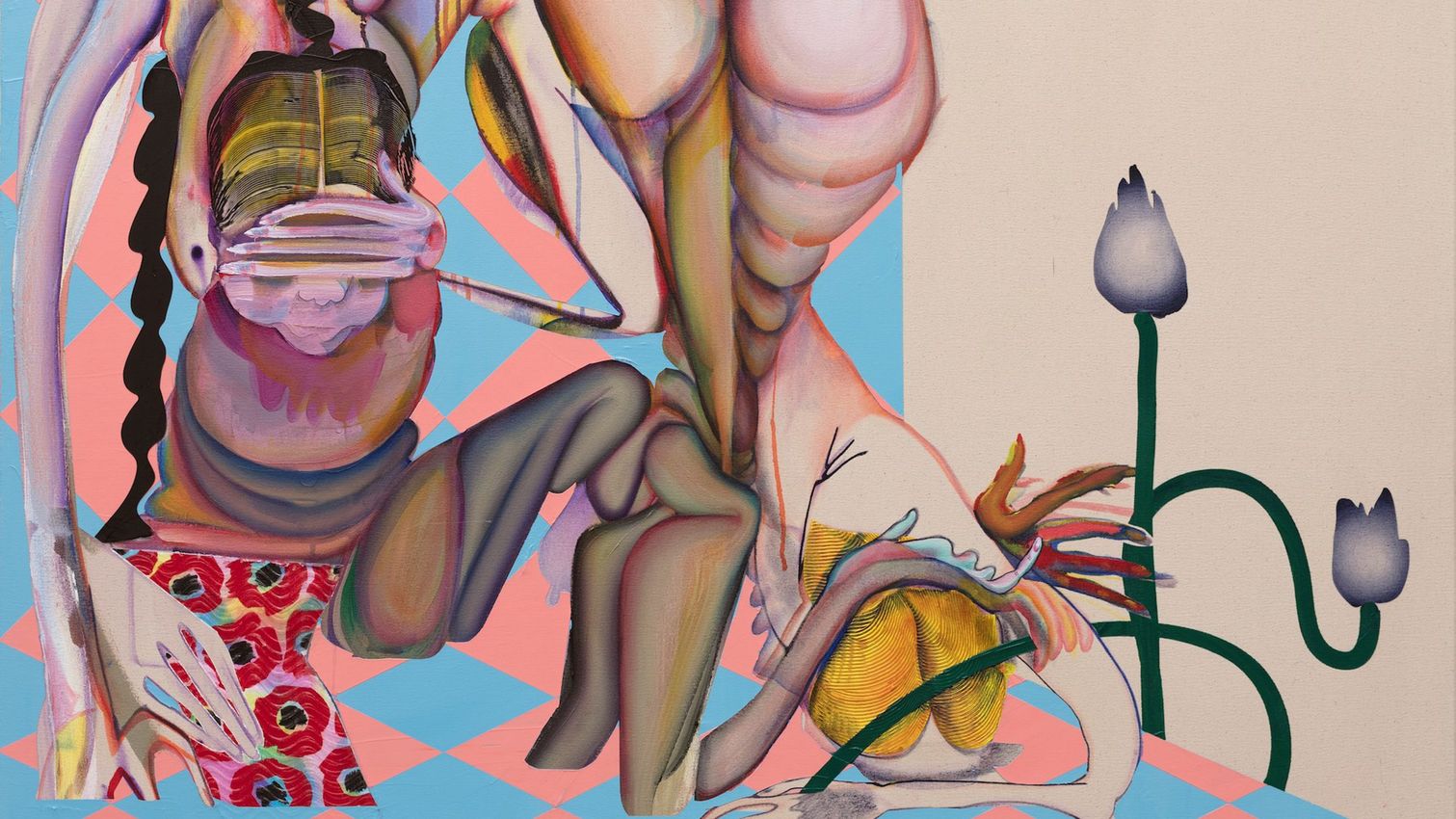
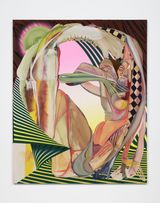
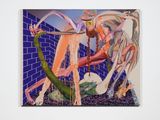
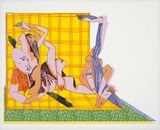
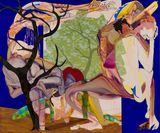
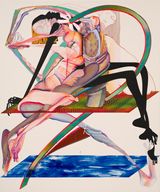
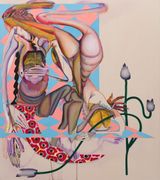
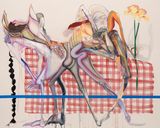
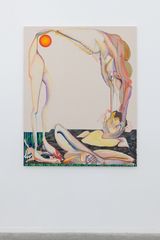
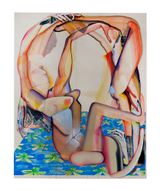
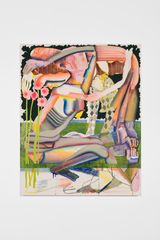
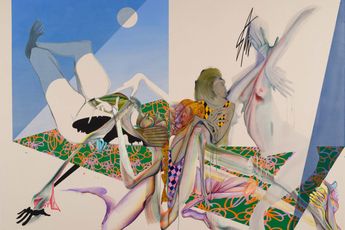
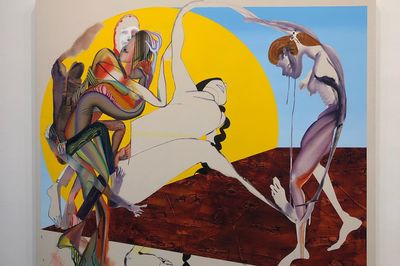
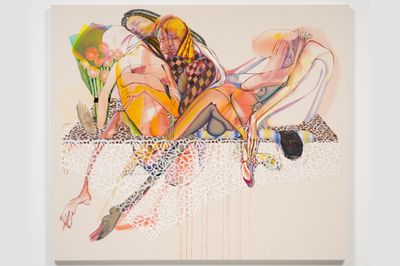
Blurring the concepts of abstraction and figuration, Quarles’ bold-coloured acrylic paintings show us contorted human figures of no obvious gender. Bodies and the bodily experience have long been a focus of her work—she considers the contradictions and nuances in individual identities. Planes of colour intersect with bodies, faces and limbs, yet she doesn’t use recognisable “human skin colours” in her work, asking us to consider an internal experience of identity rather than a perceived norm. While text originally formed part of her compositions, she has transferred this language-play into the titles of her pieces.
Her early large canvases, such as 2018’s Let Us In Too (Tha Light) explores ambiguities: are the red flowers seen against the sky or the ground? Faces, hands and feet connect in a way that creates several interpretations of how the bodies in the piece interlock.
Quarles does not shy away from political subject matter—her 2018 piece Casually Cruel, was influenced by families being separated at the US/Mexico border. Three figures are pictured on the canvas, but the limbs of one of them are set apart from the others. Parts of the canvas are left raw, others covered with expressive textural marks. An object at the centre left of the painting could be a leg, or possibly a penis.
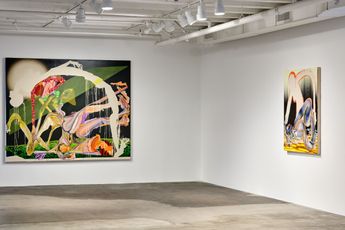
The large-scale 2023 installation Now We’re There (And We’ Only Just Begun) was inspired by a misremembered song lyric and ideas around confusion of place. The grand scale of the artwork allowed Quarles to take the picture beyond the edges of the frame, using trompe l’oeil.
The colour and light of the LA landscape are also evident in Quarles’ works—2023’s Fold Gently, for example. She has talked about the light being “very particular” with “large, long vistas from which to view the sky”, as well as the artificial nature of the landscape, from film sets to imported plants.
Christina Quarles: Select Exhibitions
Select Solo Exhibitions
- Christina Quarles: Now We’re There (And We’ Only Just Begun), Los Angeles County Museum of Art (2026)
- The Ground Glows Black, Hauser & Wirth, Los Angeles (2026)
- Living in the Wake, Kistefos Museum, Jevnaker (2025)
- Far From Near, SCAD Museum of Art, Savannah (2025)
- In The Shadow of Burning Light, GL Strand, Copenhagen (2024)
- Tripping Over My Joy, Pilar Corrias Gallery, London (2023)
- Come In From An Endless Place, Hauser & Wirth, Menorca (2023)
- Christina Quarles: Collapsed Time, Hamburger Bahnhof, Berlin (2023)
- In 24 Days tha Sun’ll Set at 7pm, Hauser & Wirth, New York City (2022)
- Christina Quarles, Frye Art Museum, Seattle (2022) (and touring)
- In Likeness, South London Gallery, London (2021) (and touring)
- Christina Quarles: Dance by tha Light of tha Moon, X Museum, Beijing (2021)
- I Won’t Fear Tumbling or Falling/If We’ll Be Joined in Another World, Pilar Corrias Gallery, London (2020)
- _Christina Quarles: Every Silver Lining Has Its Cloud. Pond Society, Shanghai (2019)
- But I Woke Jus’ Tha Same, Regen Projects, Los Angeles (2019)
- Always Brightest Before Tha Dusk, Pilar Corrias Gallery, London (2018)
Select Group Exhibitions
- Muted Hums, Para-Site, Hong Kong (2025)
- Flesh Flowers, Aïshti Foundation, Beirut (2025)
- Tha Sun Will Set: Contemporary Abstraction and The Body, Museum of Fine Arts Boston (2024)
- Dreaming of Home, Leslie Lohman Museum, New York City (2023)
- Capturing The Moment, Tate Modern, London (2023)
- Put It This Way: (Re)Visions of the Hirshhorn Collection, Hirshhorn Museum, Washington DC (2022)
- In Focus: LA Artists, Hauser & Wirth, Los Angeles (2021)
- My Body, My Rules, Perez Art Museum Miami (2020)
- Kiss My Genders, Hayward Gallery, London (2019)
- This is Not a Prop, David Zwirner, New York City (2018)
- Fictions, The Studio Museum in Harlem, New York City (2017)
- Queering Space, Yale School of Art Green Gallery, New Haven (2016)
Further Reading
- Christina Quarles’ Instagram
- Christina Quarles’ official website
- Artist profile page at Hauser & Wirth
- 2023 interview in Ocula
- 2026 interview in The Observer
Christina Quarles FAQs
Does Christina Quarles create sketches before making a painting?
No—surprisingly, even though Quarles studied figure drawing from childhood and has a significant drawing practice, she doesn’t use sketches as reference points for creating paintings. Instead, she uses intuition, memory and mark-making. While she will draw life models as part of her regular artistic activity, these sketches don’t act as a starting point for a painting. “After I’m done doing a drawing session, I’ll just take those drawings and just throw them away,” she has said.
How does Christina Quarles use Adobe Illustrator in her work?
Quarles learned how to use Illustrator while working as a graphic designer. She re-interprets her own work using the software, photographing her paintings and transferring them to Illustrator where she can then manipulate patterns and planes. “Different things can exist at a scale that’s not a one-to-one with my own body because Adobe Illustrator is so scalable,” she has said.
Was Christina Quarles’ house in the LA wildfires?
Yes, Quarles’ home was in the 2025 wildfires, but sadly this wasn’t the artist’s only experience of fire in Los Angeles. In April 2024, the home she shared with her wife and daughter burned in an electrical fire. The family started to build a home on an adjacent plot, but this too burned as the wildfires destroyed the neighbourhood in 2025.
Ocula



















Explore Christina Quarles' Exhibitions




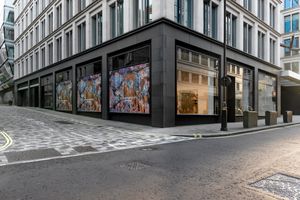


Christina Quarles in Ocula Magazine





Explore and Follow Artists Shaping Contemporary Art
A respected voice in contemporary art discourse.
Focusing on ambitious storytelling and insightful art-world commentary. Ocula Magazine publishes in-depth interviews, critical essays and timely analysis on the artists, exhibitions and ideas driving the global art world.
Learn more about Ocula Magazine
Showcasing the best of the art world.
Ocula partners with galleries from around the world to highlight their artists, artworks and exhibitions. Gallery membership is by application and invitation, with each member vetted by an independent panel.
Learn more about Ocula Membership
Specialises in the sale of major artworks.
Led by a team with deep ties to the world’s leading auction houses, galleries and collectors. Ocula’s advisory team offers bespoke services to high-net-worth clients from around the world who are looking to acquire the best of contemporary and modern art.
Learn more about our team and services