





Fritz Scholder, the Artist Who Shattered Stereotypes of Native American Life
The artist had a complicated relationship with his Native American heritage, yet his ‘Indian’ series of artworks ended up defining his career. Marking an exhibition of Scholder’s work at MMK this summer, the show’s curator talks us through five of the most interesting works. Save to My OculaFew paintings have given me such a strong sensation of being stared at as the portraits by 20th-century American artist Fritz Scholder. Walking through the exhibition of his work currently on show at Museum Für Moderne Kunst (MMK) in Frankfurt, the distorted figures, acidic in colour, their eyes hollowed out, seem to return the viewer’s gaze with unnerving force.
Scholder was born in Minnesota in 1937 and was an enrolled member of the La Jolla Band of Luiseño Indians, a federally recognised tribe of Native Americans. But he did not grow up within his tribal community and resisted identification as an “Indian artist”. Trained in modernist painting and influenced by Abstract Expressionism, Pop and Francis Bacon, he began teaching at Santa Fe’s Institute of American Indian Arts (IAIA) in 1964. Three years later, despite having vowed never to paint Native Americans, he began the Indian series that would define his career. In his portraits, he situated his subjects among the signifiers of contemporary American life: beer cans, US flags, arcade games.
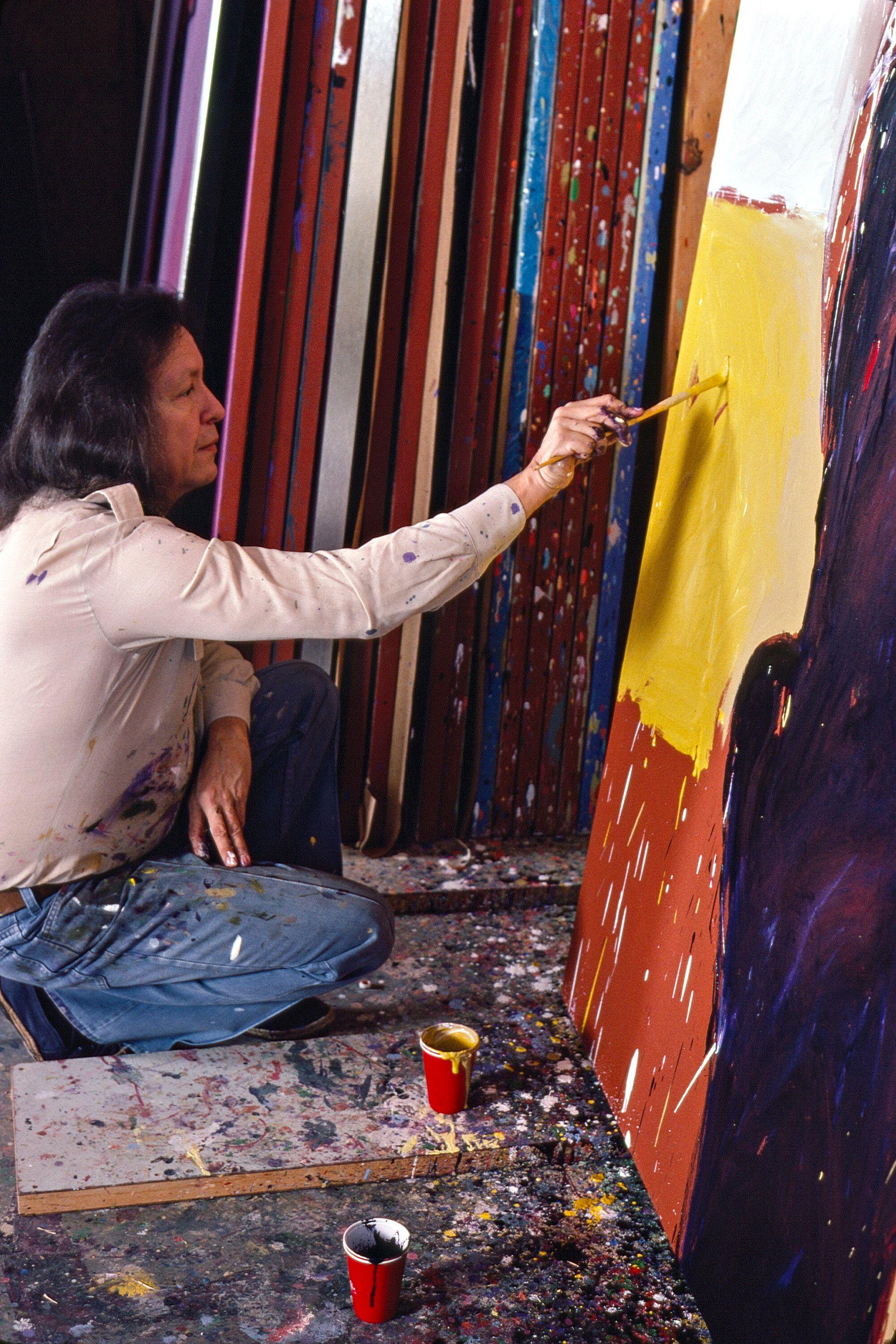
The MMK exhibition focuses on these formative years during the 1960s and 1970s, when Scholder began colliding Native stereotypes with post-war American painting tropes. By doing so, he placed himself in the history of Pop Art—which MMK was founded, in part, to explore. Indeed, Scholder was once prominent enough that Andy Warhol collected his work and painted his portrait. However, the artist has since largely disappeared from European accounts of the period.
The portraits I saw reminded me of an old American horror cliché: the “Indian burial ground”, where people living on land stolen from Native Americans experience supernatural events or hauntings, a trope that went on to be criticised as a settler fantasy, born out of guilt. It was only afterwards, when I came across Scholder’s description of Native Americans as subjects carrying America’s “national guilt”, that I realised why they had recalled the burial ground trope. Perhaps the disturbance I experienced looking at these distorted figures is not only their pain, but the guilt and unease they make the viewer feel.
“The paintings ask us to look at the images through which Native American history has been constructed and circulated”
Below, curator Julia Eichler talks us through five of the most important works from the exhibition, tracing how Scholder unsettled the boundaries between Pop Art and Expressionism, stereotype and contemporary Native American life.
Fritz Scholder, Massacre at Wounded Knee I (1970)
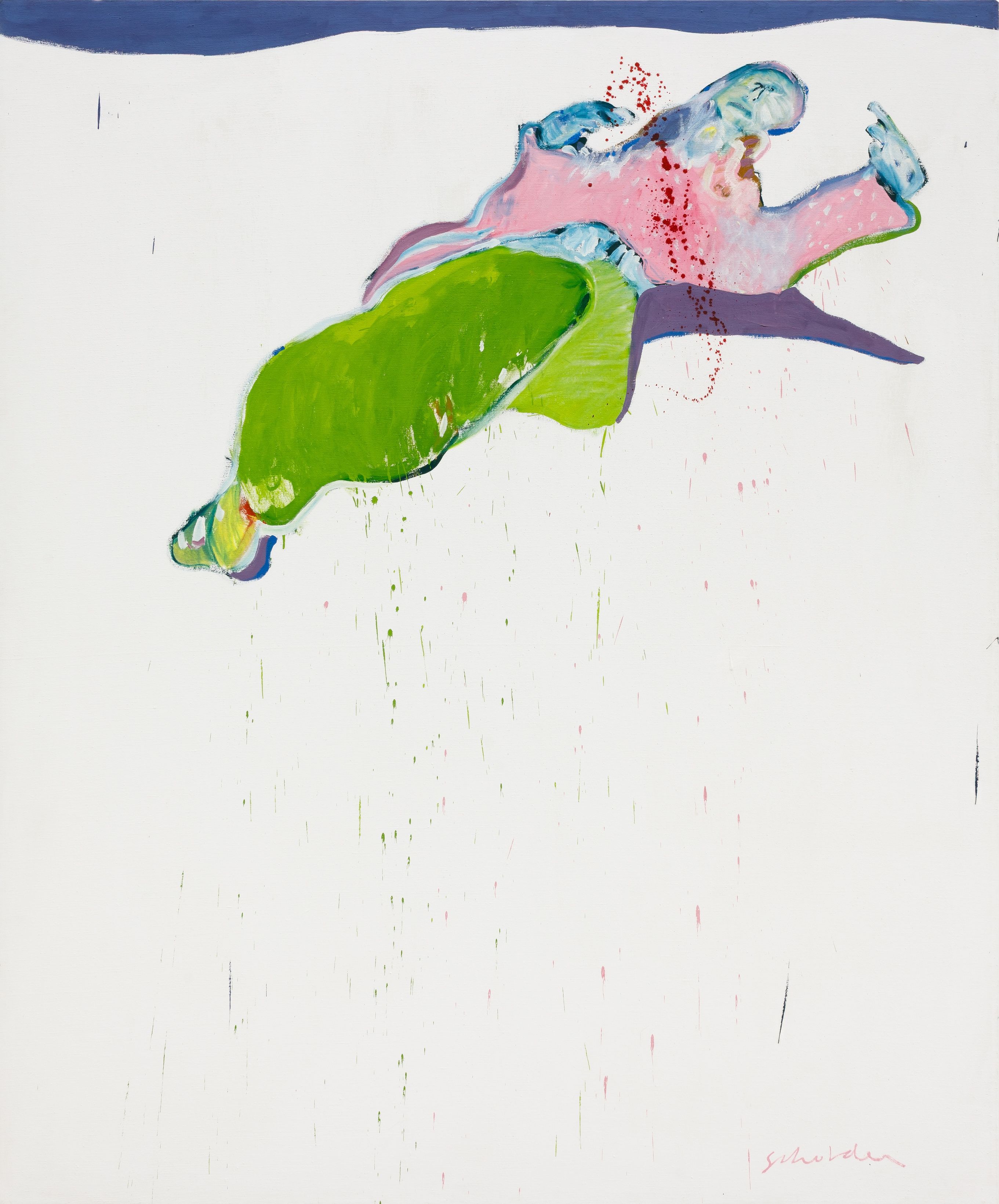
This painting refers to the December 1890 massacre in which the US Army’s Seventh Cavalry killed hundreds of largely unarmed Lakota, leaving their bodies scattered across the snowy landscape.
In the exhibition, we placed this work alongside another painting which we know was based on an archival photograph documenting the mass burial of victims in that massacre. The pairing shows how Scholder paints “images of images”. Even when there is no single identifiable source, he works with (and against) an existing visual archive of Native Americans—photographs, ethnographic images, popular culture—rather than simply reproducing it. There is always this double reflection. The paintings show us how little we know and how this knowledge is shaped: by the limited and one-sided material through which history is constructed and circulated.
This politics of representation extends even to Scholder’s technique. At the Santa Fe Institute of American Indian Arts during the 1930s, settler educator Dorothy Dunn promoted the “Studio Style” (flat colour, strong outlines and little modelling) institutionalising a particular idea of “authentic” Native American art. Scholder pushed against this legacy through Abstract Expressionism and Pop. His free colour, physical handling of paint and psychological intensity unsettle both the prescribed category of “Native American art” and the conventions of post-war US painting.
Fritz Scholder, Monster Indian (1968)
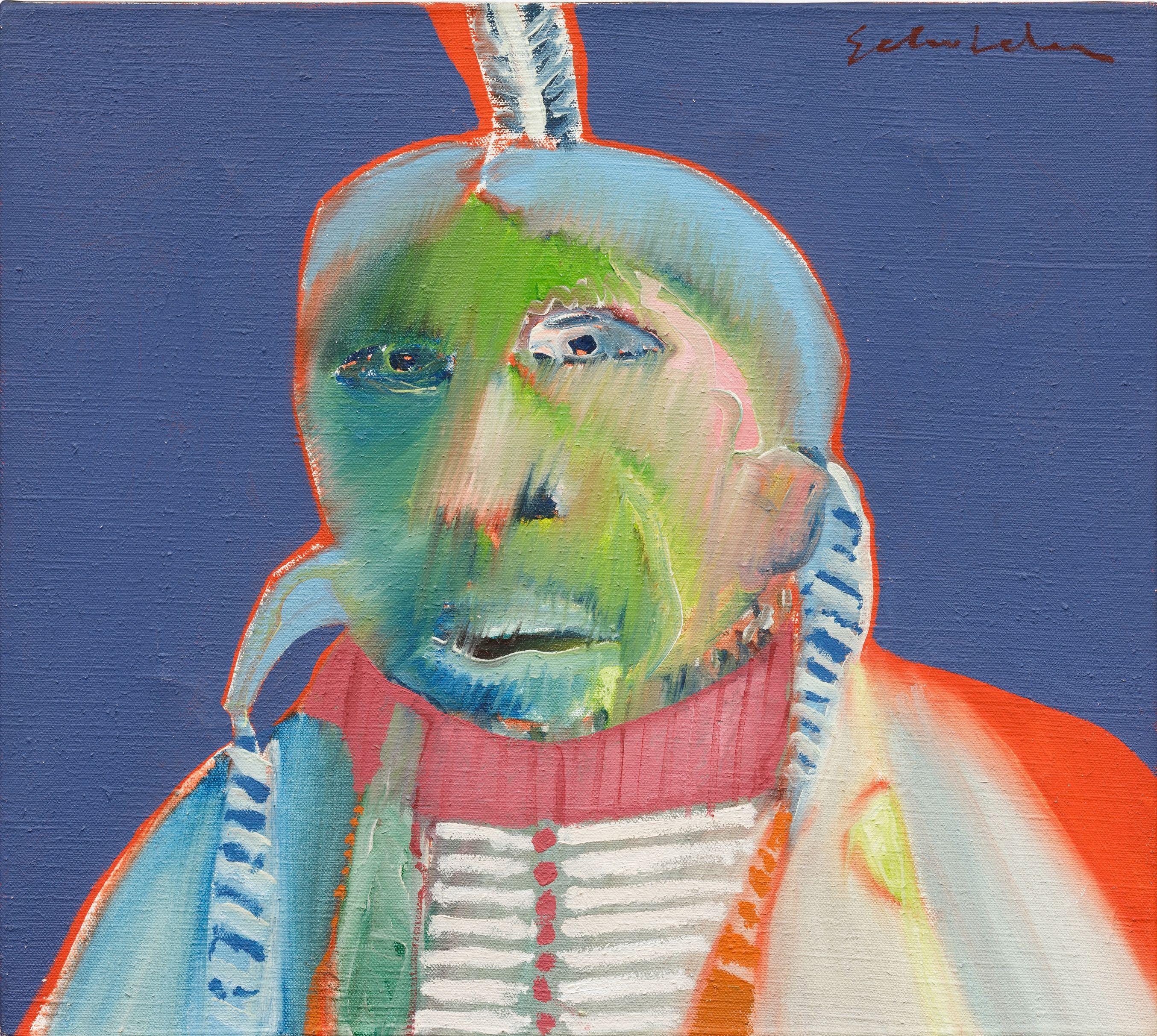
This is a formative work that curator and researcher Candice Hopkins discusses in an essay for the exhibition. For Hopkins, Scholder’s “monster” carries several things at once: the psychological torment of contemporary Native American life, the unresolved violence of colonial history, and the position of a witness looking back with a refusal of “colonial innocence”.
Scholder’s paintings are executed with verve and speed and they are boldly coloured, yet the subject matter is weighty. This is the contrast the artist seeks. He doesn’t skimp on humor—anyone who studied at the IAIA knew that the clichés Scholder painted, which were ubiquitous, could be met with humor. It is precisely this that requires us to view them with seriousness.
Fritz Scholder, Indians in Washington, DC (1969)
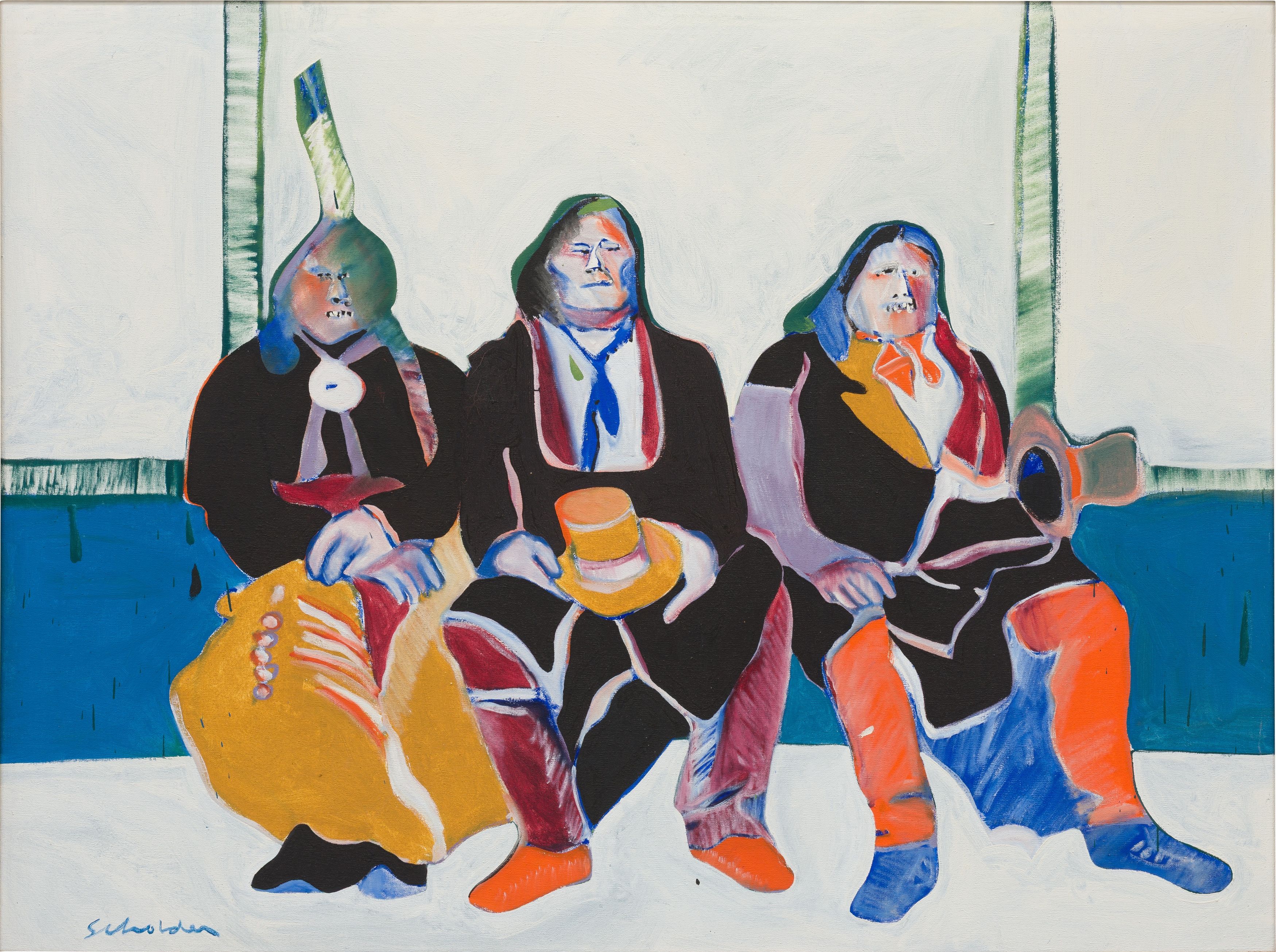
If you search historical photographs of Native American delegations, you encounter a very particular iconography: elegantly dressed Native delegates, often combining Western and traditional clothing, travelling to the US capital to negotiate with the federal government or to defend treaty rights. Hundreds of treaties between Native American tribes and the settler colonialists were signed, but almost none were respected.
Scholder was very likely exposed to a visual culture saturated with photographs such as those taken by Edward S Curtis, which presented Native Americans as part of a “disappearing” world. Curtis famously removed clocks, umbrellas and other signs of contemporary life from his photographs. Scholder does the opposite: he draws attention to the omissions; in Indians with Umbrellas, for example, he paints exactly what Curtis wanted to leave out: a broad front of horsemen with umbrellas—an image that is inherently absurd.
Fritz Scholder, Hollywood Indian and Horse #2 (1973)
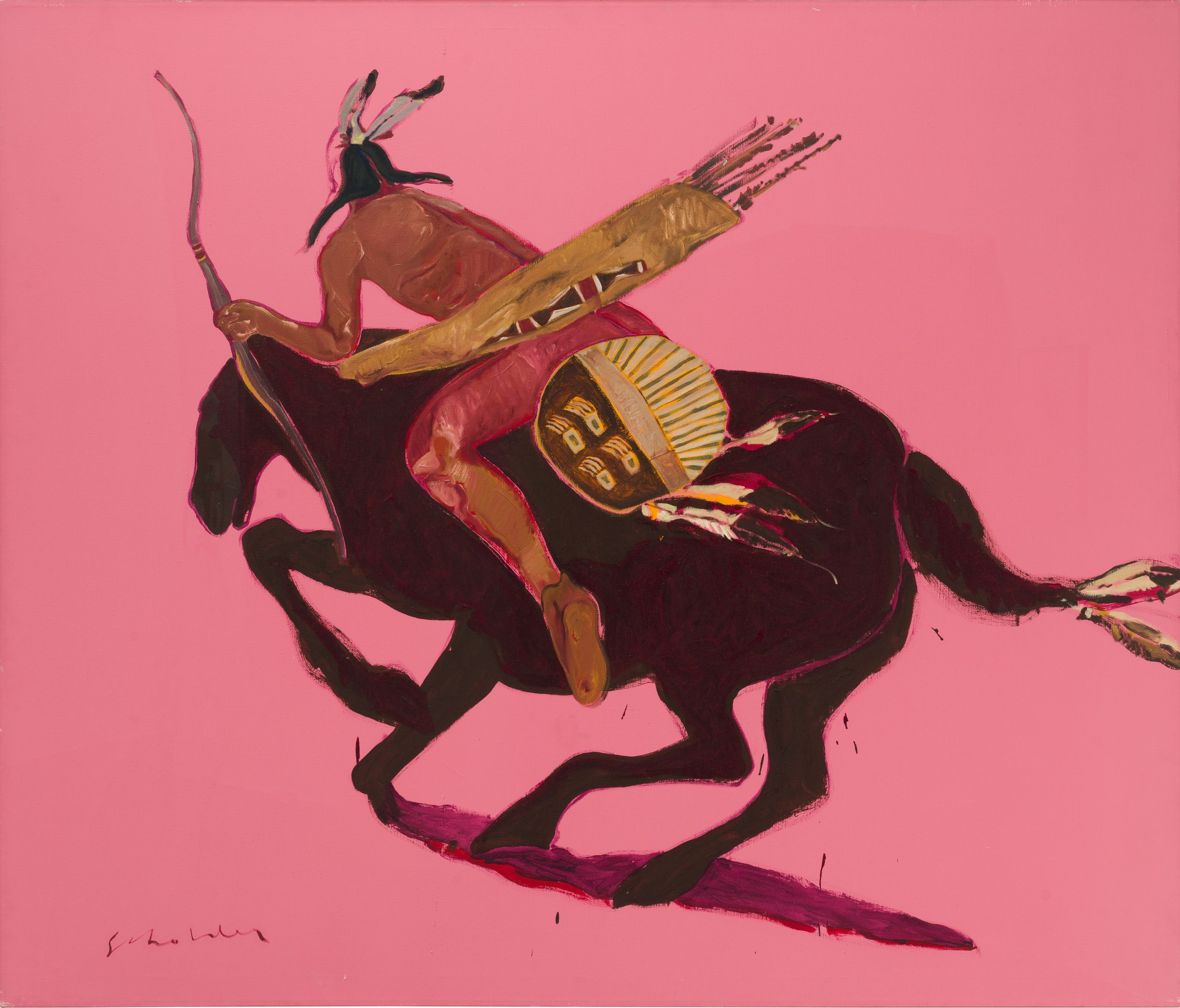
The “Hollywood Indians” are among the clearest examples of Scholder’s subversion of pop-cultural clichés. Westerns were full of stoic, romanticised or historically nostalgic stereotypes of Native Americans, often played by non-Native actors. Scholder speaks back to this visual canon through the vibrant language of Pop Art and the psychological intensity of expressionism.
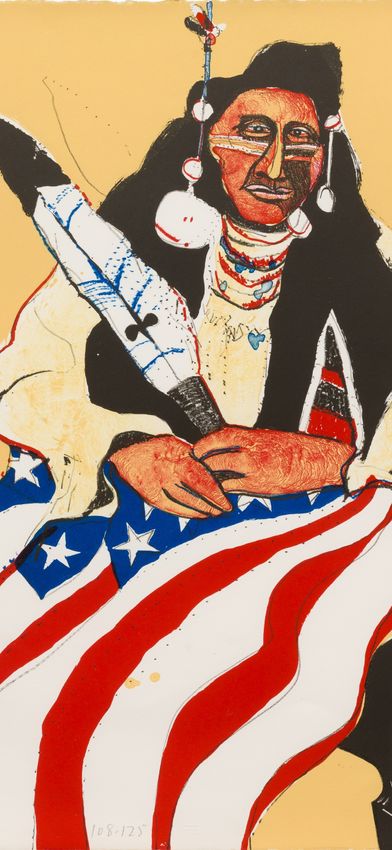
Fritz Scholder, Bicentennial Indian (1975)
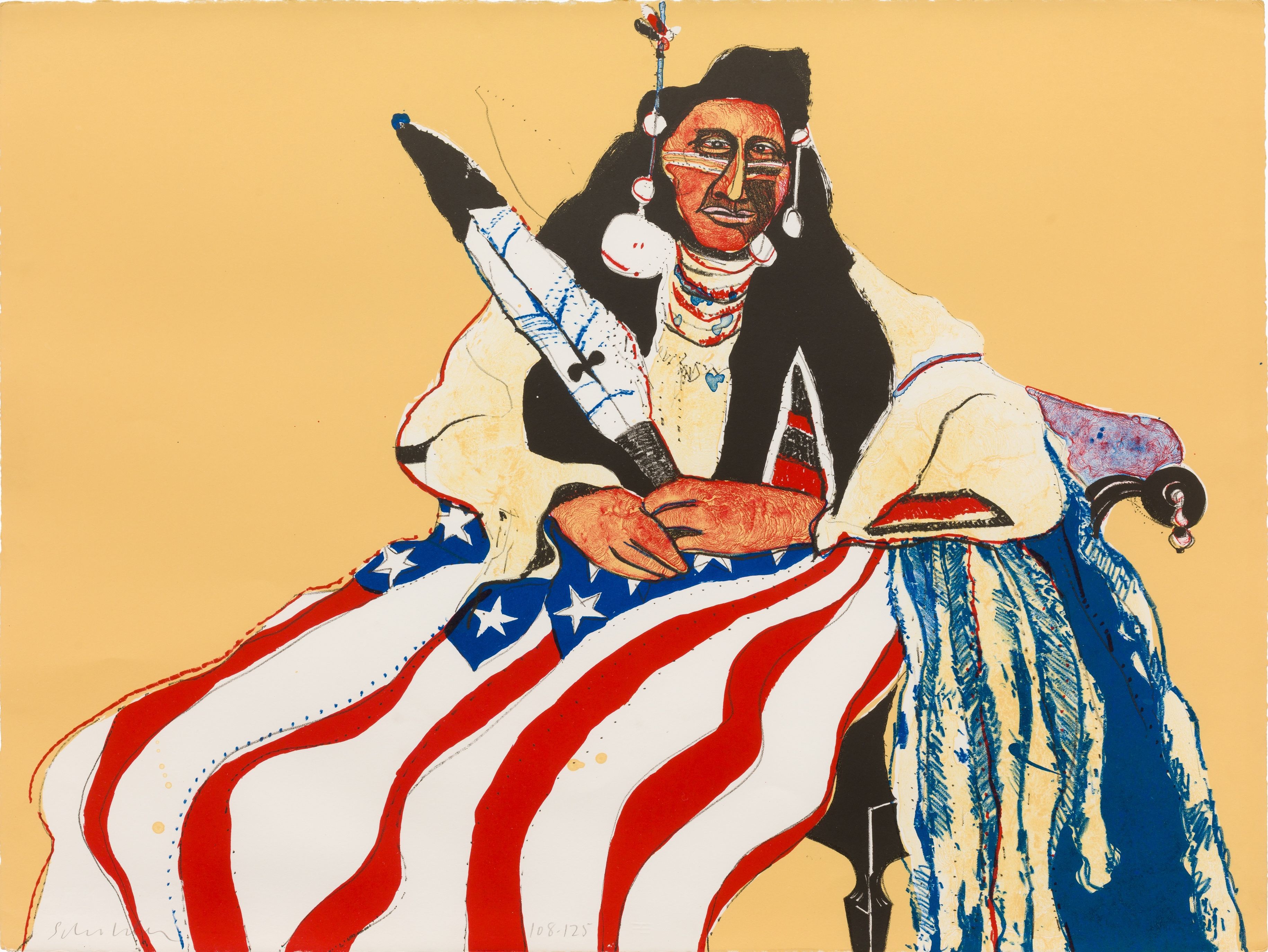
Bicentennial Indian was originally commissioned for the Kent Bicentennial Portfolio: Spirit of Independence (1975–1976), which brought together 12 American artists to answer a deceptively simple—and, for Native Americans, deeply loaded—question: “What does independence mean to you?” Made one year before the United States celebrated its 200th anniversary, the work takes on another resonance in 2026 as the country marks its 250th.
Here, the warrior’s hand rests directly on the stars of the US flag, each new star marking another state incorporated into the Union and, with it, the dispossession of Native lands. Yet Native Americans also served in disproportionately high numbers during the First and Second World Wars and Vietnam, even though universal US citizenship was only extended to Native Americans in 1924.
There was also a political dimension to Scholder’s desire to disseminate printmaking. Paintings were, of course, quite expensive, whereas a print was something many more people could afford. We spoke with acclaimed American novelist Tommy Orange, who told us he grew up with Scholder prints. People could actually have these works in their homes. —[O]
Fritz Scholder (until 25 October) at MMK Frankfurt
Main image: Fritz Scholder, Hopi Dancers (First State), 1974, © Fritz Scholder. Photo: Axel Schneider






A respected voice in contemporary art discourse.
Focusing on ambitious storytelling and insightful art-world commentary. Ocula Magazine publishes in-depth interviews, critical essays and timely analysis on the artists, exhibitions and ideas driving the global art world.
Learn more about Ocula Magazine
Showcasing the best of the art world.
Ocula partners with galleries from around the world to highlight their artists, artworks and exhibitions. Gallery membership is by application and invitation, with each member vetted by an independent panel.
Learn more about Ocula Membership
Specialises in the sale of major artworks.
Led by a team with deep ties to the world’s leading auction houses, galleries and collectors. Ocula’s advisory team offers bespoke services to high-net-worth clients from around the world who are looking to acquire the best of contemporary and modern art.
Learn more about our team and services