





Quiescent Space: Donald Judd’s Artillery Sheds Set for Massive Restoration

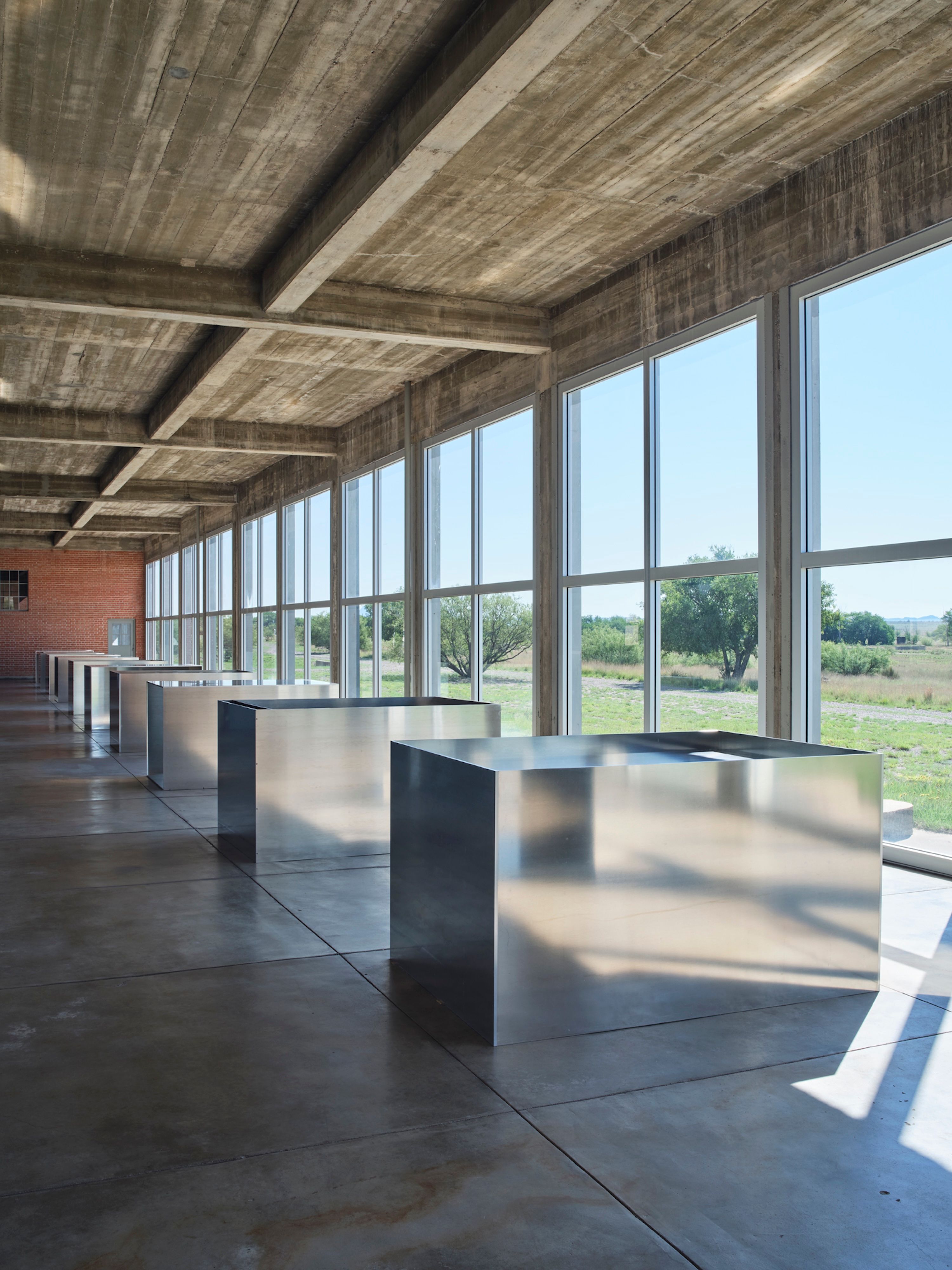
Donald Judd, Artillery Sheds with 100 untitled works in mill aluminum, 1982-1986. Permanent collection, The Chinati Foundation, Marfa, Texas. Photo by Alex Marks, courtesy of The Chinati Foundation. Donald Judd Art © 2026 Judd Foundation / Artists Rights Society (ARS), New
Plans for the restoration of The Artillery Sheds, two former military buildings in the south-western United States that house Donald Judd’s 100 untitled works in mill aluminium (1982–1986), are set to get underway this autumn.
Judd—the minimalist pioneer perhaps best known for his vertical Stacks—bought the sheds in Marfa, Texas, during the 1970s to create an exhibition space for his 100 works, all of which retain their original, unpolished metal. The site belongs to the Chinati Foundation, which Judd set up in 1986, and now attracts more than 20,000 visitors per year.
In his 1987 statement of intent for the foundation, which he created in part, to allow for the permanent installation of large-scale works, the artist wrote: “The art and architecture of the past that we know is that which remains. The best is that which remains where it was painted, placed or built.”
The sheds are among several abandoned sites in Marfa purchased by Judd—he moved there in 1971, choosing the former ranching town because it was relatively sparsely populated. Last year, the site was recognised on the US National Register of Historic Places as part of the Donald Judd Historic District, which comprises 15 buildings in Marfa plus Judd’s 15 untitled works in concrete (1980–1984).
In a statement, Caitlin Murray, executive director of the Chinati Foundation, described Judd’s 100 untitled works in mill aluminium as “100 unique pieces sharing external dimensions, each with its own structure”. She explained: “As visitors move throughout the spaces, they experience the work through measured intervals, subtle shifts in light, reflecting surfaces, and moments of stillness.
“The restoration is guided by an understanding that minor modifications to interior and exterior conditions can alter this experience.”
As part of the restoration, Judd’s 100 untitled works in mill aluminium will be moved for safety. They will be reinstalled by a team including fabricator Alfred Lippincott, who originally installed the works in 1986, and the Getty Conservation Institute.
Lippincott said: “What I like about the Artillery Sheds is that they offer a quiescent space. The environment is most unusual in that respect.
“There’s no blowing air; no humming of equipment; no artificial lighting. And this distilling away of distractions serves to sharpen one’s awareness and intensify the experience of being with the works and moving amongst them.
“One discovers that the boxes are adamantine and mutable at the same time. They are fashioned of metal and yet they dissolve into glass, they dissolve into light. It’s an altogether wonderful experience.”
Built in 1939 by the US Army Corps of Engineers for large-scale mechanical work, the sheds could accommodate more than 30 trucks when they were in military use. Judd began repurposing the spaces in 1980, replacing the garage doors with quartered glass windows that he designed himself and adding curved, prefabricated roofs which doubled the buildings’ height.
So far, $9.5 million has been raised towards the building’s restoration. Judd’s vaulted roofs, which have accumulated sand, moisture and gravel that has corroded their ribs, will be repaired, while more than 930 square metres (10,000 square feet) of energy-efficient glass will protect Judd’s artwork from extreme weather.
Accessibility will be improved via upgraded paths, and rainwater harvesting systems will help to sustain native grasses and the ecosystem of the surrounding Chihuahuan desert. The preservation project is part of the Chinati Foundation’s Art as Intended project, which aims to raise $16 million to update the historic infrastructure and enhance visitors’ experience.



A respected voice in contemporary art discourse.
Focusing on ambitious storytelling and insightful art-world commentary. Ocula Magazine publishes in-depth interviews, critical essays and timely analysis on the artists, exhibitions and ideas driving the global art world.
Learn more about Ocula Magazine
Showcasing the best of the art world.
Ocula partners with galleries from around the world to highlight their artists, artworks and exhibitions. Gallery membership is by application and invitation, with each member vetted by an independent panel.
Learn more about Ocula Membership
Specialises in the sale of major artworks.
Led by a team with deep ties to the world’s leading auction houses, galleries and collectors. Ocula’s advisory team offers bespoke services to high-net-worth clients from around the world who are looking to acquire the best of contemporary and modern art.
Learn more about our team and services