



Press Release

‘Many of the things we see computer programs doing today would have been regarded as impossible a couple of decades ago; AARON is surely one of them.’ — Harold Cohen, 1999

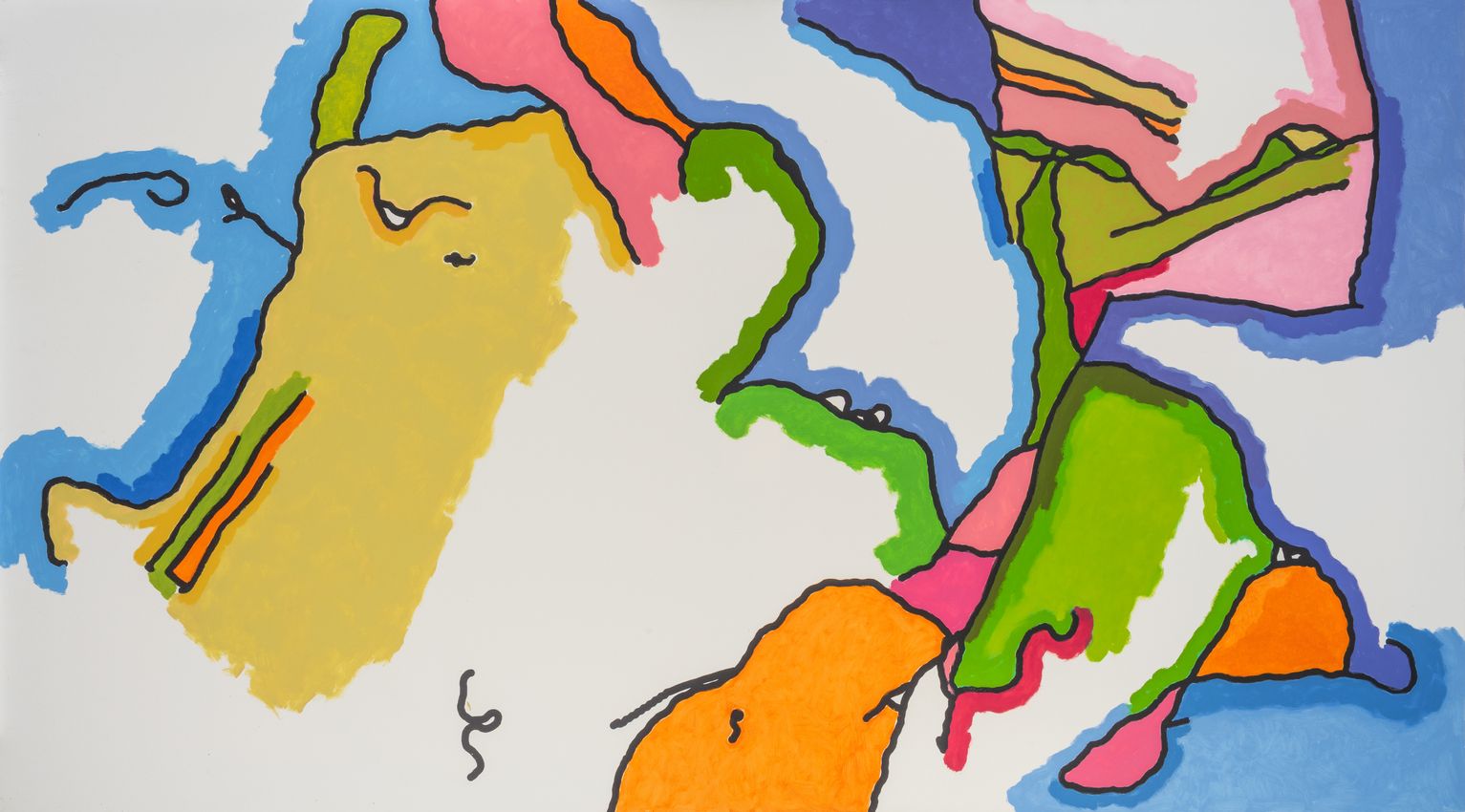
Gazelli Art House marks their worldwide representation of the Harold Cohen Estate by announcing the UK’s first AARON-focused solo exhibition, spanning four decades of Cohen’s influential machine work.Moving through the 1970s until the artist’s passing in 2016, displayed works will elucidate the ways in whichCohen both noticed and navigated evolving spaces of artistic possibility through the world’s first example ofMeta-Art. The retrospective celebrates Cohen’s appreciation of abstract sensibility, mathematical discipline,and creativity as arising once ‘the individual starts to question the unquestioned assumptions of his field.’

Now, AI technology is almost inseparable from our everyday lives, subconsciously driving many of our actions with once unthinkable sophistication. AI’s understanding of human complexity has been a vast project, withthe early work of Cohen and his peers playing a crucial role in its evolution. Thus, _The AARON Retrospective_serves as a lens through which to recognise how artists of Cohen’s era laid the necessary foundations for ourcontemporary AI landscape.

In 1968, Cohen relocated to the U.S. as a visiting lecturer at the University of California, San Diego. On this transition, Pamela McCorduck — author of ‘AARON’s Code’ — claims Cohen entered a ‘spiritualand geographical wilderness’ that radically shifted his practice. Here he marked his entry into the worldof computer-generated art with the code-controlled Turtle drawing machines. The output, alongside aprototype, will be displayed this autumn.

From what eponymously became his ‘Turtle Era’, Cohen delved into a life-defining exploration and dialogue with AI technology. Reflecting upon his shift, he explained: ‘it is characteristic of our culture both that wesearch out things to satisfy current needs, and also that we restate our needs in terms of the new things wehave found.’

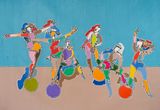
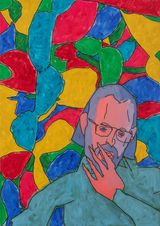
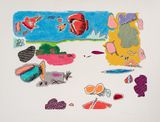
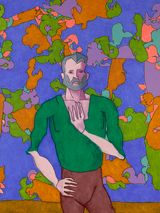
Most notably, Cohen proceeded to create AARON as ‘the first profound connection between art and computer technology.’ With a career evolving during a pivotal development period, the artist refined hispractice at the intersection of artificial intelligence and abstraction. Crucially, in exhibiting pieces fromsuch a broad timeline, works such as Untitled Amsterdam Suite 11 (1977), First Athletes, Athlete Series (1986), Jerry(1992), and First Sighting (2012) have been carefully curated to depict each decade’s level of machine learning.In chronologically locating Cohen’s work, the exhibition becomes a window into the current technologicalpopular cultural focus on AI.

Into the early 2000s, digital increasingly assumed a role within the global art landscape; Cohen redirected his focus again. This time taking a more analogue path in designing new painting brushes and pens, shiftingautonomy away from the computer in the later years of his life.

The AARON Retrospective at Gazelli Art House salutes the colour and movement that characterised both Cohen’s life and artistic career in myriad ways, namely through AARON. Although quietly, computer developmentdisruptively ‘brought with it a cultural revolution of massive proportions.’ Carrying experimental colour workinspired by abstract expressionism across the Atlantic, through his transition from painting to programmingalong the global tide of technological change, Cohen’s subversive work charts a unique period of artisticdevelopment alongside rapid digitisation.

‘By bringing this important selection of AARON work to the UK, we are excited to see the reinstatement of Cohen’s position as the forefather of computer art. Our relationship to the estate reinforces the gallery’scommitment towards revisiting historical movements and towards digital art, and we are thrilled to be able tomerge the two in this fascinating reveal of Cohen’s lifelong research.’ — Mila Askarova, CEO & Founder of Gazelli Art House

Harold Cohen (1928–2016) was a British artist whose innovations at the forefront of technology changed the face of computer art. Unfolding where art and artificial intelligence intersect, Cohen’s artistic practice waspunctuated by his famed invention of AARON, a computer programme designed to create art independently.Cohen’s work attracted global attention and was exhibited at major institutions such as Tate London andSFMOMA.

Having graduated from Slade School of Fine Art, Cohen’s first solo exhibition was held at Ashmolean Musuem, Oxford in 1951. Further solo shows followed, including at Whitechapel Gallery in 1965. Cohen represented theUK at the 1966 Venice Biennale, Documenta III, the Paris Biennale, and the Carnegie International.

Cohen relocated to the United States as a visiting lecturer at the University of California, San Diego, in 1968. It would be almost three decades Cohen remained at UC San Diego as professor, chairman of the Visual ArtsDepartment and eventually in 1992, director of the Centre for Research in Computing and the Arts. Duringthis time Cohen began work on AARON, a venture to which he would devote the next five decades, instigatingnew areas of study and pioneering generative art.

After his retirement from UCSD he continued to work on AARON and produce new artwork in his studio in Encinitas, California. In 2014, Cohen received the ACM SIGGRAPH Distinguished Artist Award for LifetimeAchievement in Digital Art.

Read More
About the Artist

Harold Cohen (1928–2016) was a British artist whose innovations at the forefront of technology changed the face of computer art. Unfolding where art and artificial intelligence intersect, Cohen’s artistic practice was punctuated by his famed invention of AARON, a computer programme designed to create art independently. Cohen’s work attracted global attention and was exhibited at major institutions such as Tate London and SFMOMA.

View Artist Profile

Also Exhibiting at Gazelli Art House

About the Gallery
Contemporary art gallery Gazelli Art House supports and presents a wide range of international artists, presenting a broad and critically acclaimed program of exhibitions to a diverse audience through international exhibition spaces in London and Baku. Gazelli Art House was founded in 2003 in Baku, Azerbaijan where it held exhibitions with Azeri artists. After hosting conceptually interlinked off-site exhibitions across London, founder and Director of Gazelli Art House, Mila Askarova, opened a permanent space on Dover Street, London in March 2012. As part of Gazelli Art House’s on-going commitment to art education, the gallery hosts a series of events and talks to run alongside each exhibition.
View Gallery Profile
Address
39 Dover Street
London
United Kingdom
Opening Hours
Monday – Friday
10am – 6pm
Saturday
11am – 7pm
(1)
London 39 Dover Street
Gazelli Art House
39 Dover Street, London, United Kingdom

Opening hours
Monday – Friday
10am – 6pm
Saturday
11am – 7pm
The art world in focus