


The art world in focus
Subscribe to our newsletter for news and insights on artists, galleries and exhibitions.

Installation view: Ryan Huggins at Frieze London, a. SQUIRE. Courtesy the artist and a. SQUIRE, London. Photo: Michael Brzezinski.
Each year, Frieze Focus brings together young galleries and emerging artists, offering a space for discourse between generations and allowing them, as Frieze London director Eva Langret recently put it, to help “shape what comes next”.
With all participating galleries founded within the past 12 years, Focus promises youthfulness and an opportunity for refreshingly daring energy, especially when set against the tried-and-tested, commercially driven—and often more conservative—approaches of its blue-chip neighbours. At this year’s fair, which welcomes 35 galleries from 17 countries, the section delivers on its promise of experimentation.
Several booths focus on aspects of contemporary sexuality, and how it is shaped, nurtured and defined by spaces and communities. Working in a post-digital era, artists Ella Fleck, Laurie Smith and Ryan Huggins insist that while such spaces are in flux, their defining elements remain: desire, community and labour.
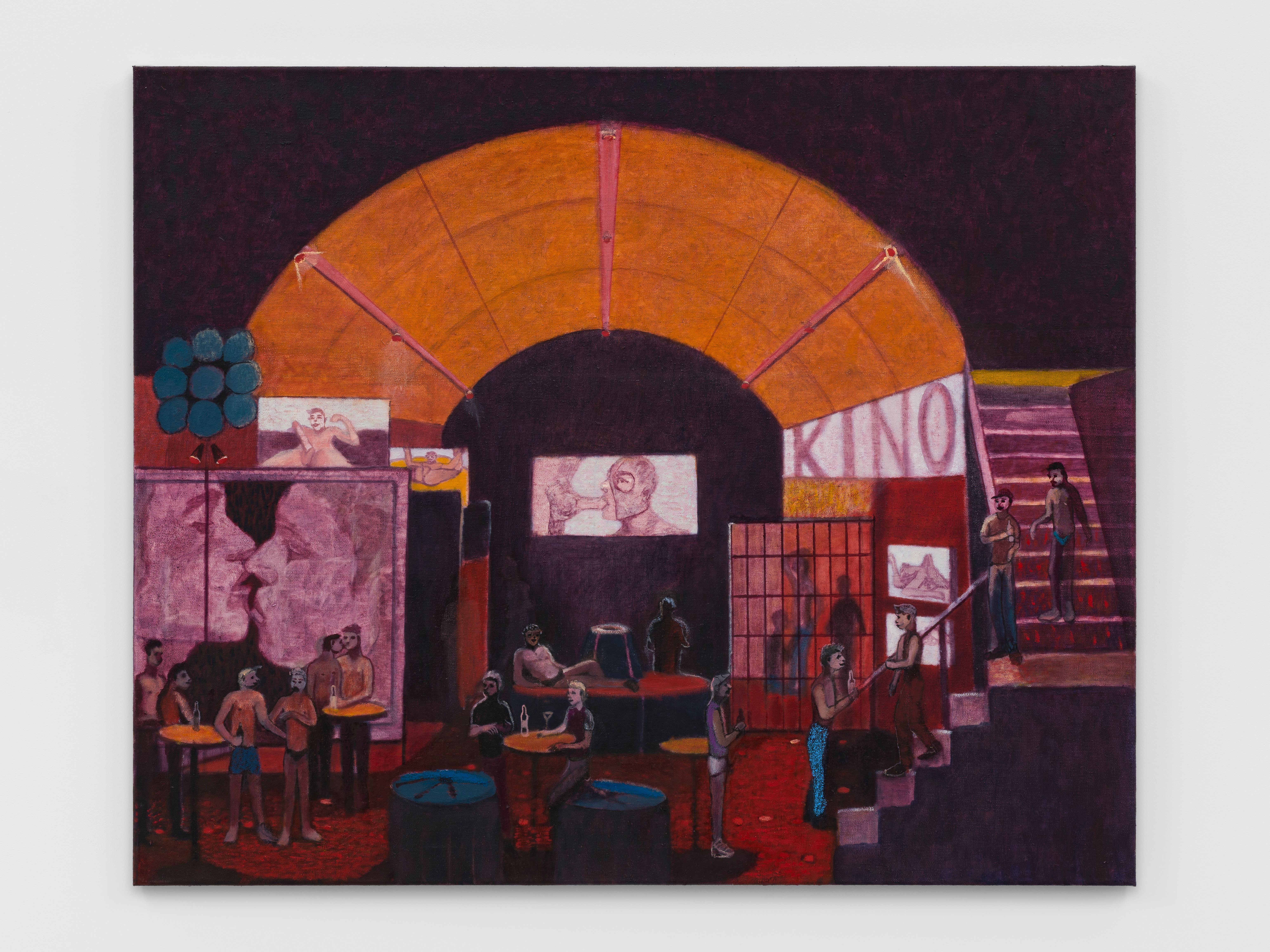
At a. Squire, four Formica cubicles are arranged in a grid layout, effectively obscuring the booth’s works from the fair’s thronging crowds. It is only on entering the structure that Ryan Huggins’ four paintings are revealed, each of them presenting the explicit interiors of one of Germany’s “sex kinos”—erotic cinemas in which visitors can both watch sex on the big screen, and also engage in it, if they choose.
Huggins’ detailed work rewards close looking, with many figures (in various states of undress) for the viewer to consider. Thanks to his installation’s padded benches and partition walls, this can be done in semi-privacy—although, of course, there is nothing truly intimate about an overcrowded fair tent.
Huggins was born and raised in Trinidad, where male homosexuality remains illegal. After moving to Berlin during his twenties, the sudden availability of cruising bars and sex kinos was a welcome shock to the system. “I’m a late bloomer and a relative newcomer to this underground scene,” he told Ocula, explaining his interest “in the borderlessness and nonconformity of encounters made possible by these places.”
As depicted by Huggins, Germany’s kinos are vibrant spaces of community and pleasure that refuse the fate of many other pornographic establishments: closure following pressure from developers, and declining visitor numbers thanks to online content. As the artist’s Frieze presentation declares: “These spaces not only still exist, but are thriving too.”
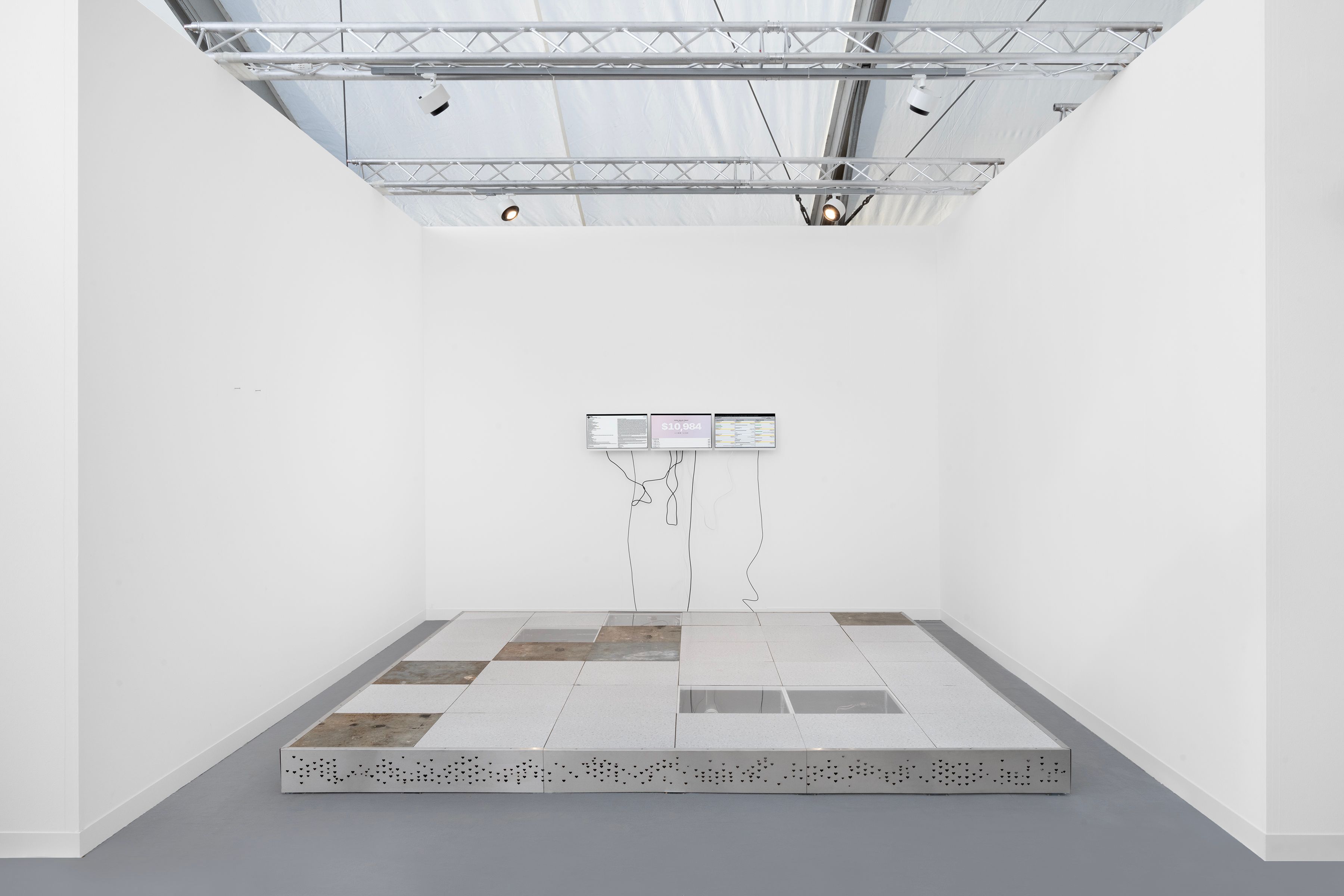
A few booths down from a. Squire, at Ehrlich Steinberg we encounter Ella Fleck—or rather, Elliot, a digital pseudonym assumed by the artist while researching her work, training material (aria) (2026). It is under this alias that the London-based Fleck trained as an OnlyFans “chatter”, learning to message subscribers on behalf of (mostly female) creators of explicit content.
In Ehrlich Steinberg’s booth, this research materialises as an immersive installation, prompting visitors to engage directly with scripted dirty talk—ranging from the mildly arousing to the frankly abhorrent. First-day crowds did so eagerly, stepping on to an industrially tiled platform floor from which they could listen to a cacophonous choir of chatter voices.
Fleck’s presentation gives physical form to the intangible pornographic mega-structure behind the digital interface of OnlyFans, investigating how ostensibly immaterial spaces give birth to whole new economies of labour. Enveloped in Fleck’s pheromone-infused scent, listening to heterosexual male fantasies, any presumed divide between the physical and the digital is dissolved.
As the artist, and winner of this year’s Camden Art Centre Emerging Artist Award, told Ocula: “You can feel all these intense things like love or arousal or sadness or deep connection whilst sitting alone in your room or the Tube.” Or, it would seem, at an art fair.
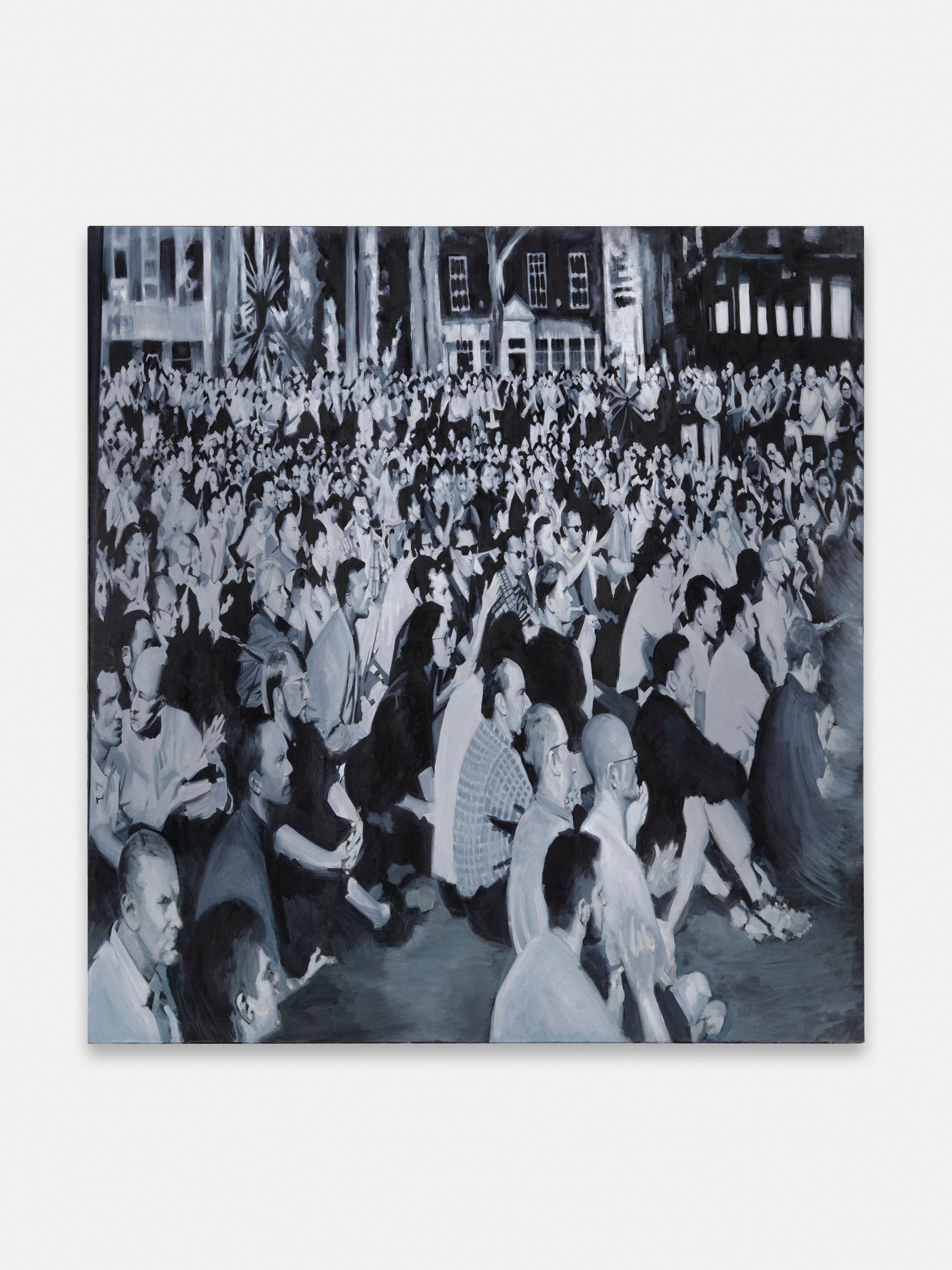
Elsewhere, at the booth of Warsaw-founded Galeria Wschód, London-based painter Laurie Smith navigates queer history, with a particular focus on the urban spaces in which it unfolded.
The artist’s earlier projects have explored historic cruising sites—now largely eroded by the sanitisation of public life—and The Gemini Club, a gay nightclub in his hometown of Huddersfield, which closed in 1983 following years of police raids. The subject of Smith’s presentation at Frieze, however, still stands.
In 1999, The Admiral Duncan, a gay pub in the heart of London’s Soho, became the target of a homophobic nail-bomb attack that killed three people and injured more than 70. Drawing on archival photographs, Smith’s presentation, as the artist told Ocula, questions “what survives, what becomes inaccessible, and who is willing to look” after such an event.
However, the site itself remains conspicuously absent from Smith’s paintings. In The Vigil (2026), the booth’s most striking work, acquired by the Arts Council Collection this week, the artist instead depicts the crowds gathered to commemorate those killed and affected—too many mourners, it seems, to be held in by the frame.
Meanwhile, just a mile away from Frieze, The Admiral Duncan remains open. Although, as Smith observed, “Maybe everyone in there is just sat on Grindr.”
A respected voice in contemporary art discourse.
Focusing on ambitious storytelling and insightful art-world commentary. Ocula Magazine publishes in-depth interviews, critical essays and timely analysis on the artists, exhibitions and ideas driving the global art world.
Learn more about Ocula Magazine
Showcasing the best of the art world.
Ocula partners with galleries from around the world to highlight their artists, artworks and exhibitions. Gallery membership is by application and invitation, with each member vetted by an independent panel.
Learn more about Ocula Membership
Specialises in the sale of major artworks.
Led by a team with deep ties to the world’s leading auction houses, galleries and collectors. Ocula’s advisory team offers bespoke services to high-net-worth clients from around the world who are looking to acquire the best of contemporary and modern art.
Learn more about our team and services