



Gomide&Co is pleased to present Alexandre da Cunha — Dudi Maia Rosa, an exhibition that brings together two practices which, while grounded in distinct procedures, share a deep engagement with materiality and with the transformative potential of industrial materials.
The exhibition opens at the gallery on April 9 (Thursday), at 6 pm, and remains on view through May 23. The accompanying text is by art critic and independent curator Fernanda Morse.
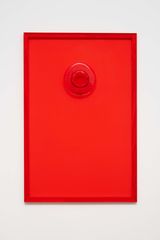
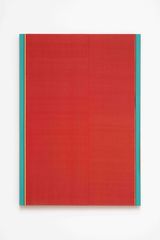
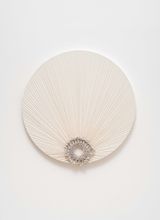
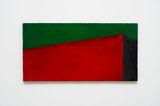
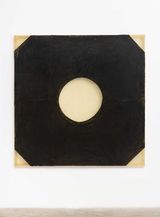
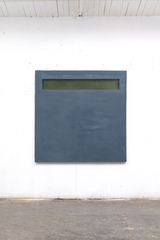
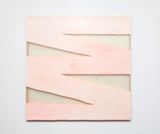
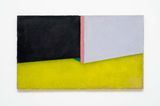
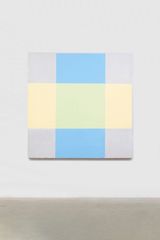
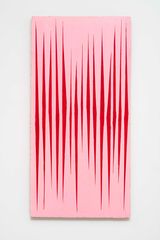
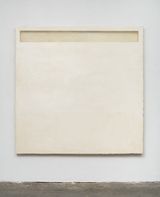
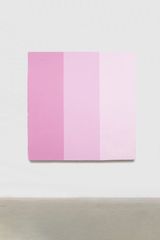
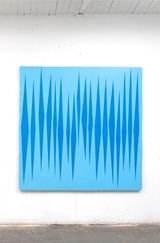
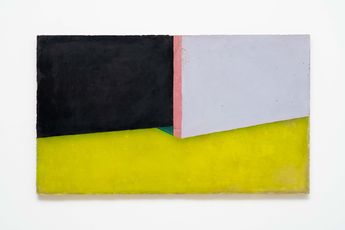
Since the 1980s, Dudi Maia Rosa (São Paulo, 1946) has developed a singular body of work that challenges the traditional boundaries of painting. Using polyester resin and fiberglass, the artist creates surfaces that are at times translucent and at others opaque, in which colour, structure, and support emerge simultaneously. Unlike conventional painting, in which the image is applied onto a pre-existing surface, in his works the pictorial material itself constitutes the body of the work.
The process begins with the resin still in its liquid state—transparent and capable of being pigmented—applied in successive layers that, once catalysed, incorporate pigments, textures, and traces of the making process itself, recording thermal variations, possible irregularities from the mould, and decisions taken during execution. Onto this already hardened surface, the artist lays fibreglass, which fuses structurally with the painted layer, forming a resistant laminate. Colour and structure thus become inseparable: the same material that defines tonality also determines the thickness, weight, and consistency of the work.
Although installed on the wall, these works depart from the planar logic of traditional painting. The thickness of the sheets and the possibility of cutting, sawing, or recomposing the elements give the works a physical presence that brings painting and sculpture into close proximity. The artist himself describes this procedure as a form of ‘expanded painting,’ in which the pictorial surface asserts itself as both object and field of material experimentation.
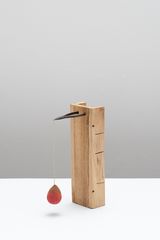
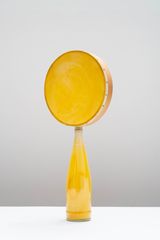
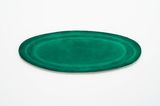
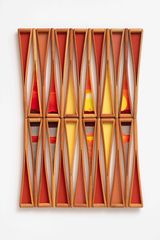
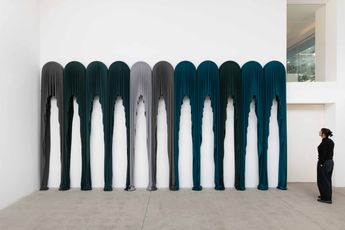
In turn, the practice of Alexandre da Cunha (Rio de Janeiro, 1969) is likewise grounded in a direct encounter with matter, though through a different approach. In his process, objects and fragments of material culture—often found in the urban environment—are brought together as part of a process of selecting and combining elements. By bringing disparate materials into relation, the artist explores tensions, weight, and balance as the sculptural configuration takes shape.
Rather than radically transforming materials, Da Cunha often works through juxtaposition, reorganising objects drawn from broad circuits of production and circulation—household utensils, industrial materials, or globally distributed consumer goods. Such objects carry with them histories of manufacture, use, and discard. Once displaced from their original contexts, they begin to operate simultaneously as carriers of memory and as sculptural forms in a broader sense.
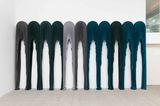
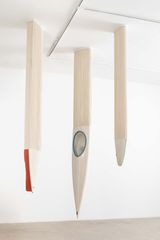
For the exhibition, the artist presents two modular sculptures conceived especially for the gallery space. In one of them, segments of kayaks—made of fibreglass—are reorganised within the exhibition space, converting an object of utilitarian origin into a sculptural composition of strong formal presence. The second work consists of a sequence of arches constructed from tires and polyester mesh, whose arrangement evokes both architectural structures and ordinary materials associated with urban environments.
In another gallery space, independent of the exhibition, visitors will also encounter a group of sculptures from his well-known ‘ikebana’ series, which highlights the artist’s interest in arrangements in which different objects are held together within a logic that is at once formal and intuitive. The artist also notes that many of his sculptures stem from concerns close to those of painting, particularly with regard to the organisation of colour, rhythm, and composition in space.
Reflecting on the encounter between the two artists in the exhibition, Alexandre da Cunha acknowledges the importance that artists from Dudi Maia Rosa’s generation had in shaping his own artistic vocabulary. According to him, it was a group that worked with remarkable freedom in relation to the disciplinary boundaries of painting and sculpture: ‘Dudi is part of a generation that had quite an influence on my practice at a certain moment. These artists did something very courageous. In Dudi’s case even more so, because there’s an enormous sense of freedom in his work.’ Da Cunha highlights in particular the fluidity with which the artist moves across different scales and formal configurations.
For his part, Maia Rosa observes in the work of artists such as Alexandre da Cunha a significant shift in the relationship with matter and with everyday objects, in which elements drawn from contemporary material culture are reorganised into compositions that retain something of their origin while acquiring new formal qualities.
When asked about the initially unexpected proposal of bringing their respective practices into dialogue, both artists note that the proximity between the works makes it possible to perceive relationships that might not be immediately evident. Within the exhibition, works developed through distinct procedures begin to reveal unexpected formal and material correspondences.
Despite their differences in language, the encounter between the two artists reveals important affinities. In both Dudi Maia Rosa’s ‘object-paintings’ and Alexandre da Cunha’s ‘pictorial sculptures,’ materials associated with the industrial sphere—such as plastics, resins, and synthetic fibres—play a central role in the construction of the work. In each case, these elements are displaced from their habitual contexts and reinserted into new relationships between form, space, and perception, demonstrating how experimentation with matter can expand the traditional boundaries of painting and sculpture.
Gomide&Co would like to thank the galleries Almeida & Dale, representing Dudi Maia Rosa, and Luisa Strina, representing Alexandre da Cunha, for their support of this exhibition.

A respected voice in contemporary art discourse.
Focusing on ambitious storytelling and insightful art-world commentary. Ocula Magazine publishes in-depth interviews, critical essays and timely analysis on the artists, exhibitions and ideas driving the global art world.
Learn more about Ocula Magazine
Showcasing the best of the art world.
Ocula partners with galleries from around the world to highlight their artists, artworks and exhibitions. Gallery membership is by application and invitation, with each member vetted by an independent panel.
Learn more about Ocula Membership

Specialises in the sale of major artworks.
Led by a team with deep ties to the world’s leading auction houses, galleries and collectors. Ocula’s advisory team offers bespoke services to high-net-worth clients from around the world who are looking to acquire the best of contemporary and modern art.
Learn more about our team and services