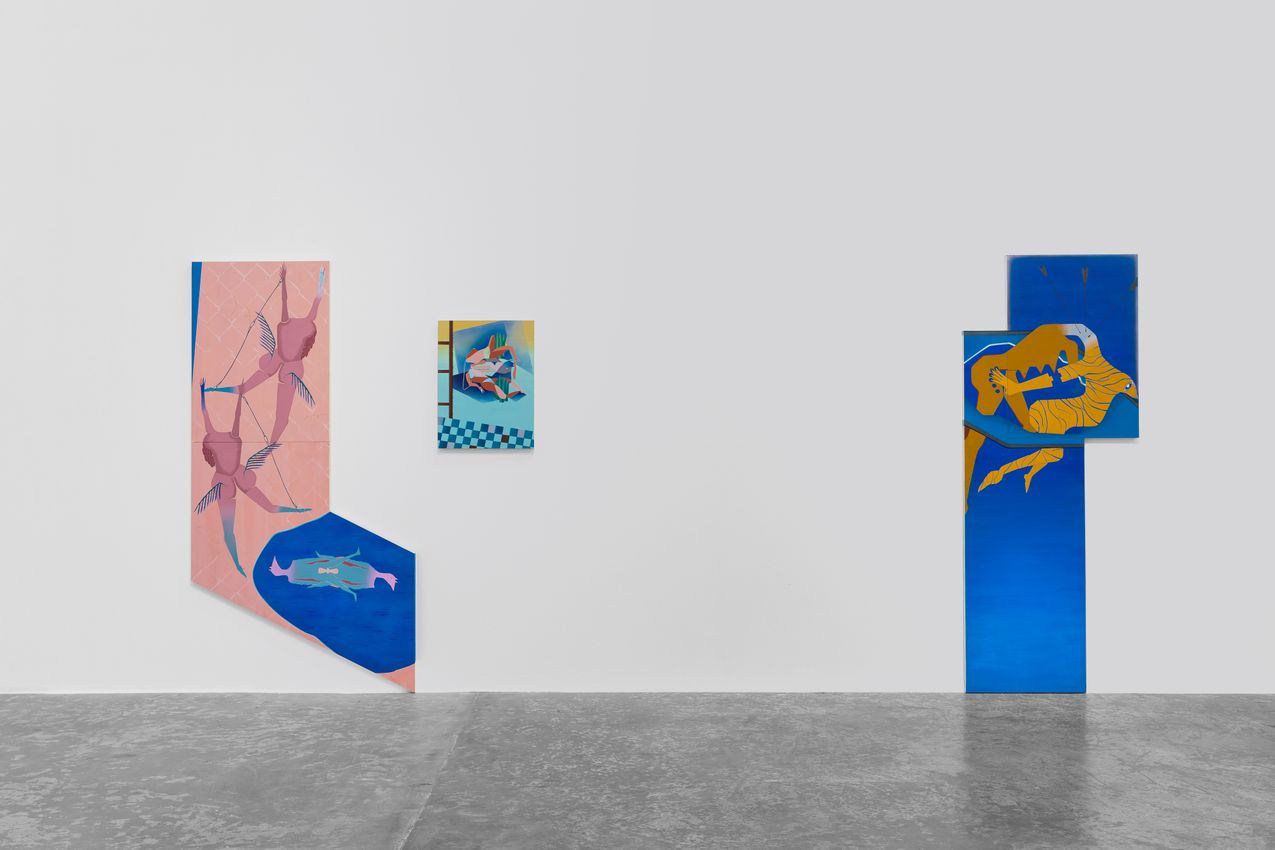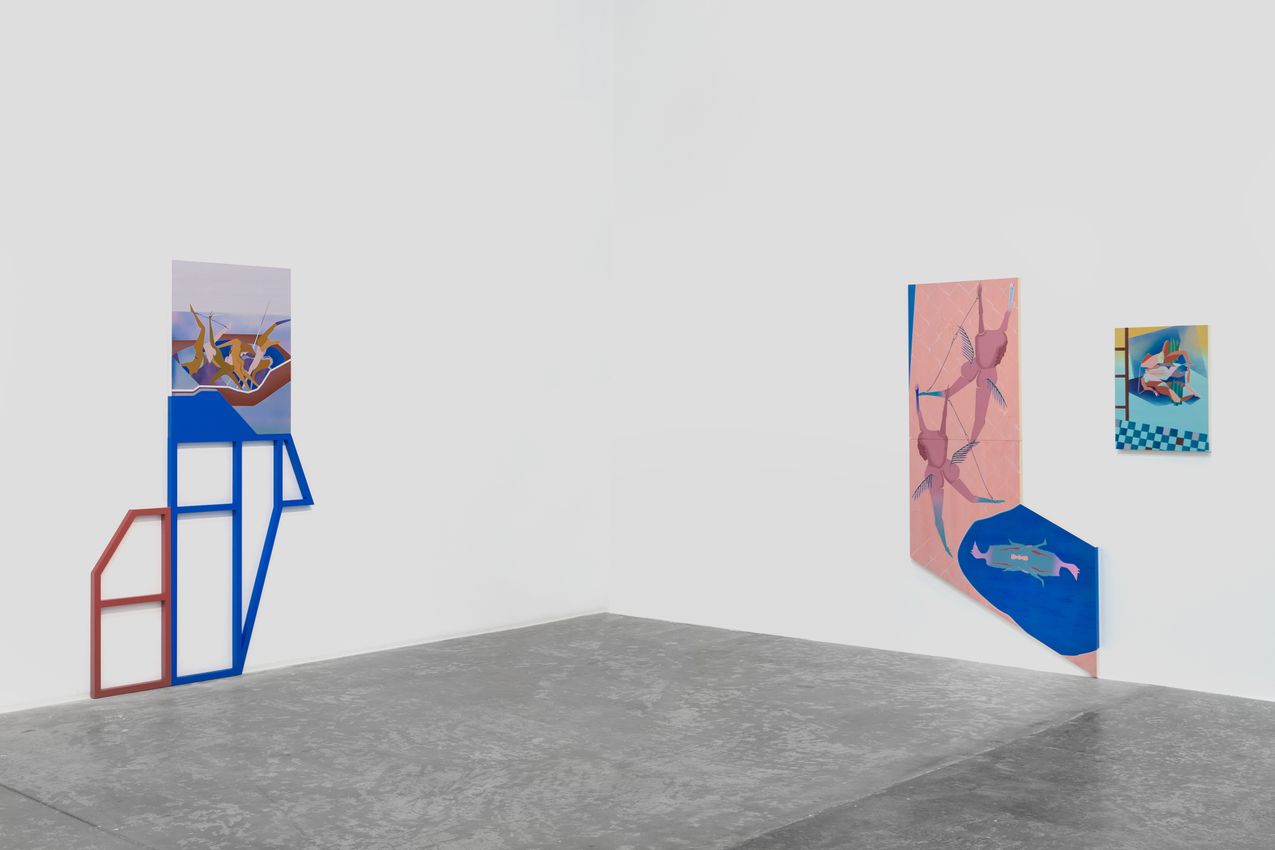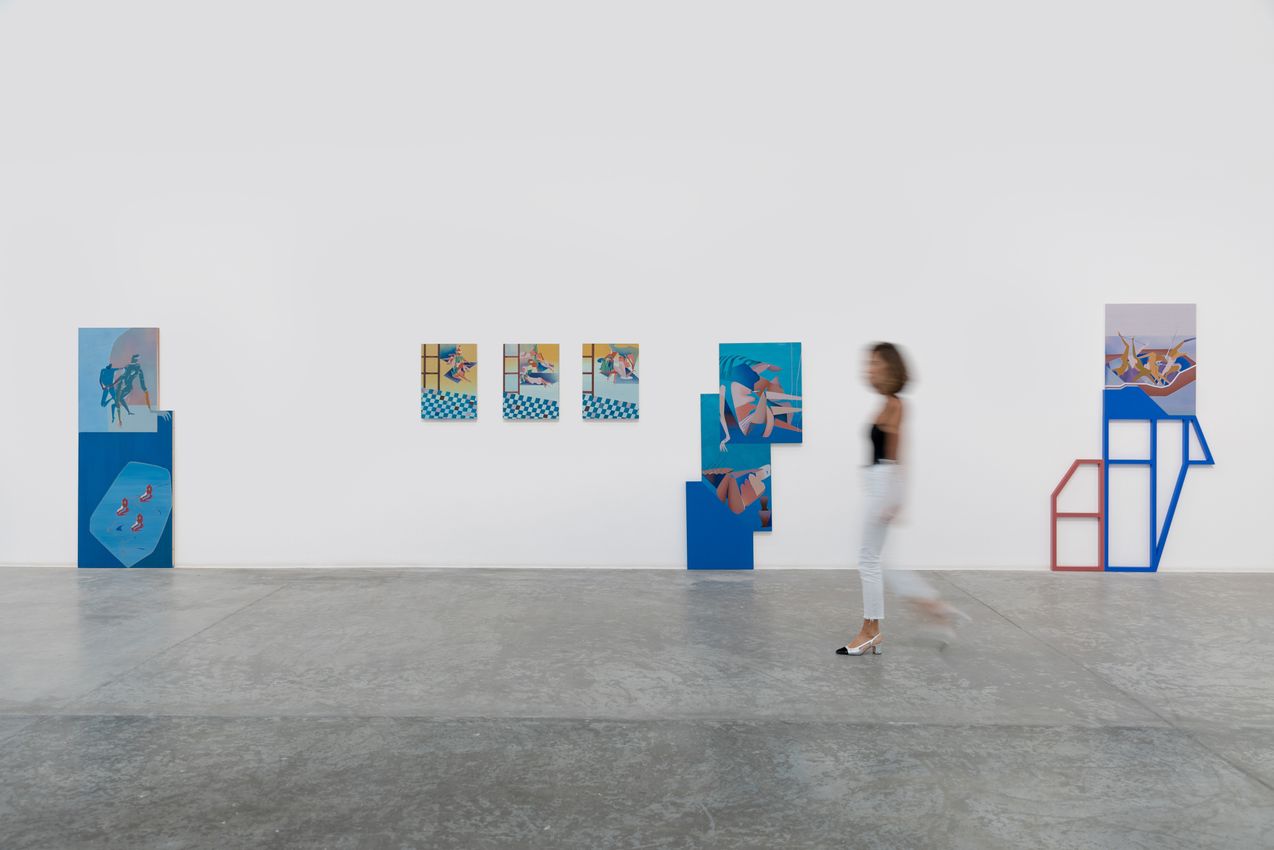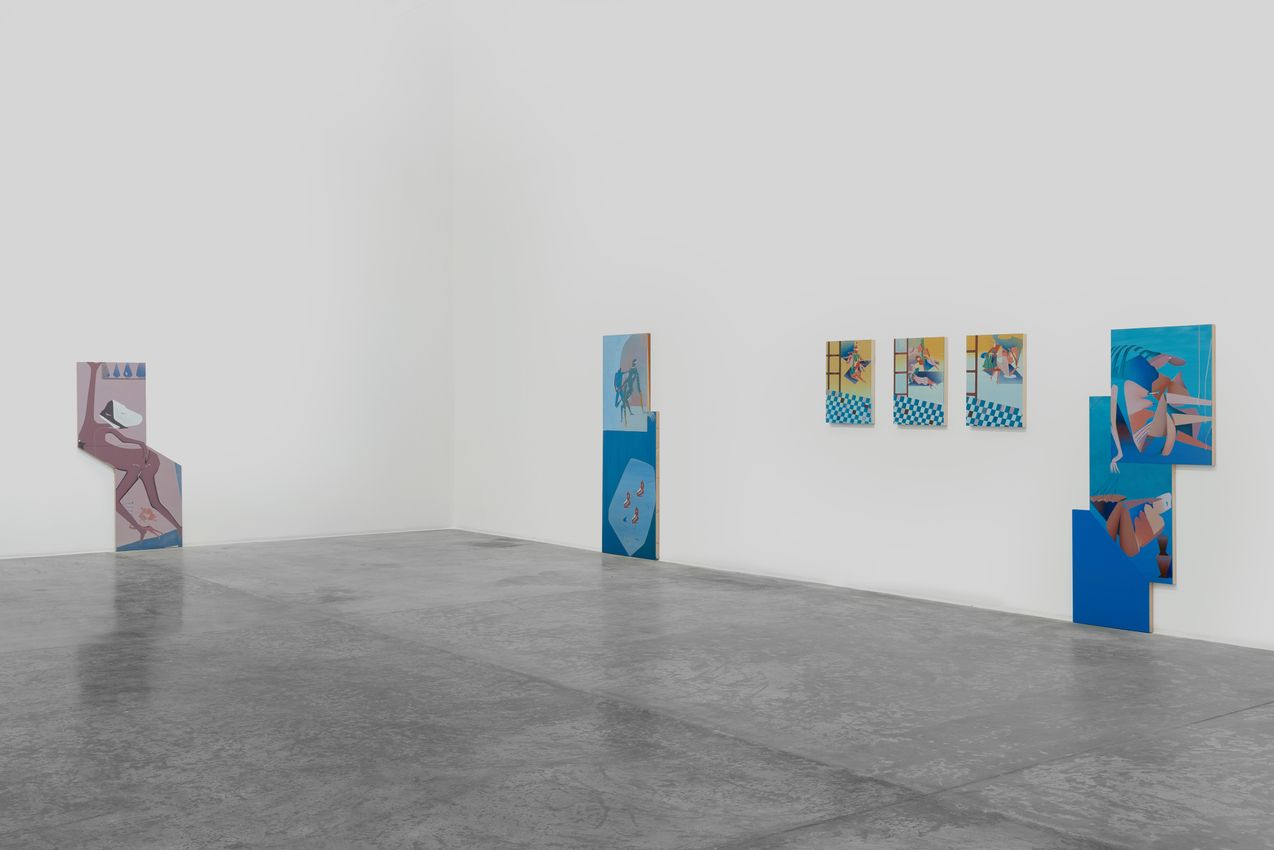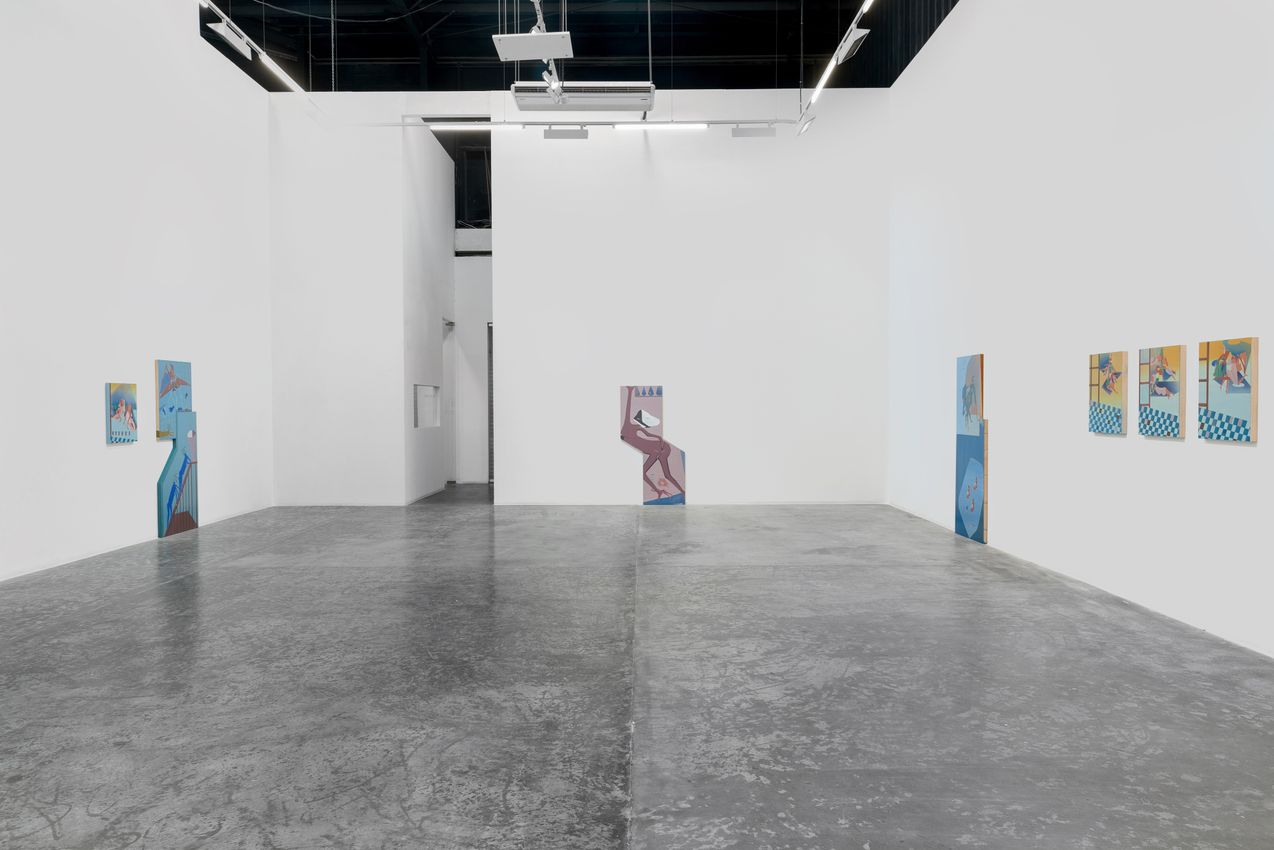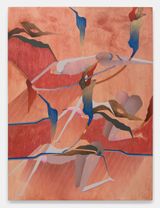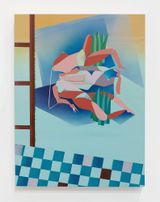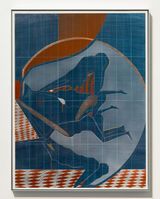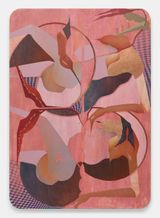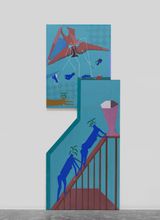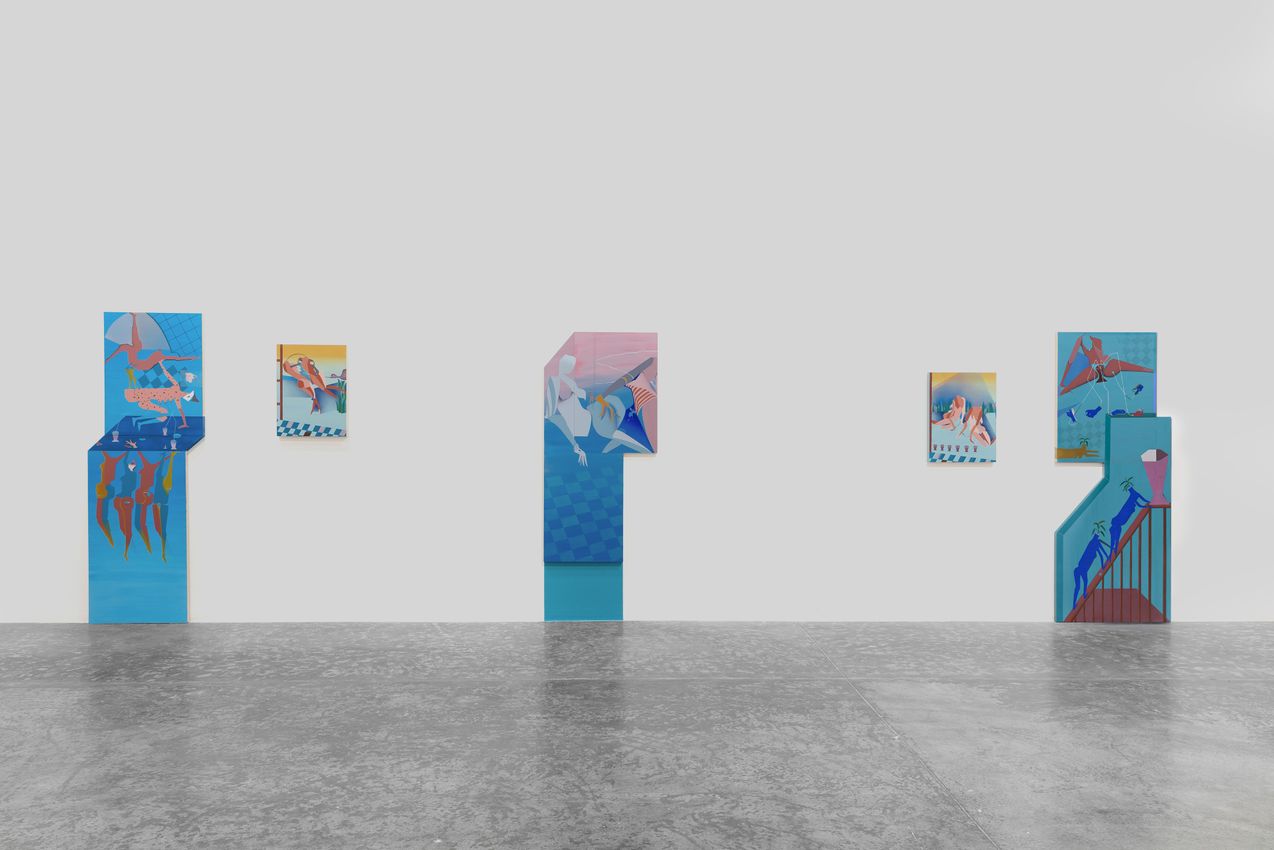
In her first solo exhibition at the gallery, New York-based Iranian artist Maryam Hoseini presents paintings on geometrically shaped, vertically oriented panels that draw the viewer into these abstract containers. Within these spaces, Hoseini’s equally abstracted figures—cast between the human and the animal—contest their confinement, displacement, and subjugation.
Hoseini’s dramaturgical plotting of space, both in the composition of the paintings and in their placement in the gallery, yields dreamscapes where bodies float between abstraction and figuration. The large panels simultaneously evoke the shapes of abstracted human forms and familiar architectures, while the shadows cast against the walls highlight the theatricality and fluidity in their relationship to the viewer. One becomes strangely body-conscious encountering the work—simultaneously connecting to the human scale of the panels while being alienated by the flatness of their surfaces.
A sequence of small-scale paintings elaborates on the oneiric experience of this spatial encounter. It begins with an abstracted architecture in which a checkered floor is legible but other elements are vaguely defined, and Hoseini’s signature warped bodies are set at a distance in a landscape. As the sequence progresses, the perspective of each successive painting gradually recedes to reveal more of the architecture while the figures diminish. As we study each painting, the effect is one of sharing our position as viewers with a ghostly third-person observer within the space of the paintings themselves—a voyeuristic experience of looking and being looked at as the definition of inside and outside shift.
This shifting of perspectival space within the paintings has implications on notions of historical time. As history is abstracted from its linear narratives, the landscapes and architecture depicted in the paintings hint at possible futures that evolve without the support of a coherent present, instead rising out of the cyclical ruins of the past. Some of Hoseini’s hybrid figures appear headless in their scenes; others exceed the scale of the picture plane. Each contests the workings of power that would control them: though many coyly retain gendered characteristics, the headless figures resist a narrative reading that would determine their possibilities along the lines of identity; the large-scale figures burst out of the spatial bounds of their confinement. The paintings resist the gravity that would tether them to the past and hamper their visions of alternate futures. In the shifting terrain of these quasi-visionary realms, we meet the physicality of these paintings, at once defined by their material conditions and set free by the imagination the material forms contain.
In their work, Maryam Hoseini explores the concept of ruins in a politicized social space. Hoseini captures empty historical echoes as bodies walk among the literal and figurative, the visible and invisible ruins of objects and architectures. In the context of the censored female figure, Hoseini presents their subjects as nude, cast simultaneously as unrealistically flattened diagrams of the human body, and hyperrealistic disembodied limbs covered in hair. Their recent work is made up of multiple fragments, strategically balanced upon one another and anchored into the wall behind at a single point, where they build their ongoing curiosity in space and sequence as a formula for a narrative where they confront their viewers’ perception, preoccupation, and projections of identity. These interjections within the gallery’s white cube serve as a way in which the artist rebuilds and elevates these fractured stories, now sturdily supported with weighted columns of opaque color.
Green Art Gallery is a contemporary art space featuring a multi-generational mix of artists whose practices are rigorously researched, idea-led, and representative of our current moment. The gallery now represents a multi-generational mix of artists from the Middle East, North Africa, South Asia and beyond, including Turkish artists Hale Tenger and Hera Büyüktaşcıyan; Iranian artists Kamrooz Aram and Nazgol Ansarinia; and Shadi Habib Allah, Seher Shah, and Alessandro Balteo-Yazbeck, who are Palestinian, Pakistani and Venezuelan respectively. In this geographic mix, the gallery reflects Dubai’s position as a cosmopolitan—as well as artistic—entrepôt, even as it boasts of a strong parallel Arab Modernist program.

A respected voice in contemporary art discourse.
Focusing on ambitious storytelling and insightful art-world commentary. Ocula Magazine publishes in-depth interviews, critical essays and timely analysis on the artists, exhibitions and ideas driving the global art world.
Learn more about Ocula Magazine
Showcasing the best of the art world.
Ocula partners with galleries from around the world to highlight their artists, artworks and exhibitions. Gallery membership is by application and invitation, with each member vetted by an independent panel.
Learn more about Ocula Membership

Specialises in the sale of major artworks.
Led by a team with deep ties to the world’s leading auction houses, galleries and collectors. Ocula’s advisory team offers bespoke services to high-net-worth clients from around the world who are looking to acquire the best of contemporary and modern art.
Learn more about our team and services