Press Release

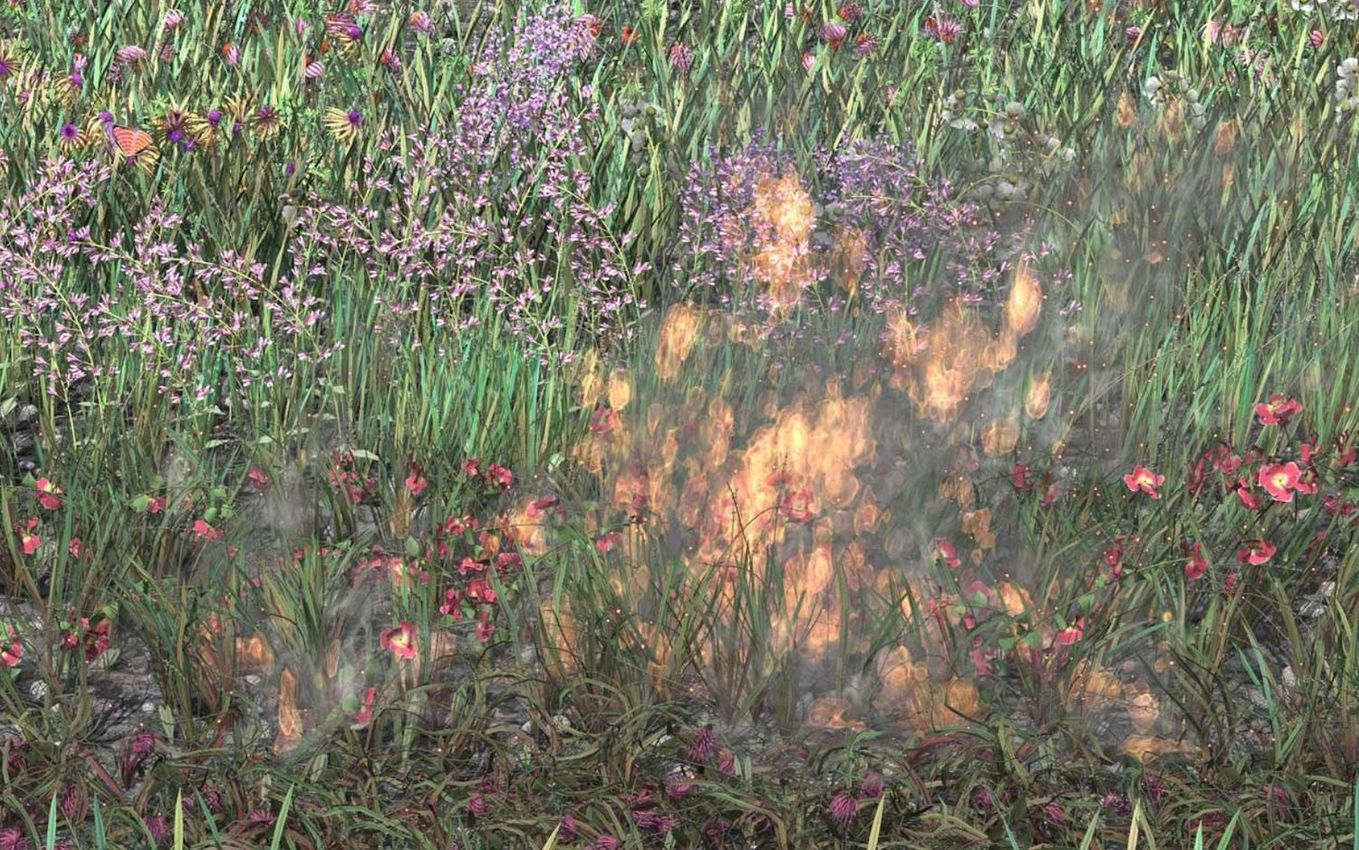
Lehmann Maupin announces In Focus: Jennifer Steinkamp, a presentation featuring one of the Los Angeles-based artist’s newest works, Renewal 2. After recognising the incredible potential of computer animation in the early 1980s, Jennifer Steinkamp began working exclusively in digital media and has created an expansive body of work spanning the last 30 years. A pioneer in the field of 3D animation, Steinkamp uses cutting-edge technology to render abstract and representational forms in motion, including organic forms such as trees, flowers, floating fabrics, rocks, fruit, and primordial organisms. Her works are often displayed as site-specific projections, and she actively engages architectural features, transfiguring existing spaces while simultaneously allowing these sites to transform her own installation. For In Focus: Jennifer Steinkamp the gallery will present Renewal 2, a panoramic projection that depicts a burning prairie native to the Midwestern United States. This new body of work stems from Steinkamp’s research of pre-settlement prairies native to Missouri for a site specific commission with Commerce Bank in St. Louis, which will be unveiled in 2023. The exhibition will be on view at Lehmann Maupin’s New York location from November 10, 2022–January 7, 2023.

Steinkamp began creating digital animations and projections in 1989, with her now famous Gender Specific, which was shown simultaneously at the artist-run Bliss House in Pasadena and the Santa Monica Museum of Art in Southern California. Her work remained largely abstract for over a decade, and she created numerous installations and projection pieces that explored vision and perspective, audience participation and shadow play, and the limits of 3D animation, computer rendering, and projection technologies. In 2002, Steinkamp created her first work featuring botanicals—a protest against war in a post-9/11 landscape that she titled Jimmy Carter, after the pacifist former president who received a Nobel Peace Prize the same year. She has since continued to employ botanical subjects, including trees that cycle repeatedly through changing seasons, fruits that shift and squash themselves against video displays, and flowers moved by invisible winds that burst apart and then reconstruct themselves in an endless loop.

Despite her shift towards representation, Steinkamp’s work remains firmly non-narrative—the artist’s pieces often consider ideas of cyclical time or ambiguous lifecycles, reflected in her use of the continuous loop. While often beguilingly beautiful, Steinkamp’s work always contains an underlying layer of research and illuminating background material. Intellectually curious, she takes inspiration from a variety of sources—a biography of Madame Curie that describes the flowers the scientist loved, Ronald Reagan’s belated discovery of butterflies after being fitted with glasses in childhood, fossil records of the first multicellular organisms of the Ediacaran Period—giving her work a subtle depth that is felt subconsciously.

In Renewal 2, Steinkamp incorporates a number of species indigenous to pre-settlement prairies, including anemone, thimbleweed, arrowhead, bergamot, bluestem grass, climbing prairie rose, cone flower, cordgrass, heliotrope, lobelia, cardinal flower, sunflower, sweet pea, trout lily, and violet missouriensis. Here, Steinkamp imagines a burning prairie, a phenomenon that occurs sporadically in nature as well as a practice used for thousands of years by Indigenous peoples. Prairie burning is carried out periodically in order to maintain the health and integrity of the prairie landscape, prohibiting the growth of trees and invasive species and returning nutrients to the soil. As fire whips through Steinkamp’s pre-colonial prairie, her animated butterflies float gently across the landscape, remaining unharmed. Here, an apparent act of destruction paradoxically prompts growth and renewal.

Read More
About the Artist

Jennifer Steinkamp (b. 1958, Denver, CO; lives and works in Los Angeles) uses 3-D computer animation and new media to create video installations that activate architectural space and alter phenomenological perception. She designs and digitally simulates movement of organic and abstract forms such as trees, flowers, and floating fabrics. Her works are displayed as site-specific projections that amplify the architectural setting by blurring the boundary between real and illusionistic space. These animated environments, while visually alluring, often carry subtle ominous references such as Daisy Bell, which features an array of beautiful yet poisonous flowers. Time plays a significant role in Steinkamp’s work, often depicting cyclical occurrences such as changing seasons and life cycles. These cycles do not typically have a beginning, middle, or end, but rather are working with non-narrative concepts of change. In this sense, her work is more aligned with artists who prioritised sensorial experience, like James Turrell, Mary Corse, and others of the Light and Space movement of the 1960s, than with film or other such time/media-based art.

View Artist Profile

Also Exhibiting at Lehmann Maupin

About the Gallery

Rachel Lehmann and David Maupin founded Lehmann Maupin in 1996. The gallery represents a diverse range of American artists, as well as artists and estates from across Europe, Asia, Africa, South America, and the Middle East. It has been instrumental in introducing numerous artists from around the world in their first New York exhibitions.

View Gallery Profile
Address
501 West 24th Street
New York
United States
Opening Hours
Tuesday – Saturday
10am – 6pm
(1)
New York 501 West 24th Street
Lehmann Maupin
501 West 24th Street, New York, United States

Opening hours
Tuesday – Saturday
10am – 6pm
The art world in focus