



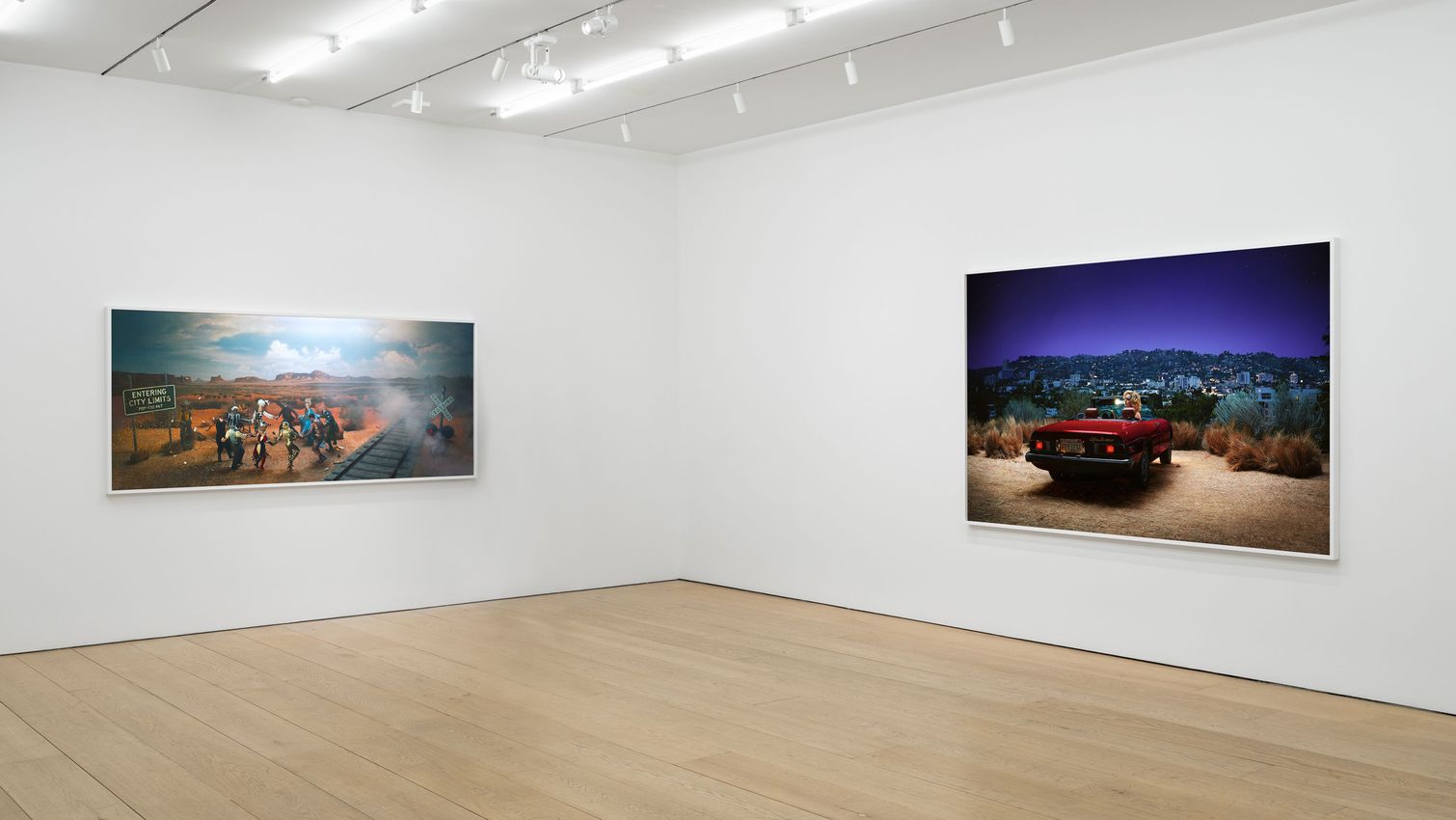
Lehmann Maupin is pleased to present Alex Prager: Matinee, a solo exhibition of new work by Alex Prager in New York. Bringing together four new large-scale photographs, the exhibition positions Los Angeles as both subject and muse, examining the construction of distorted memory and myth-making through the city’s enduring allure and ephemerality. Influenced by artists whose respective portrayals of Los Angeles have profoundly informed contemporary understandings of the city, Prager’s work considers how our perceptions of reality may, in turn, shape what the future becomes. Matinee follows a landmark year for Prager, marked by the premiere of the artist’s feature film, Dreamquil. This exhibition serves as a prelude to Prager’s solo presentation in New York in 2027, which will coincide with a major museum exhibition by the artist, to be announced in the coming months.
Over the last two decades, Prager has developed a multidisciplinary practice characterized by uncanny, surreal images and films that explore the human condition. Working simultaneously across film, photography, and sculpture, Prager constructs highly emotional moments that feel like a fabricated memory or dream. Prager’s work is defined by a distinctive and carefully constructed mise-en-scène, where every element within the frame is created practically and captured physically and entirely in-camera. Her process is intuitive, guided by experimentation, atmosphere, and an instinctive approach to image-making that gives the work its singular visual language.
In this new body of work, Prager continues her exploration of human experience and perception through the landscape, mythology, and cultural history of Los Angeles. Moving beyond the city as a physical place, this new series probes the psychological and cultural undercurrents that have shaped generations of narratives, identities, and entire industries, transcending any singular notion of Los Angeles itself. For Prager, who was born and raised in Los Angeles and continues to work there today, the city has long represented a constant juxtaposition—an environment perpetually suspended in a state of transformation and contradictions. Drawing on historical reference points, the work engages with these perceptual and mind-altering ideas, questioning how reality is constructed while remaining grounded in intimacy and humanity.
Highlights from the exhibition include Bonnie Hill (Overlook), a work that captures the psychologically charged cinematic scenes that have become synonymous with Los Angeles. Like Joan Didion and Ed Ruscha, who used the city of Los Angeles as a subject, Prager’s work captures the city in specific points of time to understand its complexities, position in culture, and its surreal nature. Prager takes this one step further by evoking the city’s mythos through the use of nonlinear time. The overlook is an iconic motif in Los Angeles, where rolling hills cut through the city’s glittering surface to form a kind of constructed memory. The main subject in Bonnie Hill (Overlook) is held in a moment of suspension and ambiguity, drawing the viewer into an unfolding narrative. An underlying eeriness lends a surreal quality, as though the scene exists on the threshold of something about to happen. In Ceremony, Prager celebrates the tradition of theatricality in Hollywood. Here, Prager uses her distinct characters and meticulously planned use of color to create a contemporary renaissance style tableau with multiple viewpoints. In Los Angeles, the ritual of dressing for significant events has become its own form of performance—an extension of the city’s broader culture of image-making. At a moment when established systems are visibly shifting and the future of an industry that sustains much of Los Angeles feels uncertain, the scattered attention of the audience carries new weight and fragility, mirroring our own efforts to seek a path forward.
Matinee emerges as a self-referential series in which Prager employs time and memory as critical devices, collapsing the boundaries between reality and artifice, the sinister and the frivolous. In doing so, Prager’s work reflects a contemporary moment in which these oppositions increasingly feel inseparable within our culture and society.
Alex Prager (b. 1979, Los Angeles; lives and works in Los Angeles) is a photographer and filmmaker who creates elaborately staged scenes that draw inspiration from a wide range of influences and references, including Hollywood cinema, experimental films, popular culture, and street photography. She deliberately casts and stages all of her works, merging past and contemporary sources to create a sense of ambiguity. Her familiar yet uncanny images depict worlds that synthesise fiction and reality. Each photograph captures a moment frozen in time, inviting the viewer to ‘complete the story’ and speculate about the narrative context. Prager’s work often makes the viewer aware of the voyeuristic nature of photography and film, establishing the uneasy feeling of intruding upon a potentially private moment. In her images of both crowds and individuals, she examines conflicting emotions of claustrophobia and isolation, revealing an ominous and perpetual anxiety. The highly choreographed nature of her photographs and films exposes the way images are constructed and consumed in our media-saturated society. This puts her work in direct conversation with artists engaged in the tradition of staged photography, such as Cindy Sherman, Gregory Crewdson, and Thomas Demand.


Rachel Lehmann and David Maupin founded Lehmann Maupin in 1996. The gallery represents a diverse range of American artists, as well as artists and estates from across Europe, Asia, Africa, South America, and the Middle East. It has been instrumental in introducing numerous artists from around the world in their first New York exhibitions.

A respected voice in contemporary art discourse.
Focusing on ambitious storytelling and insightful art-world commentary. Ocula Magazine publishes in-depth interviews, critical essays and timely analysis on the artists, exhibitions and ideas driving the global art world.
Learn more about Ocula Magazine
Showcasing the best of the art world.
Ocula partners with galleries from around the world to highlight their artists, artworks and exhibitions. Gallery membership is by application and invitation, with each member vetted by an independent panel.
Learn more about Ocula Membership

Specialises in the sale of major artworks.
Led by a team with deep ties to the world’s leading auction houses, galleries and collectors. Ocula’s advisory team offers bespoke services to high-net-worth clients from around the world who are looking to acquire the best of contemporary and modern art.
Learn more about our team and services