



Press Release

LINSEED is thrilled to present Well, well, by Antone Liu (b. 1999, Liaoning), at booth 1C33 in the Discoveries section of Art Basel Hong Kong 2026. The exhibition explores paradox and material subversion through hollowed-silk sculptures shaped by heritage, folklore, and identity. A poetic mirroring of a well and a visual analysis of voids, in which belonging is in perpetual flux, and visibility remains an aspiration.

Being comes into existence as an exact function of this lack.1

In his pursuit of monumental quietude, Liu orchestrates a paradox. Between soft and rigid, light and weight, transplant and harvest, he compels traditional materials to abandon their usual forms and functions. These intentions are consolidated by a precise hollowness, creating a home for his ghosts to inhabit; for us to see a void and wonder what fills it.

Liu’s evolving studio practice consolidates fashion, sculpture, and painting. Drawing upon Gongbi Painting, Western framing, and cross-stitching, he appropriates traditional techniques into a harmonious language that enables a pivot from using everyday objects to sculpting bespoke armatures.

TO LACK:

STRUCTURE - WRAPPING) + REMOVAL

By orchestrating the abandonment of his chosen materials, Liu exemplifies a paradox. An approach that connects Georges Bataille’s philosophical idea that forms of poetry blend and fuse separate objects, dissolving boundaries between them.2

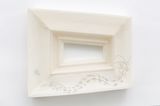
The centerpiece borrows the form of a well. Inside is a graphite drawing of water, providing a poetic mirage.

Liu’s opaque references are anchored in China’s rich history, using the personal as a compass. This trajectory is defined by Kojin Karatani’s “transcritique3, ” an intense parallax produced by the continual movement between distinct positions. Suggesting that a landscape can be discovered only by those who do not turn their gaze outward. The self mirrors a landscape.

This perspective frames Liu’s encounter with the restored Chinese garden in Bethmann Park, Frankfurt as a site of cultural friction; by painting cross-stitched scenes of power in garden ecologies, he depicts the pursuit of visibility within the diaspora. These stories become expansive introspections that interrogate the dangerous trope of nostalgia, asserting that the yearning for visibility is more important than visibility itself.

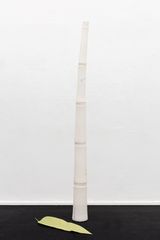
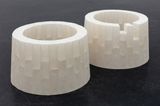
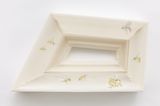
His unyielding sculptures demand an intense process. Silk is subjected to extreme tension over sculptures that are eventually removed, leaving hollow forms that manifest a profound sense of absence. Suspended in a paradox, these empty frames are arranged in a serpentine pattern near a well. A mirage of water, in graphite, offers a quiet reflection of folklore. These subtle traces of intensive labor become a hollowed dwelling for the ghosts Liu leaves behind.

TO ASPIRE:

PROCESS - OUTPUT

Liu desires to be legible and visible, yet refuses it; becoming invisible in the very process of becoming visible. Transforming destination into aspiration. A disidentification is shaped by a diasporic impulse to adapt and compromise, resulting in a practice that prioritizes process over outcome.

The title Well, well operates as a semantic pivot, shifting from a noun of depth to a verbal pause. While the repetition references the folklore and the garden, the phrase also signals tension. Liu seeks the liminality of that tension, a purgatory he desires to inhabit. Between materials and reflections, belonging is always in motion. He constructs a loop, resisting finality and refusing a simple conclusion. This desire for visibility remains a horizon: always in view, yet unreachable.

Well, well demands to be looked at without nostalgia, to be regarded beyond a diasporic memoir. It seeks a delicate, nuanced study of complex desires. Through his artistic practice, Liu asks not to be perceived through what he reveals, but through the way he accepts what he cannot.

References:

1 Lacan, J. (1991). The seminar of Jacques Lacan: Book II. The ego in Freud’s theory and in the technique of psychoanalysis, 1954–1955 (J. -A. Miller, Ed., S. Tomaselli, Trans.). W. W. Norton & Company. (Original work published 1978)

2 Bataille, G. (1986). Erotism: Death and sensuality (M. Dalwood, Trans.). City Lights Books. (Original work published 1957)

3 Karatani, K. (2005). Transcritique: On Kant and Marx (S. Kohso, Trans.). The MIT Press. (Original work published 2003)

Augustine PAREDES | LINSEED Projects

Read More

Also Exhibiting at LINSEED Projects

The art world in focus