



The art world in focus
Subscribe to our newsletter for news and insights on artists, galleries and exhibitions.


Sarah Lucas, Selfish in Bed II, 2000. Courtesy Julia Stoschek Foundation. © The artist.
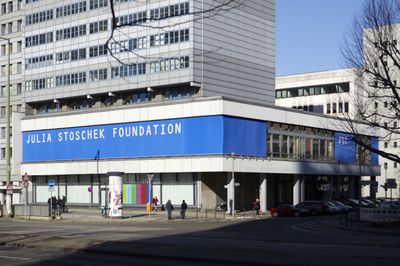
The Julia Stoschek Foundation will reopen its Düsseldorf headquarters next April with Selfish in Bed, an exhibition that considers how we construct our sense of self, image and identity via the narrative framework of what should be our safest space: the bed.
The nonprofit, which is dedicated to the presentation and conservation of time-based art, was established by philanthropist and heiress Julia Stoschek in 2017 and holds a collection of more than 1,000 artworks by around 300 artists. However, it closed its Berlin exhibition space in April for reasons of “strategic realignment”, and its Düsseldorf location has been undergoing refurbishment since April 2025.
Selfish in Bed, an exhibition described by the foundation as being “conceived more as a feeling than a thesis”, takes its starting point from Sarah Lucas’ 2000 self-portrait Selfish in Bed II, and is designed as “a provocation, an attitude of self-determination and an invitation to claim one’s own identity, image and queerness”.
The show hinges on the concept that bed is where we are most intimate with ourselves, but also most likely to be scrolling our phones and absorbing how we see the world, and that a place of rest can also be a place of vulnerability.
It is set to feature 52 works by 43 artists from the Julia Stoschek Collection, spanning the late 1960s to the present day and including pieces being presented by the foundation for the first time. Curated by Krist Gruithuijsen, chief executive of Espoo Museum of Modern Art in Finland, works will include Tracey Emin’s Why I Never Became a Dancer (1985), Wolfgang Tillmans’ Peas (2003) and Hannah Wilke’s Through the Large Glass (1976), as well as pieces by Sturtevant, Ed Atkins, Sophie Calle, Bruce Nauman and Wu Tsang.
“I am a very emotional collector,” said Julia Stoschek. “An artwork has to get under my skin. I need images that stay with me. Over the past 20 years, I’ve built a collection of time-based art… driven by the energy of the works and the artists who create them. From the very beginning, I wanted to share that experience with the public.”
Artworks will be projected onto the space’s newly refurbished glass walls and mirrored surfaces, as well as being shown on screens and TV monitors. A statement announcing the show said that the works will showcase “the breadth of the collection’s holdings and its commitment to feminist and queer perspectives”, while also highlighting the “deeply personal endeavour shaped by Stoschek’s vision, interests, and emotional connection to the works”.
The renovation of the nonprofit’s Düsseldorf space, originally a factory built in 1907, has been overseen by Kuehn Malvezzi architects, and will include new event areas, improved accessibility and a ceiling opening to connect the space’s two floors.
When the foundation’s Berlin space shuttered earlier this year, a statement described the closure as part of a wider shift in focus towards international projects, intended to make its collection accessible to a wider audience.
A respected voice in contemporary art discourse.
Focusing on ambitious storytelling and insightful art-world commentary. Ocula Magazine publishes in-depth interviews, critical essays and timely analysis on the artists, exhibitions and ideas driving the global art world.
Learn more about Ocula Magazine
Showcasing the best of the art world.
Ocula partners with galleries from around the world to highlight their artists, artworks and exhibitions. Gallery membership is by application and invitation, with each member vetted by an independent panel.
Learn more about Ocula Membership
Specialises in the sale of major artworks.
Led by a team with deep ties to the world’s leading auction houses, galleries and collectors. Ocula’s advisory team offers bespoke services to high-net-worth clients from around the world who are looking to acquire the best of contemporary and modern art.
Learn more about our team and services


