

The art world in focus
Subscribe to our newsletter for news and insights on artists, galleries and exhibitions.

Ferran Barenblit, chief curator of the 16th Shanghai Biennale, 2026. Courtesy of Power Station of Art.
Drawing on chief curator Ferran Barenblit’s established interest in punk and politics, the 16th edition of the Shanghai Biennale will explore how music and popular culture shape identity, belonging and the collective imagination, organisers announced earlier today.
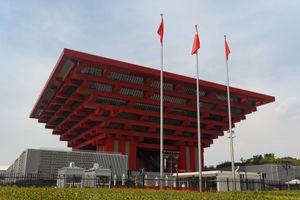
Titled Louder, the exhibition will open at the Power Station of Art this time next year—returning as a centrepiece of Shanghai Art Week, the 2026 edition of which is currently under way in the Chinese city.
“What does it mean to speak louder today?” Barenblit asked during a press conference in Shanghai this afternoon. For the curator, the question concerns both art’s capacity to imagine a different world, and the struggle within the art world for certain voices to be heard.
As Barenblit told assembled media: “Politically, we live in a world of constant friction.” That friction informs a biennale concerned with popular culture’s contradictions: its ability to create community and a sense of belonging, while also enabling exclusion, homogenisation and social control.
“Popular culture can reveal changes in society before we’ve even found the language to describe them,” he continued.
The biennale’s framework will encompass rock, punk, hip hop, electronic music and C-pop, alongside fashion, fandoms and digital platforms, with both commercial and underground scenes informing its approach. However, the curator told Ocula: “It will not be a biennial about music.”
Instead, he said “music is an alibi” that will offer a way into questions that reach beyond sound: how communities form, how desires circulate, and how cultural expression can challenge or reinforce existing hierarchies. A song need not explicitly address identity or authority to engage with either, he suggested; meaning can emerge through a gesture, a dance or a way of gathering.
The theme of Louder extends an interest developed through Barenblit’s leadership of Spanish art institutions. As director of Madrid’s Centro de Arte Dos de Mayo (CA2M), he programmed Sonic Youth etc.: Sensational Fix (2010), Pop Politics: Activism at 33 Revolutions (2012–2013) and Punk. Its Traces in Contemporary Art (2015), each organised by guest curators. He also directed Barcelona’s Museu d’Art Contemporani de Barcelona (MACBA) from 2015–2021.
In order to prepare for the punk exhibition, Barenblit described approaching internationally established artists who readily identified with its premise. Their responses suggested that punk persisted as an attitude across practices far removed from its musical origins.
Louder draws on a broader genealogy, connecting the historical avant-garde, the Situationists and Fluxus with contemporary popular culture. Barenblit also cited American critic Greil Marcus, whose writing traces connections between music and wider social histories.
The curator pointed to Jeremy Deller’s Acid Brass (1997), which saw a traditional British brass band play acid house and techno, as a touchpoint for artwork that seeks to explore encounters between apparently distant cultural forms.
The announcement of the 2027 biennale’s theme coincides with this year’s Shanghai Art Week, when West Bund Art & Design (until 15 November) and ART021 (11–14 November) draw galleries and collectors to a city-wide programme of exhibitions, screenings and performances.
Beyond these fairs, the boutique event Hang Over Shanghai returns for its second edition (11–15 November), bringing together 18 galleries, including the Shanghai-based Linseed and Capsule, and Tokyo gallery Misako and Rosen.
Also returning for its second edition, the independently produced bilingual map Annotated Shanghai offers opinionated tips on where to go. Alongside established institutions and informal venues, it traces relocations, pop-ups and spaces that have gone dormant or disappeared.
Having previously visited Shanghai for the 2016 and 2018 biennales, Barenblit told Ocula that he sensed a changed cultural landscape since the Covid-19 pandemic. “The role that culture plays in Chinese society has evolved,” he said. “Everything is bigger, louder... Shanghai has become an even larger hub.”
A respected voice in contemporary art discourse.
Focusing on ambitious storytelling and insightful art-world commentary. Ocula Magazine publishes in-depth interviews, critical essays and timely analysis on the artists, exhibitions and ideas driving the global art world.
Learn more about Ocula Magazine
Showcasing the best of the art world.
Ocula partners with galleries from around the world to highlight their artists, artworks and exhibitions. Gallery membership is by application and invitation, with each member vetted by an independent panel.
Learn more about Ocula Membership
Specialises in the sale of major artworks.
Led by a team with deep ties to the world’s leading auction houses, galleries and collectors. Ocula’s advisory team offers bespoke services to high-net-worth clients from around the world who are looking to acquire the best of contemporary and modern art.
Learn more about our team and services