


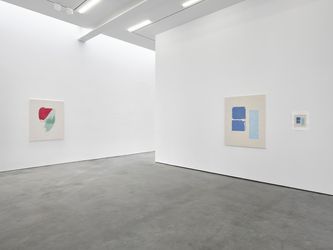
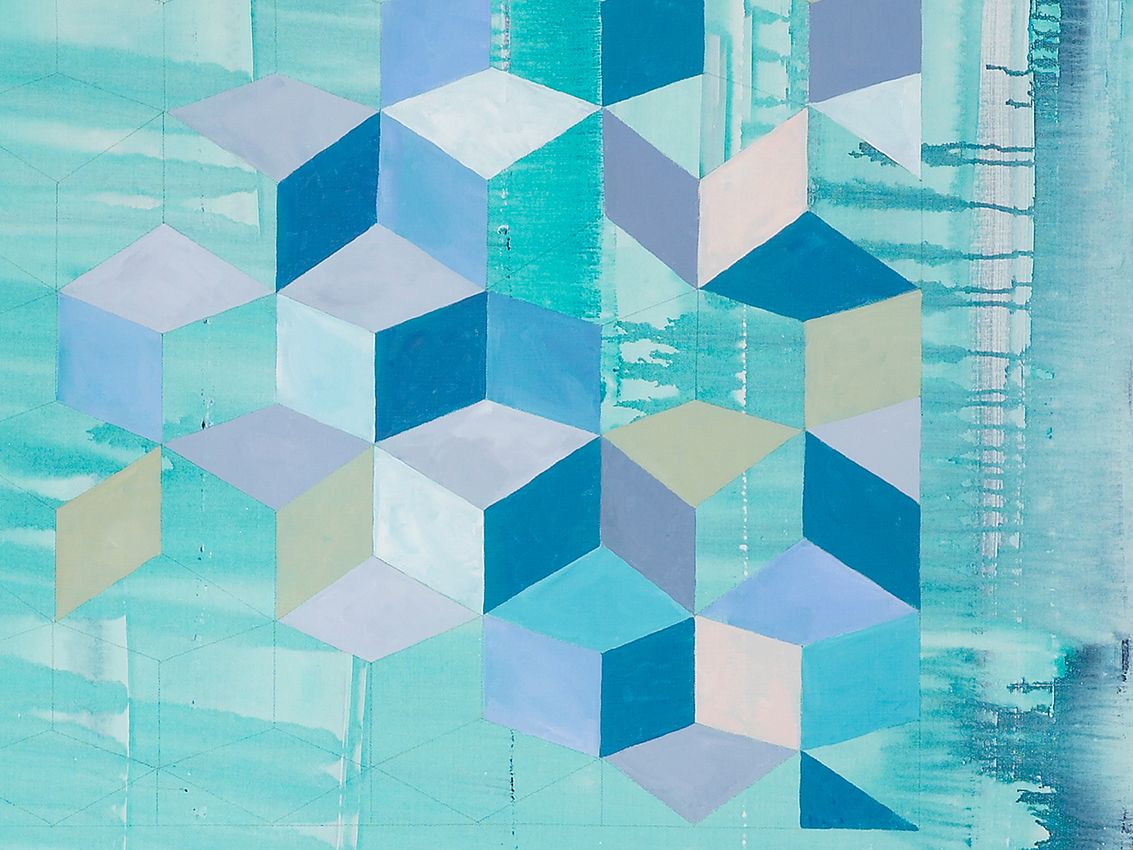
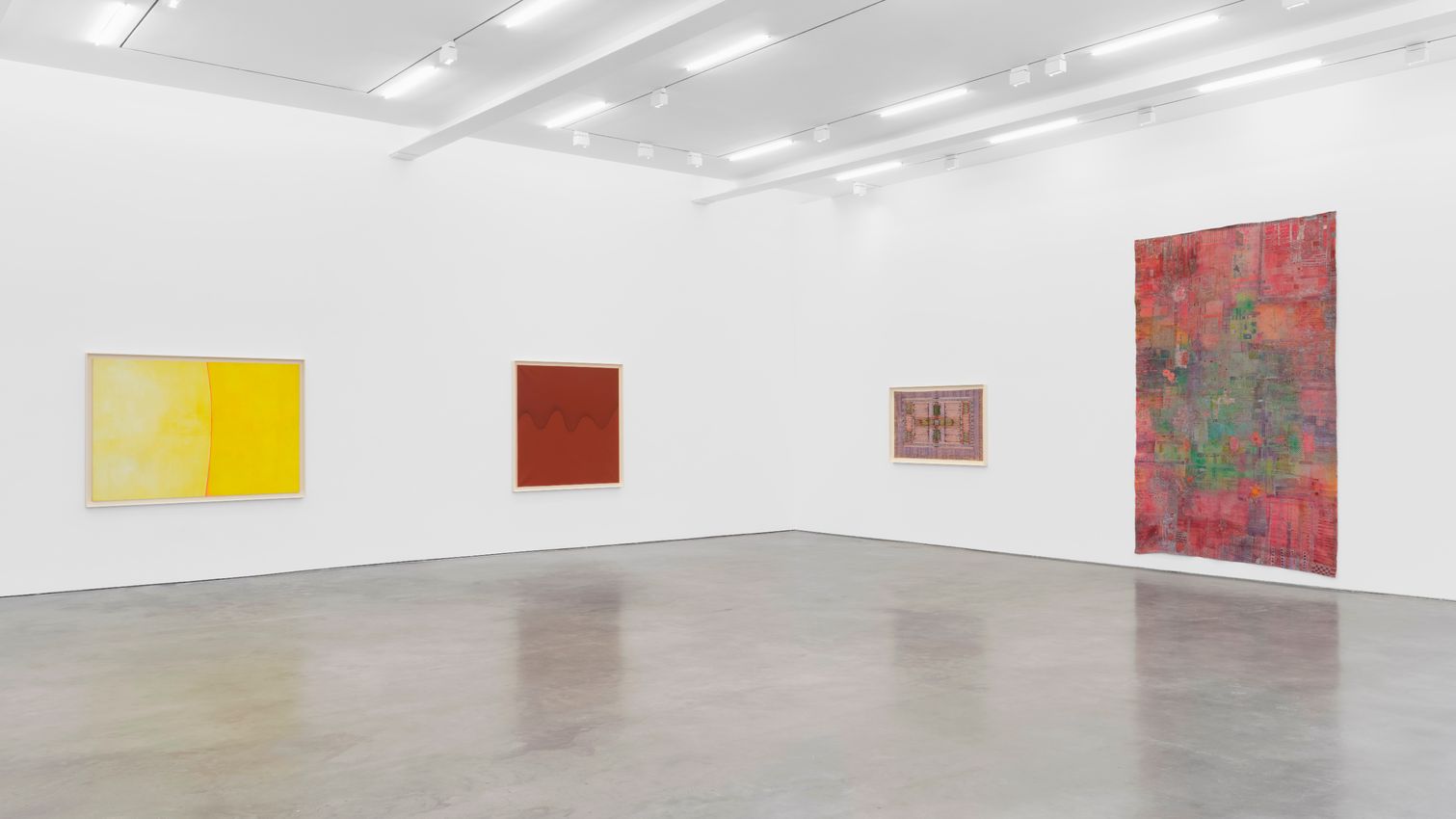
For his first exhibition at Lisson Gallery New York, abstract painter Peter Joseph will present all new work. Recognized for his early paintings of simple, formally symmetrical shapes in a carefully considered color palette, the works in this exhibition continue his recent experimentation with a looser structure. These new compositions further extend Joseph’s departure from the closed boundaries of his early work. He is the longest standing artist represented by Lisson Gallery, with his first exhibition in London in 1967, and this exhibition will be his sixteenth in nearly fifty years of collaboration. The gallery will publish a fully illustrated catalogue to accompany the exhibition, acting as a continuation of the 2014 publication Peter Joseph: The New Painting. The second volume will include an essay by art historian Alex Bacon.
The new paintings are rendered in sunny shades of pastel colors, referencing Joseph’s home and studio in the rolling hills of the Cotswolds in the English countryside. Joseph is often inspired by nature and classical architecture, and approaches his paintings with a consistent conceptual practice similar to that of an architect’s draft. Joseph begins his paintings by studying swatches of colored paper and canvas. In these pieces he works to select two hues which he finds complement or create an interesting juxtaposition with another. Using this “sketch” he then mixes acrylic paint to exactly the color of the swatch, and applies it to the canvas in washes identical to that of the study. As Joseph notes, “For me, it’s like an architect who makes a drawing on paper in two dimensions and then realizes the vision in real space.” The paintings in the exhibition will be accompanied by a selection of studies, demonstrating Joseph’s artistic process.
Writing on Joseph’s recent work and their effect on the viewer in the catalogue, Alex Bacon describes: “This sense of things coming together and falling apart, in constant motion while still expressing an ultimate impression of balance and stability is what captivates us when looking at Joseph’s recent work. It is also how I imagine—even if he works intuitively—the artist judges the success or failures of his paintings. Even if there are intellectual issues to be gleaned from these formal considerations, we must start there, with the terms set out by the paintings. To begin with, these means, and our experience of them as viewers, are unabashedly romantic—insofar as they suggest the tone, rather than the shape, of our sensate experience of the world.”


Established in 1967 in London, Lisson Gallery is one of the most well-known galleries operating globally. Boasting an influential and continuing legacy, including playing a pivotal role in the careers of many pioneers of historically important art movements, the gallery works with some of the most significant contemporary artists today.

A respected voice in contemporary art discourse.
Focusing on ambitious storytelling and insightful art-world commentary. Ocula Magazine publishes in-depth interviews, critical essays and timely analysis on the artists, exhibitions and ideas driving the global art world.
Learn more about Ocula Magazine
Showcasing the best of the art world.
Ocula partners with galleries from around the world to highlight their artists, artworks and exhibitions. Gallery membership is by application and invitation, with each member vetted by an independent panel.
Learn more about Ocula Membership

Specialises in the sale of major artworks.
Led by a team with deep ties to the world’s leading auction houses, galleries and collectors. Ocula’s advisory team offers bespoke services to high-net-worth clients from around the world who are looking to acquire the best of contemporary and modern art.
Learn more about our team and services