Press Release

Pace Gallery is honored to present a major exhibition of works from Jean Dubuffet’s celebrated Hourloupe cycle. On view from March 13 to April 26 at the gallery’s 540 West 25th Street location in New York, the exhibition has been conceived to celebrate the 50th anniversary of the Fondation Dubuffet last year.

It brings together a selection of important paintings, sculptures, and architectural models from public and private collections, including the monumental canvas Nunc Stans—among the largest paintings that Dubuffet ever created—on loan from the Guggenheim Museum in New York.

One of the great innovators of post-war European painting, Dubuffet looked to the margins of society—to the art of outsiders, mediums, the incarcerated, and the institutionalized—to liberate his own creativity. He coined the term “Art Brut” to describe the raw aesthetic of such outsiders, challenging the conventions of the period. Ahead of his time as both an artist and a philosopher, Dubuffet’s works posed fundamental questions about the nature of reality, leaving an indelible mark on the history of Modernism.

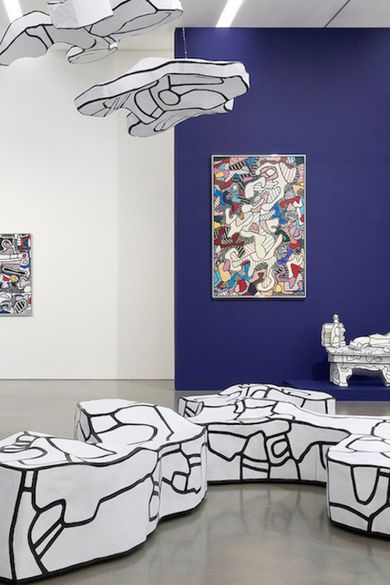
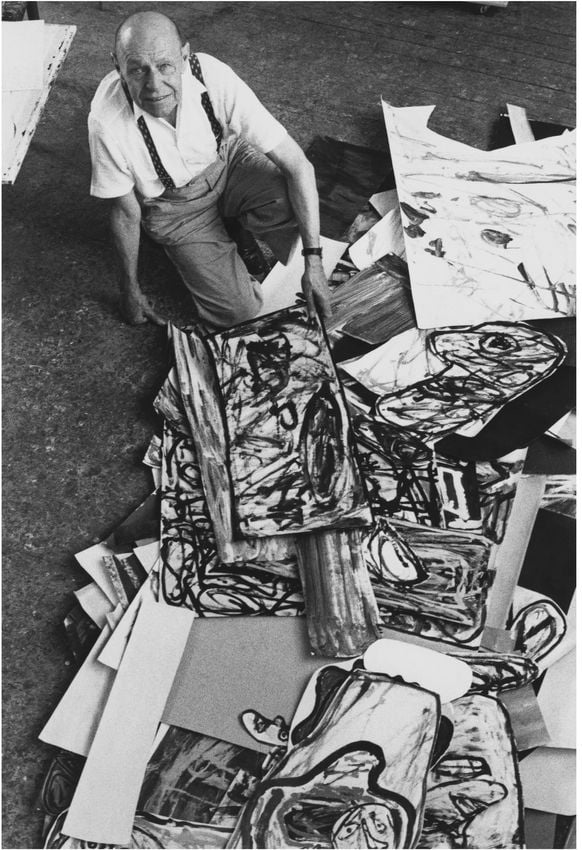
With the Hourloupe, Dubuffet used his practice as a means to reinvent the everyday in an alternate world. He posited the parallel universe of the Hourloupe, which the viewer was invited to imaginatively inhabit, to critique the consensus of reality—as if one might step through a portal in the humdrum existence of waking life into an alternative space of fantasy and possibility. The gallery’s upcoming exhibition in New York will showcase the dictionary of biomorphic forms that Dubuffet invented as part of the Hourloupe‘s visual language of experience and sensation. Charting the artist’s use of a recurring alphabet of forms across painting, sculpture, and architecture, the show will reflect his lifelong effort to disrupt and refashion our modes of perception.

The Hourloupe cycle was the longest lasting series of Dubuffet’s career, comprising works created between 1962 and 1974. Pace, which has represented the artist since 1967, was the first American gallery to exhibit sculptures from L’Hourloupe in its inaugural exhibition of the artist’s work in 1968. A foundational figure in the gallery’s history, Dubuffet has been the subject of more than 20 solo exhibitions at Pace over the course of seven decades.

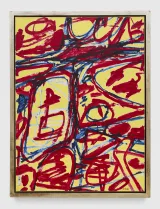
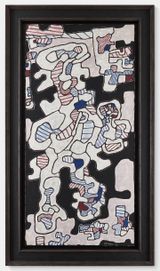
The Hourloupe style emerged in the early 1960s from Dubuffet’s Paris Circus period, the result of casual experiments with felt-tip markers. Creating absent-minded doodles in red, black, and blue pen while chatting on the telephone, Dubuffet arrived at a visual language resembling a web of meandering lines. These lines create interlocking shapes of negative space, which lock together like puzzle pieces. Over the course of more than ten years, he produced some of his best-known drawings, paintings, sculptures, and large-scale public environments in this style, comprising the cycle known as L’Hourloupe.

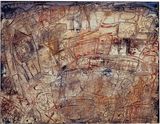
Anchoring Pace’s presentation is Nunc Stans (1965), a 26-foot-long painting on loan from the collection of the Guggenheim Museum in New York for the first time. This masterpiece of L’Hourloupe contains an inventory of characters and forms that recur throughout the cycle and the exhibition. The work’s title refers to the philosophical concept of eternity—the notion that there is no such thing as past and present, but only an eternal ‘now.’

“If Dubuffet teaches anything, it is that there are no conclusions, and no true beginnings,” the late critic Peter Schjeldahl once observed. “There is only the middle, the presentness of life.”

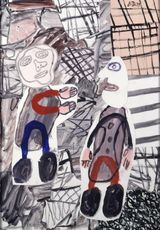
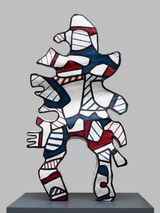
The exhibition also includes the 1966 painting Fusil Canardier, in which Dubuffet reimagines a punt gun as an animated creature, suggesting the metamorphic powers of L’Hourloupe to render alive what was previously inanimate. This uncanniness is reflected in the more figurative sculptures from the cycle, three of which will be on view at the gallery. In these large-scale works, including L’Incivil (1973–2014) and Le Facetieux (1973–2014), faces and limbs are abstracted and contorted but, like Fusil Canardier, retain a sense of anatomical familiarity.

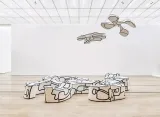
Sculpture and architecture were central to Dubuffet’s process in the Hourloupe cycle. He realized his sculptural works first in polystyrene, which he produced by cutting through the material with a hot wire, creating maquettes for forms that would then be realized at a larger scale. The exhibition at Pace will feature Banc-Salon (1974–2024), a hybrid between a sculpture and an architectural bench, on which visitors are welcomed to sit beneath a sculptural cloud suspended from above. The show also includes the original nine-by-12-foot model of Dubuffet’s monumental, habitable environment, the Jardin d’email(1968), which the artist realized for grounds of the Kröller-Müller Museum in the Netherlands in 1974 and remains on view today. These works are presented with two wall-mounted ceramic compositions from 1965, as well as Comptoir amoncelant (1968), a still life of a food-laden counter. Together, these works express the artist’s aim to transpose domestic and quotidian scenes from our reality into the parallel universe of L’Hourloupe.

Pace’s exhibition is presented in collaboration with the Fondation Dubuffet. Founded by the artist himself, the Fondation Dubuffet’s mission is to protect and promote the work of Jean Dubuffet.

Read More
Pace at 65: Mega-Gallery to Celebrate with a Year of Retrospectives News Pace at 65: Mega-Gallery to Celebrate with a Year of Retrospectives Exhibitions paying homage to the long list of luminaries that defined the gallery’s history will open throughout the year. Read the story
About the Artist

Jean Dubuffet (b. 1901, Le Havre, France; d. 1985, Paris) began painting at the age of seventeen and studied briefly at the Académie Julian, Paris. After seven years, he abandoned painting and became a wine merchant. During the thirties, he painted again for a short time, but it was not until 1942 that he began the work which has distinguished him as an outstanding innovator in postwar European painting. Dubuffet’s interest in art brut, the art of the insane, and that of the untrained person, whether a caveman or the originator of contemporary graffiti, led him to emulate this directly expressive and untutored style in his own work. His paintings from the early forties in brightly coloured oils were soon followed by works in which he employed such unorthodox materials as cement, plaster, tar, and asphalt-scraped, carved and cut and drawn upon with a rudimentary, spontaneous line. Jean Dubuffet has been represented by the Gallery since 1967.

View Artist Profile

Also Exhibiting at Pace Gallery

Address
508 & 510 West 25th
New York
United States
Opening Hours
Tuesday – Saturday
10am – 6pm
(1)
New York 508 & 510 West 25th
Pace Gallery
508 & 510 West 25th, New York, United States
+1 212 421 3292
http://www.pacegallery.com

Opening hours
Tuesday – Saturday
10am – 6pm
The art world in focus