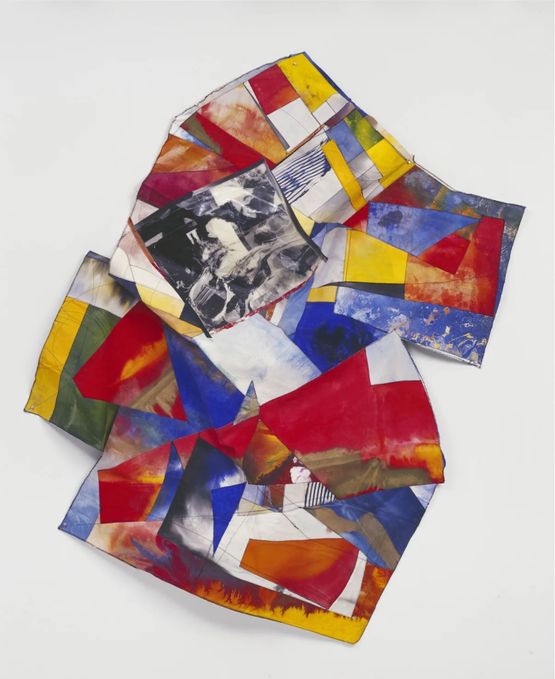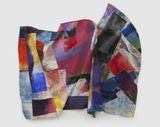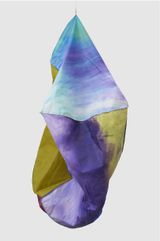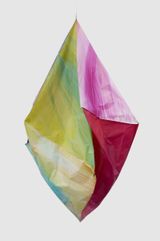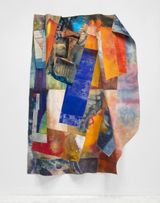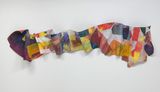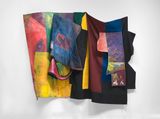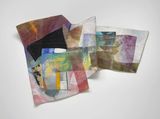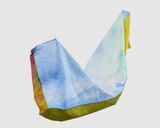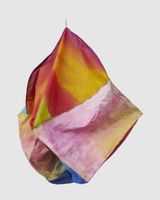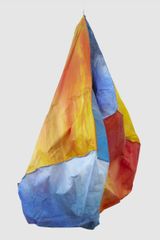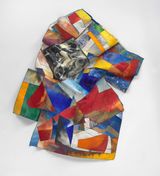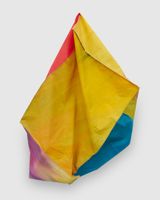
In 1993, Sam Gilliam was accepted as the artist in residence at Ballinglen Arts Foundation in the rural north of Ireland and went to ship his usual paints to the residency. When the paints were barred from shipment because they contained highly flammable petroleum, Gilliam found himself in a dire circumstance that called for innovation. At his studio in Washington D.C., Gilliam painted and stained a large group of monumental loose canvases, folded them up, and shipped them to Ballinglen.
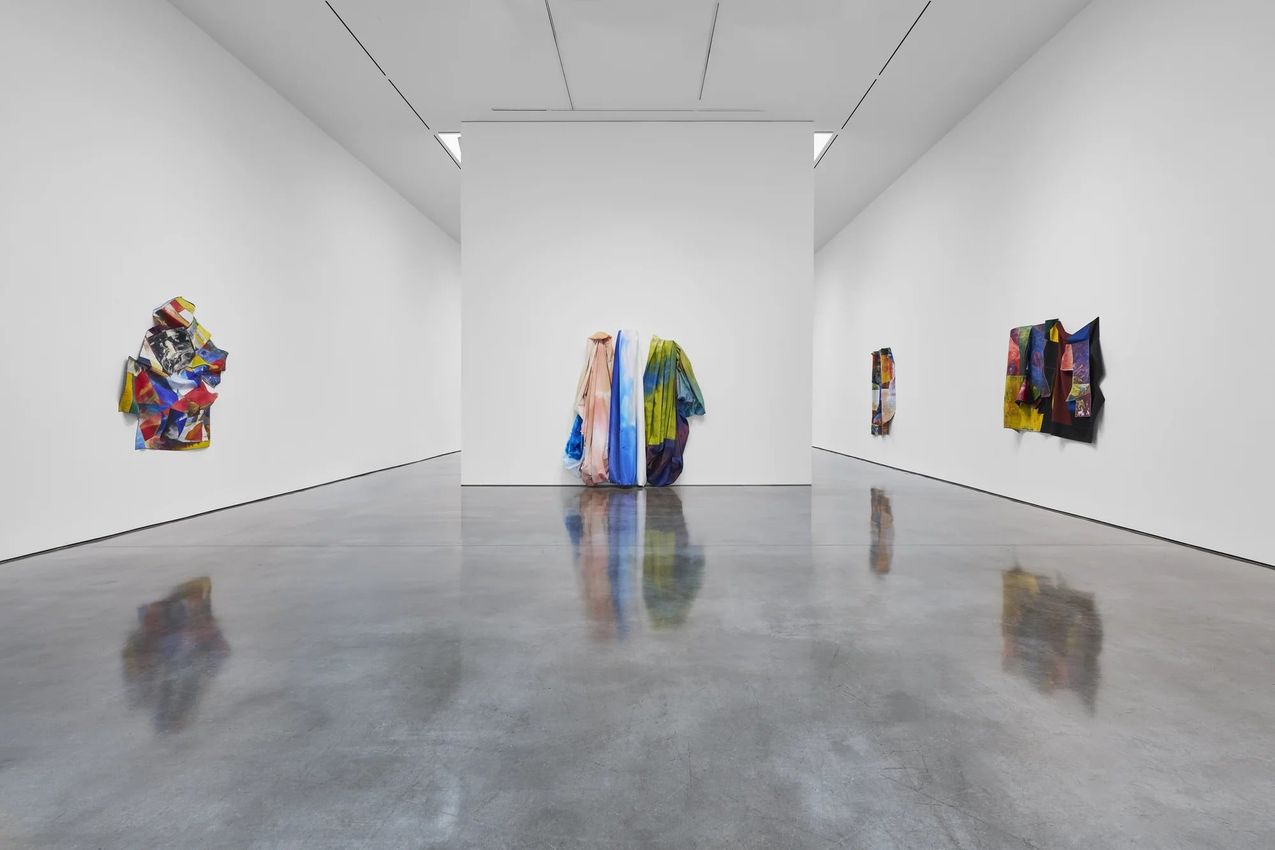
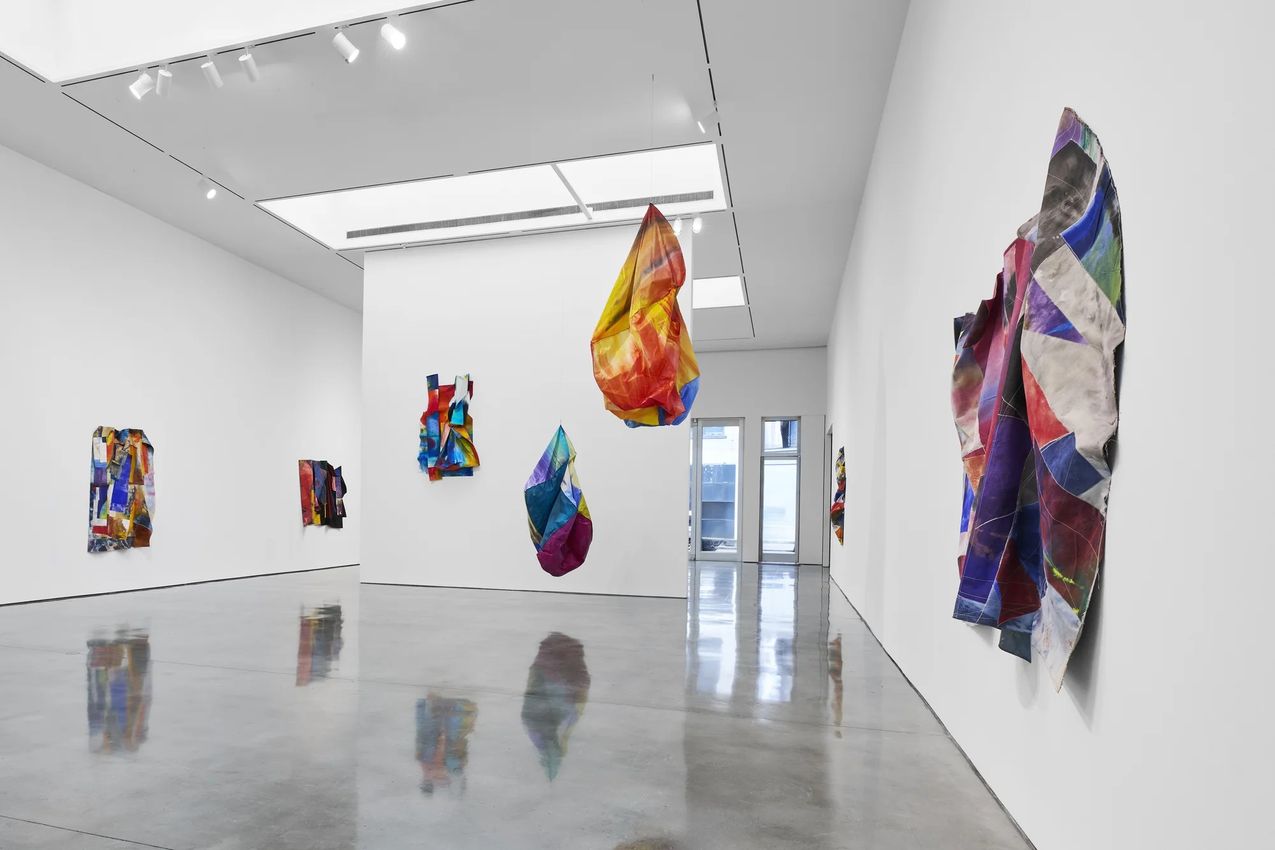
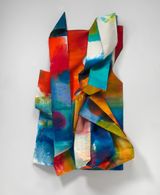
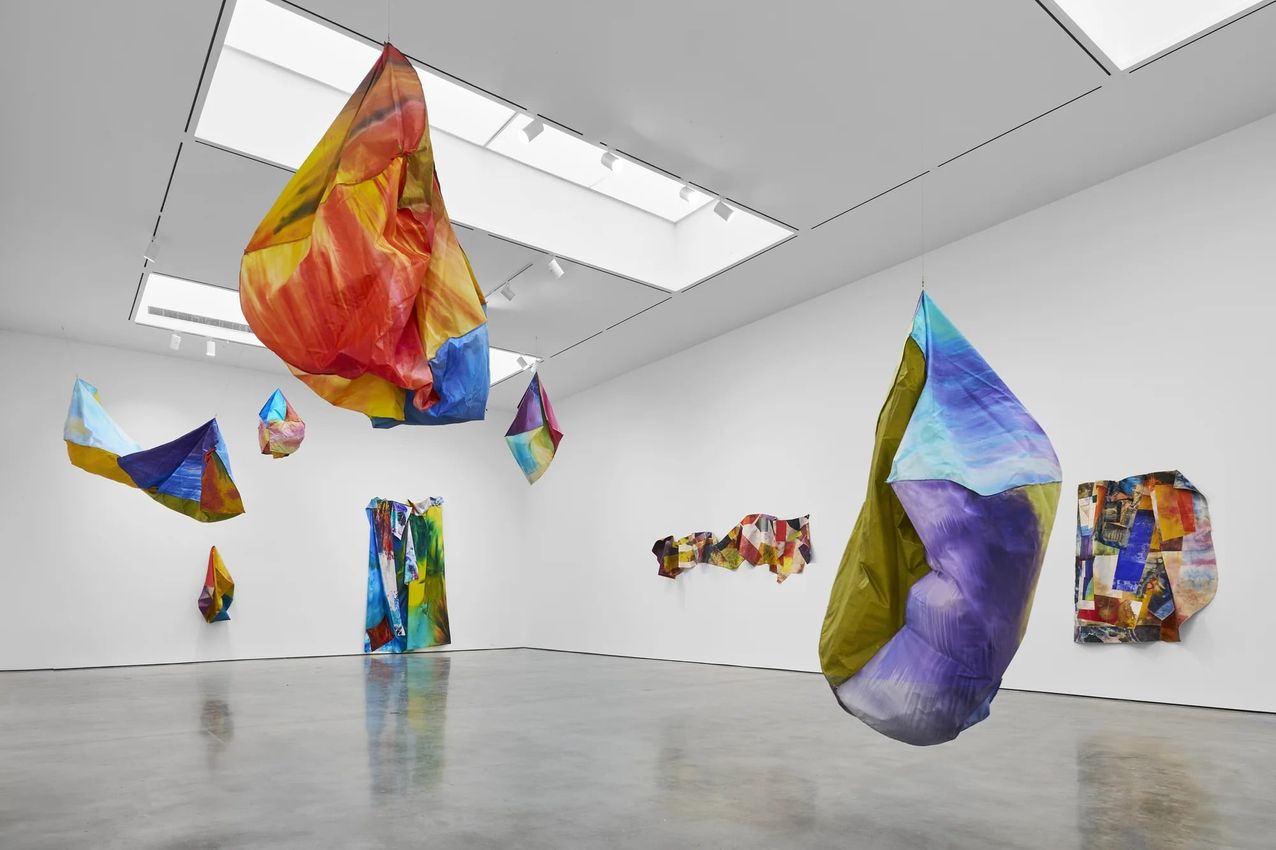
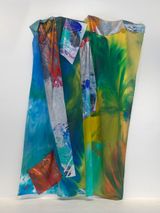
These canvases became the source material for a new body of work he would produce in Ireland—for a painting residency during which he did no actual painting. Once on site, Gilliam hired a local seamstress and worked alongside her every day, cutting and stitching the pre-painted canvases to construct brand new paintings from the found material of his own creation. The results were dynamic three-dimensional wall works and hanging sculptures, vibrant compositions of colliding and coalescing geometries and colors which defy easy categorization as painting or sculpture. Gilliam’s stitched works are perhaps best understood as Constructivist objects, which reflect his tireless spirit of invention, much like the circumstances of their own creation. Three decades later, many of these works were shown for the first time in Sam Gilliam: Sewing Fields at the Irish Museum of Modern Art (IMMA) in Dublin in 2025.
On view at Pace at its 510 West 25th Street from March 13 to April 25, Sam Gilliam: STITCHED expands upon the IMMA exhibition. The gallery’s presentation features many of the wall-mounted works that were the focus of IMMA’s exhibition, as well as never-before-seen volumetric, balloon-like hanging sculptures from the same period. The exhibition marks the United States debut for all included works, and the global debut for several others.
Often credited with freeing the canvas from its support, Gilliam broke down the distinctions between painting and sculpture throughout his career. In many ways, these stitched works from the 1990s are the product of Gilliam’s lifelong interest in Constructivism, and they bridge his canonical early-career Drape paintings with his late work, last shown at Pace in 2023.
“I’d call myself a mirror,” the artist once said. “A mirror that reflects, borrows, and steals from different art movements, reorienting them in order to squeeze out new life.”
Widely recognized as one of the boldest figures of postwar American painting, Gilliam emerged from Washington, D.C. in the mid-1960s with works that elaborated upon and disrupted the ethos of Color School painting. Drawing inspiration from the improvisatory nature of jazz and the history of art itself, he nurtured a radical vision that extended the traditional boundaries of art. Through his investigations of technique, gesture, materiality, color, and space, Gilliam continually reinvented his practice to pursue a lifelong inquiry into the expressive, aesthetic, and philosophical powers of abstraction.
The catalogue accompanying IMMA’s recent exhibition as well as Phaidon’s 2024 monograph on the artist will both be available on-site at the gallery during the run of the show and can also be purchased on Pace’s website.


Sam Gilliam (b. 1933, Tupelo, Mississippi) is one the great innovators in postwar American painting. He emerged from the Washington, D.C. scene in the mid 1960s with works that elaborated upon and disrupted the ethos of Color School painting. A series of formal breakthroughs would soon result in his canonical ‘Drape’ paintings, which expanded upon the tenets of Abstract Expressionism in entirely new ways. Suspending stretcherless lengths of painted canvas from the walls or ceilings of exhibition spaces, Gilliam transformed his medium and the contexts in which it was viewed. For an African-American artist in the nation’s capital at the height of the Civil Rights Movement, this was not merely an aesthetic proposition; it was a way of defining art’s role in a society undergoing dramatic change. Gilliam has subsequently pursued a pioneering course in which experimentation has been the only constant. Inspired by the improvisatory ethos of jazz, his lyrical abstractions continue to take on an increasing variety of forms, moods, and materials.


A respected voice in contemporary art discourse.
Focusing on ambitious storytelling and insightful art-world commentary. Ocula Magazine publishes in-depth interviews, critical essays and timely analysis on the artists, exhibitions and ideas driving the global art world.
Learn more about Ocula Magazine
Showcasing the best of the art world.
Ocula partners with galleries from around the world to highlight their artists, artworks and exhibitions. Gallery membership is by application and invitation, with each member vetted by an independent panel.
Learn more about Ocula Membership

Specialises in the sale of major artworks.
Led by a team with deep ties to the world’s leading auction houses, galleries and collectors. Ocula’s advisory team offers bespoke services to high-net-worth clients from around the world who are looking to acquire the best of contemporary and modern art.
Learn more about our team and services