Press Release

Perrotin is pleased to present Daydream, a solo exhibition by artistJosh Sperling, organised across three floors of the gallery’s NewYork space, and on view April 28th through June 11th. The exhibition, Sperling’s largest, marks a return to key motifs in the artist’s practice, developed over the course of the last decade andre-articulated by Sperling in this new body of work. Additionally, inDaydream, the Ithaca-based painter will debut a new series,continuing his investigation into the material possibilities of colorand form.

The following essay was authored by writer and critic Max Lakinafter visiting Sperling’s studio in Ithaca, New York.Taped to a small refrigerator in the back of Josh Sperling’s studio inIthaca, New York is a curling piece of office paper printed with seven bulleted lines of plain type that detail, in the flattest possible terms, how to understand colour:

• Hue is color
• Chroma is the purity of a colour
• Saturation is how strong or weak a colour is
• Value is how light or dark a colour is
• Tone is a hue combined with gray
• Shade is a hue combined with black
• Tint is a hue combined with white

These rules are immutable and rigorous, but also there’s something clarifying and non-negotiably true about them, which is what a Josh Sperling work is like, too. Colour is important to Josh, and he’s obsessive about it. That’s clear from just a few minutes with him, before you learn that his studio has developed 1,200 proprietary blends of paint, and before you see a good percentage of them, in the form of little pots of finely tuned burnt umber and cadmium red and manganese blue that colonise the floors and figure into the finished paintings, which are deeply saturated and uniformly immaculate. Looking at one of Josh’s paintings is also like being submerged in it, each construction a warm bath of azure or malachite or cerise, each one a fully formed world.

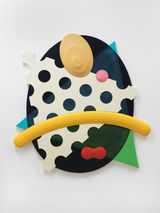
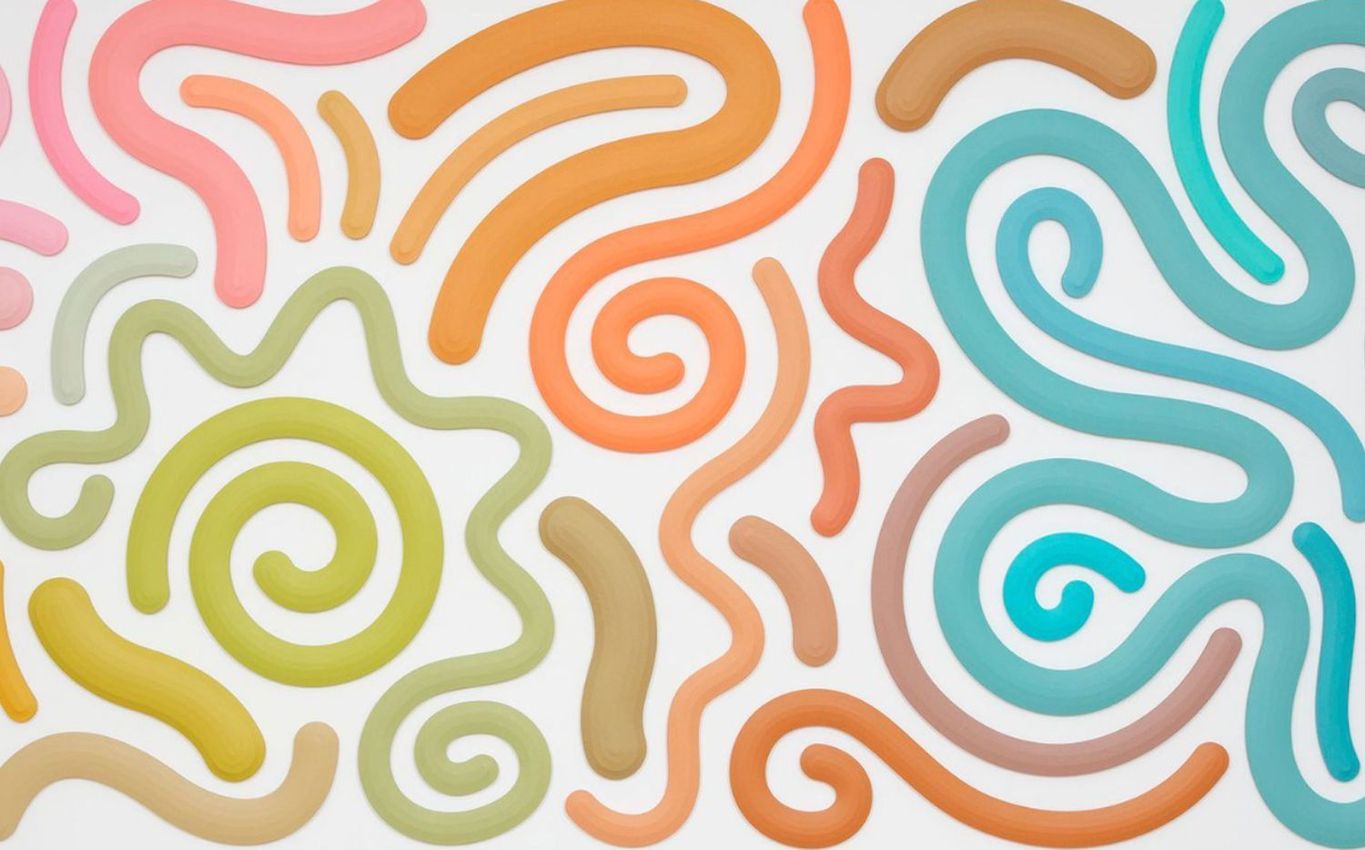
Josh is also interested in shapes. His paintings don’t look like paintings, exactly. They curl and wend and spiral. They shimmy up the wall and slide across it, possibly in a corkscrew, or maybe a segment of sinecurve. They don’t really do this, of course, because they’re securely fixed in space and strictly mapped, yet they manage a kind of uncanny movement, vibrating like beveled moray eels. His built-up canvases, stretched over precision-cut plywood supports that radiate outward, like the rings of a tree, protrude from the wall in limitless permutations, so that the picture plane not only extends into space, it makes space part of the deal. There’s a sense of freedom about them that’s totally hypnotic.Many artists have been credited with liberating the picture from the canvas, but Josh’s feel like a jailbreak, like he’s hooked his truck to the stretcher bars of a painting and floored it, busting apart the whole thing,making something new with the parts. The astrophysicist Carl Sagan, another Ithaca resident, said “If you wish to make an apple pie from scratch, you must first invent the universe.” Josh seems to have taken the advice.

Where do Josh’s shapes come from? One of his earliest series, the squiggles, still make up the atomic structure of everything that came after. To any artist, the line is the crucial bit of information, the primordial imperative that sets the whole thing in motion. Josh’s squiggles are like that—the mark, the brushstroke. His lines are stretched taught, so it’s something of a miracle that they should look so soft, as if you were to take a circle and unravel it the way you would peel a clementine.

His practice travels along the formal continuum shared by theMinimalists, so there’s some Frank Stella and Sol LeWitt and evenDonald Judd in there. But there’s a lot of design, too: the Googie driveins of mid-century Los Angeles, with their postwar optimism and look at-me geometry—the Bob’s Big Boy Broiler of the mind; and Memphis:a puckish clash of squiggles and blaring colour that shakes you just enough so you can see straight. Josh’s constructions are finely wrought, like a particularly beautiful chair you can’t sit in, like the constituent parts of a Peter Shire settee grafted onto the wall.

At first, his newest series seems to return to a more orderly form: a square canvas, neatly confined within its frame. That’s a bit of a feint; they’re some of the most conceptually heavy works Josh has made yet, interlocking bands that bubble and contract, like an undulating bicycle chain without end, and which expand outward from a central node—a classical, satisfying circle-in-the-square formation. Each piece, which can seem to incorporate a technicolor dream coat of hues, actually only features one, viridian green, say, or pyrrole orange, dialled up and down along the spectrum so they resemble an Josef Albers on psilocybin.After a while of looking they begin to hum, the crash course seminar painter’s taped to the fridge given physical form.

On a drive through downtown Ithaca, Josh points out Sagan’s former residence, a majestically spooky Egyptian Revival tomb built partway down a cliff overlooking Ithaca Falls. The pitch of it looks maniacal, the whole thing ready to totter into the gorge at any moment. But there’s a placidity, too, an awareness of its place in space. There’s something of that terrain in Josh’s work, his panels suspended in elegant precariousness, the roughness of their ridges smoothed into something beautiful, the kind that reveals itself in balance.

Read More
About the Artist

Sperling’s work draws on the language of Minimalist painting from the 60s and 70s, with shaped canvases as his main recourse. For these, he crafts intricate plywood supports over which canvas is stretched and painted over in a signature palette of saturated, sometimes clashing colours. In their three-dimensionality, Sperling’s works blur the lines between painting and sculpture, image and object. Mining a wide range of sources, from design to art history, Josh Sperling has crafted a unique visual vocabulary remarkable for its expressive quality and irrepressible energy.

View Artist Profile

Also Exhibiting

About the Gallery
Emmanuel Perrotin founded his first gallery in 1989 at the age of 21. He has opened since then over 17 different spaces, with the aim of continuing to offer increasingly vibrant and creative environments to experience artists work. He has worked closely with his roster of artists, some since more than 25 years, to help fulfill their ambitious dreams and projects. The gallery is now based in New York, Paris, Hong Kong, Seoul, Tokyo, and participates in all the significant worldwide art fairs each year (Art Basel (Hong Kong, Miami, Basel), Frieze (London, New York), FIAC (Paris), Dallas Art Fair, Art Cologne, Art Stage Jakarta, Expo Chicago, Art021 & West Bund Art & Design, Shanghai, Zona Maco Mexico, amongst others).
View Gallery Profile
Address
130 Orchard Street
New York
United States
Opening Hours
Tuesday – Saturday
10am – 6pm
(1)
New York 130 Orchard Street
Perrotin
130 Orchard Street, New York, United States
+1 212 812 2902
http://www.perrotin.com

Opening hours
Tuesday – Saturday
10am – 6pm
The art world in focus