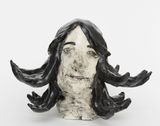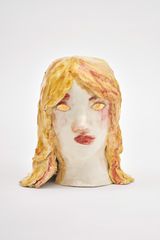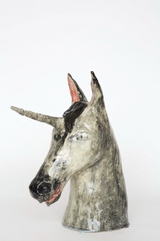
Perrotin is pleased to present Beast, Klara Kristalova’s eighth soloexhibition with the gallery and her fourth at Perrotin Paris. On thisoccasion, the artist will showcase a new series of sculptures andworks on paper in which reality blends with fiction and boundariesbetween nature and humanity become blurred, revealing thefragility of life and the complexity of the relationships betweenbeings.
“I am a sculpting draughtsman and painter”: Klara Kristalova, born in1967, doesn’t let herself be pigeonholed into categories, and even takespleasure in defying them. Far from any conventional approach, she allowsunexpectedness and singularity to emerge from the abolition ofboundaries between the arts, from the exploration of undefined margins.In the mid-1990s, her artistic path took her away from pure painting andtowards modelling. She approaches this discipline with a great deal offreedom and playfulness, appreciating both its shaping and its materiality.Kristalova’s ceramics arise from successive transformations. A quick drawing is soon followed by modelling, which develops this initialintention. By kneading, she reconnects with an ancestral practice. Theclay is worked directly with the fingers, creating irregularities and shiftingsurfaces. An initial firing precedes the moment of painting on ceramic,quick and playful... Finally comes the ultimate transformation: the finalfiring and its unpredictability. Kristalova’s creative process incorporatesimperfection, emergence and a certain amount of chance: when the kilnis opened, she particularly likes it when the colours have dripped andblended. When they nestle in an unexpected space, blurring the contrastbetween the purity of the white and the intentionally cold, dark colours.
In the midst of this ceramic population, a few vigorous bronzes temperthe vulnerability of the clay.
[Beast]
Beast invites us to plunge into Kristalova’s enigmatic universe. Realityblends with fiction: human or animal heads and masks rub shoulders withhybrid beings, with unusual distortions of scale. What emerges is afantastic world where anxiety borders on humour, as with the giganticinsect in The fly’s kiss, whose flower-like proboscis delicately touchesthe child’s lips. An unexpected moment of tenderness is born from thissupernatural kiss.
Kristalova blurs the boundaries between nature and humanity. Fascinated by the connection between humans, animals and plants, she combines them at will, like playful and disturbing exquisite corpses. Man as a natural being is omnipresent: he merges into an invasive, all- encompassing nature; the plants incorporate human faces. Are Kristalova’s beings humanoid animals, or are they animalised, vegetalised humans? Probably neither: the hybrid being occupies a space between, a limbo land. Far from the classifications in which humans like to confine the world in order to control it better.
The indeterminate nature of these hybrid beings places them in afantastical universe rooted in symbolism: in front of All my thoughts orthe flower-faces, we are irresistibly reminded of Odilon Redon’s SmilingSpider. These beings become “phantasms,” in the etymological sense ofapparitions. Are we in another reality or are we in the world of dreams, oreven nightmares, a distant cousin of the visions of Munch or Goya?Kristalova’s creatures’ non-compliance with real beings gives them thestatus of “beasts.” As such, they embody an otherness, a uniqueness, adifference that raises questions: the beast externalises and transposesfears, frustrations, rage and panic into its very appearance, but alsoexpresses a form of outlet, of freedom... A strange people not unlikeGauguin’s ceramic monsters.
[Vacillations]
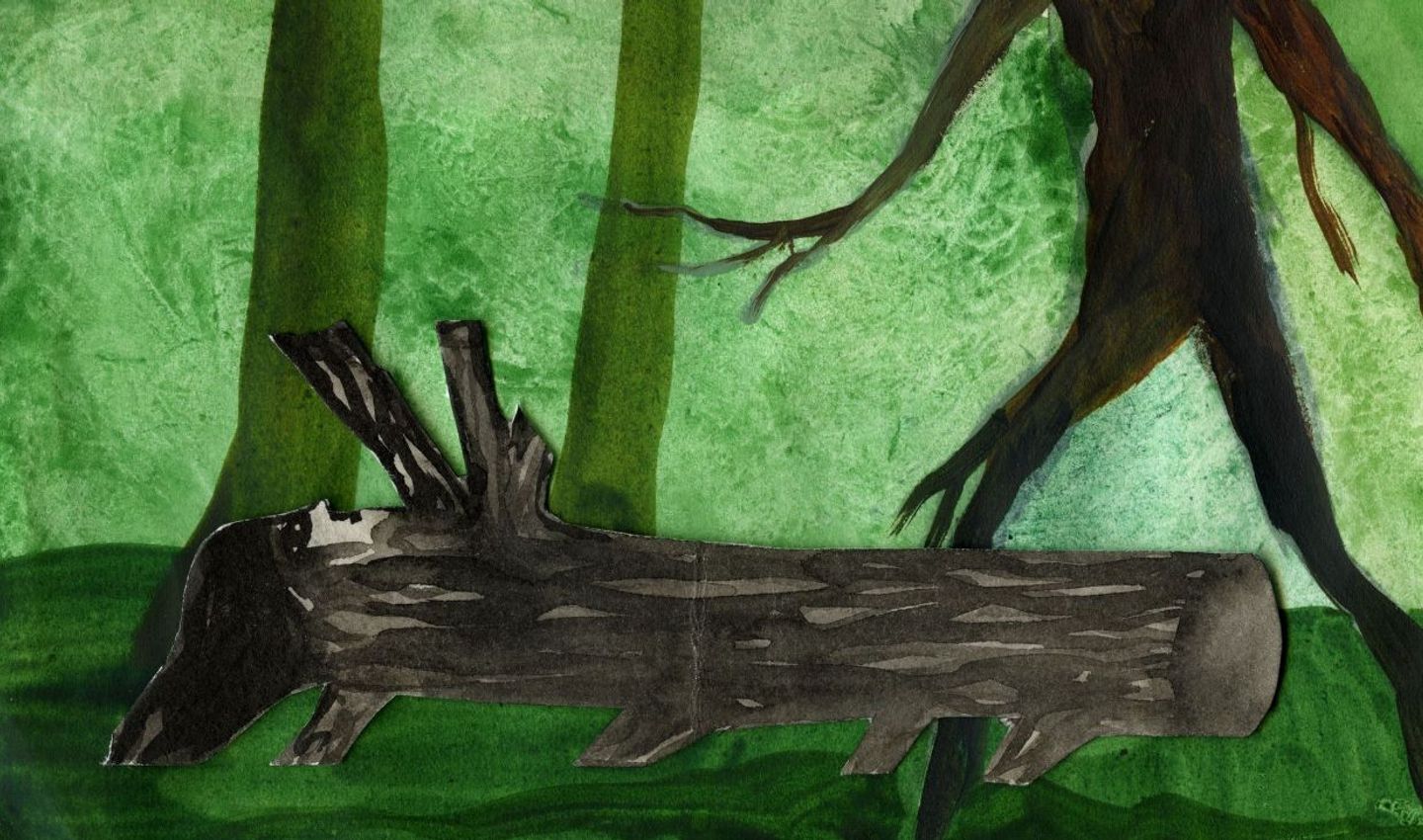
Kristalova’s hybrid beings sound out the way we look at others, oursociety’s complex relationship with monstrosity and deviations from thenorm. What room is there for difference when smooth, standardisedbeauty is valued above all else? The hybrid world challenges thedefinition of the human, and raises the question of the definition of thebody, its limits and its integrity. The transformations undergone by theseimaginary bodies are sometimes tinged with a muted violence. The treebranches and roots that sprout from the bodies are as much factors ofpower, bulwarks against human excess, as they are potential prisons:such is the case of the astonishing Log, a young girl trapped in a trunkthat is reminiscent of the piece of wood cradled by the enigmatic “LogLady” in David Lynch’s universe. When difference calls existence intoquestion.
The eruption of plant life into the bodies of young people also reflects themutation of adolescent bodies, bearers of a vitalistic sap. Power andfragility, playfulness and seriousness, growth and invasion are all at work in these young beings steeped in questions, contradictions and doubts.Worry mingles with insouciance, grandeur with a fragility that can beseen in the attitude of the Mouse, with his hands in his pockets. Yetadolescence is the age of all possibilities, before gender determines howan individual is viewed, before the divorce between the sexes isirrevocably consummated. There is an omnipresent nostalgia for thissuspended time.
The liminality of physical appearance is also the liminality of an instant:the narrative seems interrupted, without a thread to hold on to. Theviewer questions both the nature of the beings and the links betweenthem: why does All my thoughts stand apart? Larger than life, a smilingyoung girl perched on never-ending stick-legs, seems to move slowlyand benevolently amongst the others, like a carnival monster on stilts. Atimeless moment in which social norms and conventions are turned ontheir head. Non-conformity, freedom, distance and entertainment arealways active in Kristalova’s work: in the shade of the head-flowers, aReclining bird lounges in high heels. In Ordinary day, rabbits taunt adisgruntled wolf from the top of a tree.
There is no Manichaeism in this suspended world of possibilities. Thetipping point is never certain, even when anxiety wells up: is the humanoidMouse just shy, encircled by the beings around him, or is he threateningthem? The young mouse-man reflects the complexity at work in all of us,whether or not we are inclined towards darkness. Simultaneouslyvulnerable and powerful, he reflects the threat that man poses to theearth. His invocation by the artist is invested with a cathartic value, in theAristotelian sense of the term: a purifying of the passions. The worktherefore has an almost magical, prophylactic value.
Concerned about the rise of extremes and mankind’s destructive attitude,Kristalova constructs a world that reveals the fragility of life and thecomplexity of the relationships that are forged between beings. Theviewer is invited to question his or her perception, which changesaccording to his or her psychology and state of mind. “My art is aboutlanguage, communication,” says Kristalova. This imaginary dialogue, thekeys to which are not revealed, allows each of us to project our ownfeelings and anxieties... A genuine relationship that engages the individualand integrates him or her into the space of the work: art as experience,to paraphrase John Dewey.
Kristalova was born in former Czechoslovakia in 1967 and moved to Sweden with her parents when she was only a year old. She studied at the Royal University College of Fine Art in Stockholm and lives in Norrtälje, Sweden. Klara Kristalova constructs a dark, odd, and yet familiar world. The characters that inhabit her universe are peculiar, alone, quiet, perhaps lost, as if they have just escaped from a cruel tale, waiting for a passer-by to stop and indicate the way. Made from glazed ceramics, Kristalova ‘s figures carry a raw, vulnerable, human feel to them. Drawing from Nordic storytelling and traditional myths, Kristalova manages to convey basic human emotions such as fear, love, sadness and guilt, which emerge from her work like memories from our own childhood. An essential component without being literally represented in it, the landscape occupies Klara Kristalova’s mental and physical universe, without being a theme in and of itself. It is inferred in fragments from the drawings, ceramics and bronzes that populate the dark and mysterious exhibitions she has unveiled in recent years.
Emmanuel Perrotin founded his first gallery in 1989 at the age of 21. He has opened since then over 17 different spaces, with the aim of continuing to offer increasingly vibrant and creative environments to experience artists work. He has worked closely with his roster of artists, some since more than 25 years, to help fulfil their ambitious dreams and projects.

A respected voice in contemporary art discourse.
Focusing on ambitious storytelling and insightful art-world commentary. Ocula Magazine publishes in-depth interviews, critical essays and timely analysis on the artists, exhibitions and ideas driving the global art world.
Learn more about Ocula Magazine
Showcasing the best of the art world.
Ocula partners with galleries from around the world to highlight their artists, artworks and exhibitions. Gallery membership is by application and invitation, with each member vetted by an independent panel.
Learn more about Ocula Membership

Specialises in the sale of major artworks.
Led by a team with deep ties to the world’s leading auction houses, galleries and collectors. Ocula’s advisory team offers bespoke services to high-net-worth clients from around the world who are looking to acquire the best of contemporary and modern art.
Learn more about our team and services