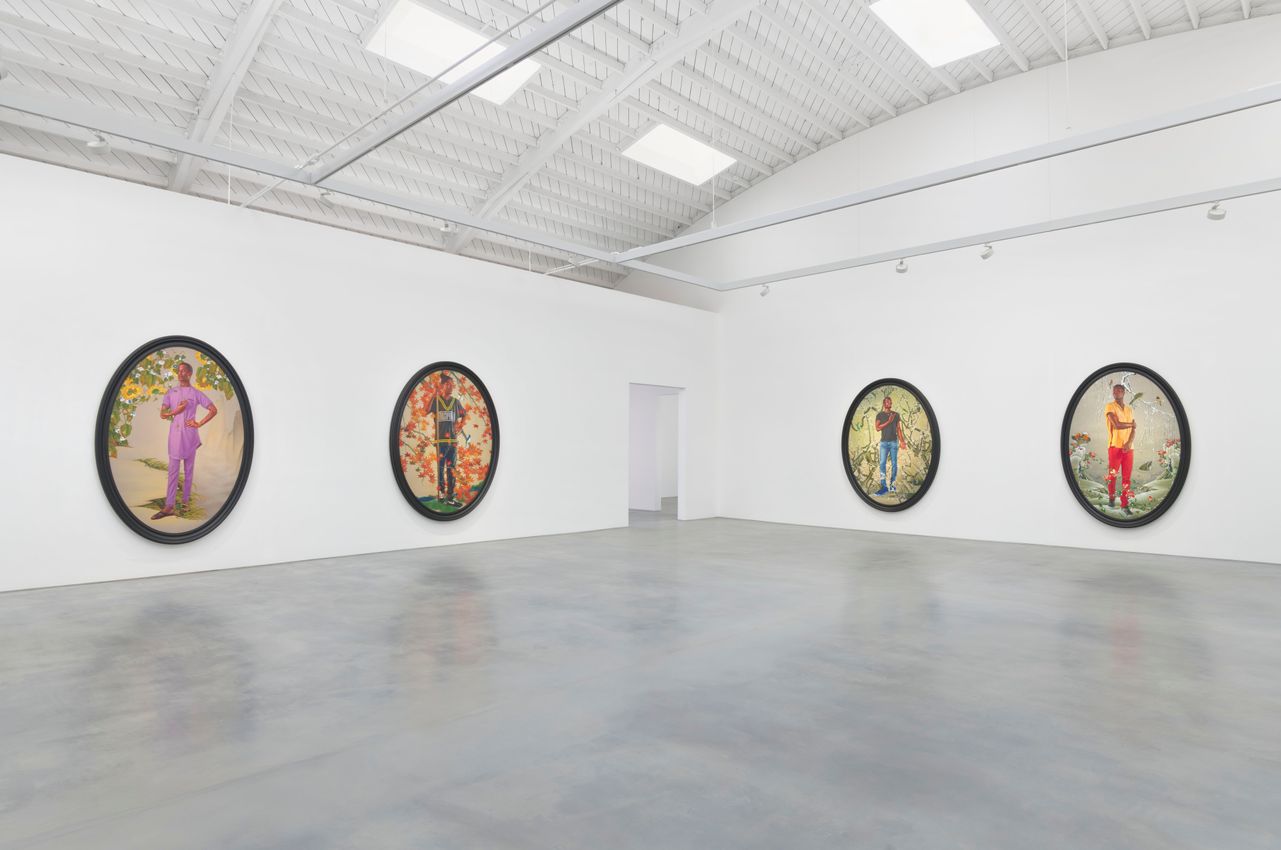
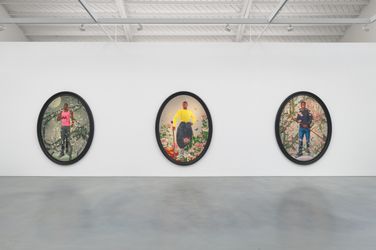
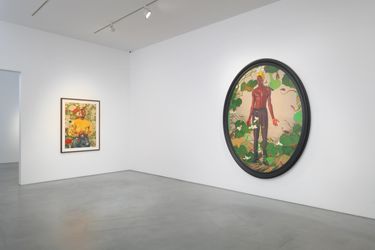
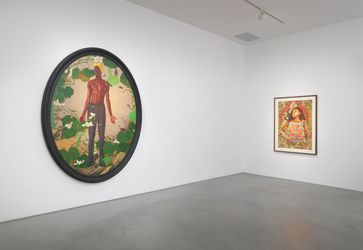
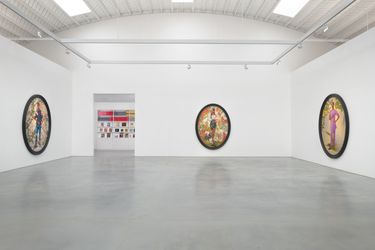
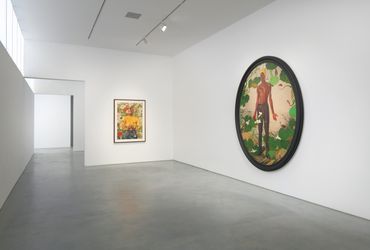
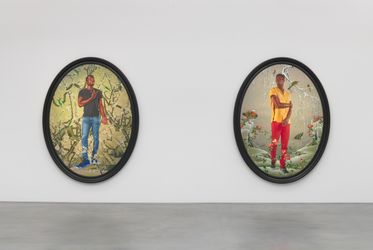
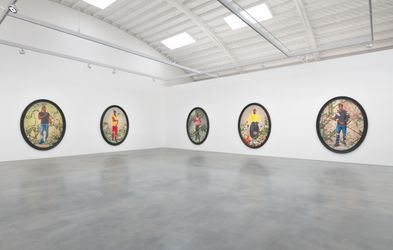
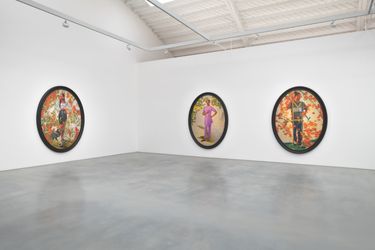
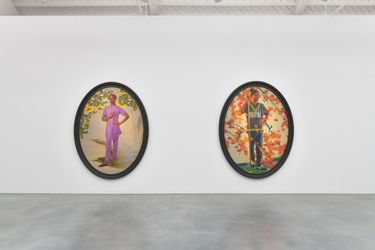
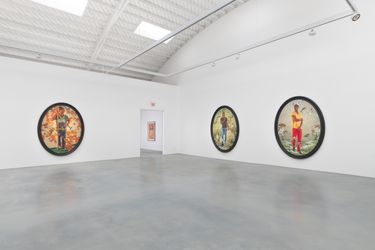
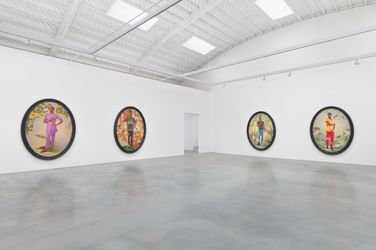
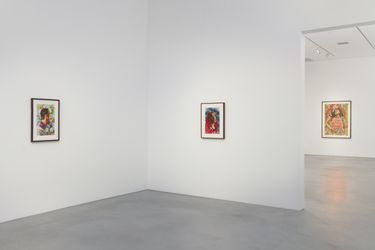
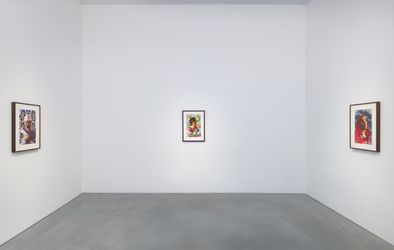
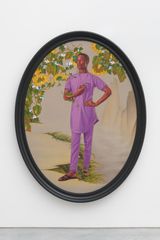
Roberts Projects is delighted to announce Colorful Realm, anexhibition of new work from renowned contemporary artist Kehinde Wiley.Drawing inspiration from Japanese nature paintings of the Edo period(c.1600–1868), Wiley parallels traditional techniques and materials innine monumental paintings. Exposed linen highlights the depicted naturalscenes while also preserving the delicate balance of the untouchedpicture space. Per the artist, “So much of my work is about appearanceand showing up and being visible, and this dance between exploring thevastness of space within the minimality of this technique I find to bean interesting juxtaposition.”
In this new work, Wiley references famed Edo-period artists such asKitagawa Utamaro, Kiyohara Yukinobu, and Utagawa Kunisada in his use ofnegative space in compositions that significantly advance his distinctvisual lexicon. In the absence of something besides a single subject,the functional emptiness highlights the oneness of nature and theexpansive scale of the natural world. The impact of these ideas echoesthroughout. The focal point of each painting is the story itself, onethat extends beyond a path that blends into the horizon, and theunderstanding of the narrative as a whole. Similarly, Itō Jakuchū’srenowned Images of theColorful Realm of Living Beings (c.1757-1766), from which this exhibition takes its title, embodies hownature scenery is depicted and symbolized in Japanese art.
Panoramic displays of flora and fauna—both real and fantastical—arerendered in meticulous detail on raw silk in rich compositions that blurthe boundary between painting and objects of devotion. Jakuchū’svirtuosity in capturing these details is noteworthy, as it providedconsiderable insight into the then-contemporary understanding of therelationship between nature and art.
Wiley broadens the political context of the divine subject, asadmired by an Edo audience, by exploring painting’s role incommunicating power, ritual, and performativity, and how this dialoguecan shift historical memory by both incorporating and monumentalizingBlack and brown men and women in art historical spaces not accustomed totheir presence.
The mid-Edo period saw the rapid growth of an urban culture, due inpart to the movement of artists between rural to inner-city locales, andan expansion of both literary and artistic practices, includingpainting, woodblock prints, ceramics, lacquer, and textiles. This periodalso saw the growing influence of different cultural markers,specifically Chinese and Western art, newly reflected within Japaneseaesthetic principles. In Wiley’s reinterpretation of the Edo period’svisual vocabulary, the overlapping relationships are decidedly moreglobal. Per Wiley, “This series has developed over a number of years andhas involved models from different stages of my life. You’ll findmodels from New York, West Africa, and Europe. This exhibition is anopportunity to picture some of my favorite subjects within one body ofwork.”
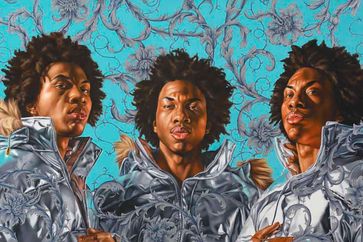
With this new series, Wiley recontextualizes the naturalist landscapegenre from a non-Western perspective, activating different historicalmemories and therefore different ways of thinking about man’srelationship to nature. Generally removed from any narrative content, here-presents the landscape as one with intersecting cultural, social,and artistic discourses. The aesthetic principles of hispractice–portraits defined by their dramatic realism set against dynamicbackgrounds–have expanded to incorporate a heightened appreciation forthe natural world. The rigidly structured English William Morris style,as featured in Wiley’s celebrated series The Yellow Wallpaper(2020), has given way to a more organic aesthetic expression. Theoverall effect, in its looseness and beguiling simplicity, is moresubtle, more sensitive yet more complex when seen as a whole.
In both subject matter and execution, these new works are alsonotable in how they emphasize a dimensional space with no end, one thatextends beyond the limits of the painting itself. Wiley’s use of boldoutlines and almost flat regions of color contrast against the nearblankness of exposed raw linen, which becomes less of a color than asuggestion, or tone. The empty spaces connect intertwining leaves andflowers, and separate, yet link figures. In these paintings, Wileycreates presence in the physicality of absence, and this conception ofspatiality and space centers not only on space itself, but ontemporality, relations, negation, and negotiation. It is in this void,untied to any specific time or space, where different people, places,and experiences can be found and converge, without resistance orboundaries.
To clarify what he describes as a “divine void,” in these paintings,Wiley proposes his act of painting as one of refusal. His suspension ofthe figure in a sort of self-described “fabulous vacuum,” where theypreviously existed in a purely decorative environment, espouses anintimacy that is provocative without being exploitative. In this space,his subjects achieve a type of joy, a type of freedom, and finally, atype of impossibility. It is a state of being that is in directopposition to the reality of how Black and brown bodies exist incontemporary American society: surviving the paucity of access to bothnatural and societal resources that is deliberate, cumulative, andsystemic. Per Wiley, “In this new turn, I’m trying to break open theconversation again towards what nature really means in the 21st century,in an era of widespread ecological disasters. Our relationship withnature is increasingly in a perilous position. It invites areinterpretation of not only an incredible opportunity to explore thevastness and the beauty of nature, but also the astonishing fragilityand sadness that surrounds us, and lost opportunities.”
Colorful Realm is the artist’s sixth solo exhibition withRoberts Projects and is the inaugural show at the gallery’s newMid-Wilshire Los Angeles space.
In conjunction with the exhibition, an extensively illustrated catalogue will be published by Roberts Projects in 2023.
About the ArtistKehinde Wiley (b. 1977, Los Angeles) is an American artist best knownfor his portraits that render people of color in the traditionalsettings of Old Master paintings. Wiley’s work brings art historyface-to-face with contemporary culture, using the visual rhetoric of theheroic, the powerful, the majestic and the sublime to celebrate Blackand brown people the artist has met throughout the world. Working in themediums of painting, sculpture, and video, Wiley’s portraits challengeand reorient art-historical narratives, awakening complex issues thatmany would prefer to remain muted.
In Summer 2023, a monumental bronze sculpture will be unveiled atSankofa Park, commissioned by Destination Crenshaw, Los Angeles.
Recent exhibitions include Kehinde Wiley: An Archaeology of Silence,Fondazione Giorgio Cini, Venice, Italy, a collateral event of the 59thInternational Art Exhibition, La Biennale di Venezia (2022); Kehinde Wiley: The Prelude,The National Gallery, London, England (2022). In 2021, The HuntingtonLibrary commissioned Wiley to create a new painting inspired by ThomasGainsborough’s The Blue Boy (ca. 1770). A Portrait of a Young Gentleman(also the original title of the Gainsborough painting) is now in TheHuntington’s permanent collection. In 2018, Wiley became the firstAfrican American artist to paint an official U.S. Presidential portraitfor the Smithsonian National Portrait Gallery. Former U.S. PresidentBarack Obama selected Wiley for this honor. In 2019, Wiley founded BlackRock Senegal, a multidisciplinary artist-in-residence program thatinvites artists from around the world to live and create work in Dakar,Senegal. Wiley is the recipient of the U.S. Department of State’s Medalof Arts, Harvard University’s W.E.B. Du Bois Medal, and France’sChevalier dans l’Ordre des Arts et des Lettres (Knight of the Order ofArts and Letters). He holds a BFA from San Francisco Art Institute, anMFA from Yale University, and honorary doctorates from the Rhode IslandSchool of Design and San Francisco Art Institute. He has held soloexhibitions throughout the United States and internationally and hisworks are included in the collections of over 50 public institutionsaround the world. He lives and works in Beijing, Dakar, and New York.
Exhibition view: Kehinde Wiley, Colorful Realm, Roberts Projects, Los Angeles (January 21 - April 8, 2023). Courtesy of the artist and Roberts Projects. Photo: Robert Wedemeyer
Exhibition view: Kehinde Wiley, Colorful Realm, Roberts Projects, Los Angeles (January 21 - April 8, 2023). Courtesy of the artist and Roberts Projects. Photo: Robert Wedemeyer
Exhibition view: Kehinde Wiley, Colorful Realm, Roberts Projects, Los Angeles (January 21 - April 8, 2023). Courtesy of the artist and Roberts Projects. Photo: Robert Wedemeyer
Exhibition view: Kehinde Wiley, Colorful Realm, Roberts Projects, Los Angeles (January 21 - April 8, 2023). Courtesy of the artist and Roberts Projects. Photo: Robert Wedemeyer
Exhibition view: Kehinde Wiley, Colorful Realm, Roberts Projects, Los Angeles (January 21 - April 8, 2023). Courtesy of the artist and Roberts Projects. Photo: Robert Wedemeyer
Exhibition view: Kehinde Wiley, Colorful Realm, Roberts Projects, Los Angeles (January 21 - April 8, 2023). Courtesy of the artist and Roberts Projects. Photo: Robert Wedemeyer
Exhibition view: Kehinde Wiley, Colorful Realm, Roberts Projects, Los Angeles (January 21 - April 8, 2023). Courtesy of the artist and Roberts Projects. Photo: Robert Wedemeyer
Exhibition view: Kehinde Wiley, Colorful Realm, Roberts Projects, Los Angeles (January 21 - April 8, 2023). Courtesy of the artist and Roberts Projects. Photo: Robert Wedemeyer
Exhibition view: Kehinde Wiley, Colorful Realm, Roberts Projects, Los Angeles (January 21 - April 8, 2023). Courtesy of the artist and Roberts Projects. Photo: Robert Wedemeyer
Exhibition view: Kehinde Wiley, Colorful Realm, Roberts Projects, Los Angeles (January 21 - April 8, 2023). Courtesy of the artist and Roberts Projects. Photo: Robert Wedemeyer
Exhibition view: Kehinde Wiley, Colorful Realm, Roberts Projects, Los Angeles (January 21 - April 8, 2023). Courtesy of the artist and Roberts Projects. Photo: Robert Wedemeyer
Exhibition view: Kehinde Wiley, Colorful Realm, Roberts Projects, Los Angeles (January 21 - April 8, 2023). Courtesy of the artist and Roberts Projects. Photo: Robert Wedemeyer
Exhibition view: Kehinde Wiley, Colorful Realm, Roberts Projects, Los Angeles (January 21 - April 8, 2023). Courtesy of the artist and Roberts Projects. Photo: Robert Wedemeyer
Exhibition view: Kehinde Wiley, Colorful Realm, Roberts Projects, Los Angeles (January 21 - April 8, 2023). Courtesy of the artist and Roberts Projects. Photo: Robert Wedemeyer
Kehinde Wiley (b. 1977, Los Angeles) is a world-renowned visual artist, best known for his vibrant portrayals of contemporary African-American and African-Diasporic individuals that subvert the hierarchies and conventions of European and American portraiture. Working in the mediums of painting, sculpture, and video, Wiley’s portraits challenge and reorient art-historical narratives, awakening complex sociopolitical issues that many would prefer remain muted.
Roberts Projects offers a critical and discursive platform for presenting diverse perspectives on contemporary art. It commissions and showcases projects from a multinational, multi-generational, and multi-disciplinary array of artists.