






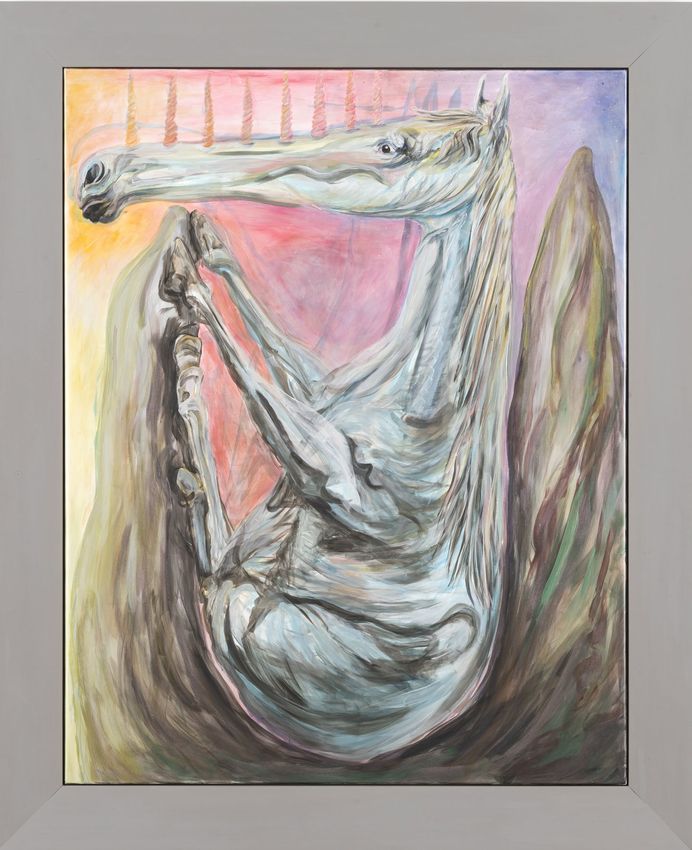
JANA EULER
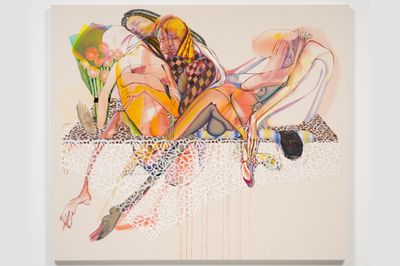
b. 1982, GermanySince the mid-2000s German artist Jana Euler has produced a heterogeneous body of work that diagrams painting’s social, material, and historical bases. Known for her exacting technique and a cast of characters both real and imagined, Euler “doesn’t break convention,” writes Isabelle Graw, but rather “makes the sometimes-excruciating restraints it imposes visible and explicit, performing a black comedy of accommodation.” Old or new masters—from Leonardo to Duchamp, Georg Baselitz to her Städelschule teacher Michael Krebber—provide Euler with templates that she is free to bloat, vaporize, or otherwise pervert. Pop icons serve as references, too (Ed Sheeran, Whitney Houston), as do animals, whether phallic sharks and slugs or Morecorns, a mythical creature of her own invention. Often treating her subjects with deadpan affect, Euler renders the familiar inscrutable, questioning the authority or self-evidence of these sources in turn.Houston’s presence, in _Whitney _(2013), signals Euler’s interest in the social construction of image and taste in not just in mainstream culture but also art’s networks. The title duly refers to the New York museum which commissioned it and which appears as a specter abutting the face of the singer. Euler’s work has long been attuned to the impact of art’s institutions and conventions on the body, human and otherwise. The figures in paintings such as _Human Size _(2014)—or the tangled nudes in her 2020 Artist’s Space exhibition Unform—contort themselves to fit rectangular frames, as if documenting the biological impact of art’s structures writ large.
Power and institutionality likewise motivate a group of paintings that depict electrical sockets. “For Euler,” notes Catherine Chevalier, “the exhibition is a device for circulating energy.” In solo shows at Kunsthalle Zürich and the Stedelijk Museum, such canvases highlight circulation’s often binary framing: on/off, input/output, male/female. Yet, here as elsewhere, Euler ultimately implies power’s dimensionality as not binary but multiple—and often hidden, whether by architectural cladding or art historical myths.
Courtesy Greene Naftali





Explore and Follow Artists Shaping Contemporary Art
A respected voice in contemporary art discourse.
Focusing on ambitious storytelling and insightful art-world commentary. Ocula Magazine publishes in-depth interviews, critical essays and timely analysis on the artists, exhibitions and ideas driving the global art world.
Learn more about Ocula Magazine
Showcasing the best of the art world.
Ocula partners with galleries from around the world to highlight their artists, artworks and exhibitions. Gallery membership is by application and invitation, with each member vetted by an independent panel.
Learn more about Ocula Membership
Specialises in the sale of major artworks.
Led by a team with deep ties to the world’s leading auction houses, galleries and collectors. Ocula’s advisory team offers bespoke services to high-net-worth clients from around the world who are looking to acquire the best of contemporary and modern art.
Learn more about our team and services