





JULES DE BALINCOURT
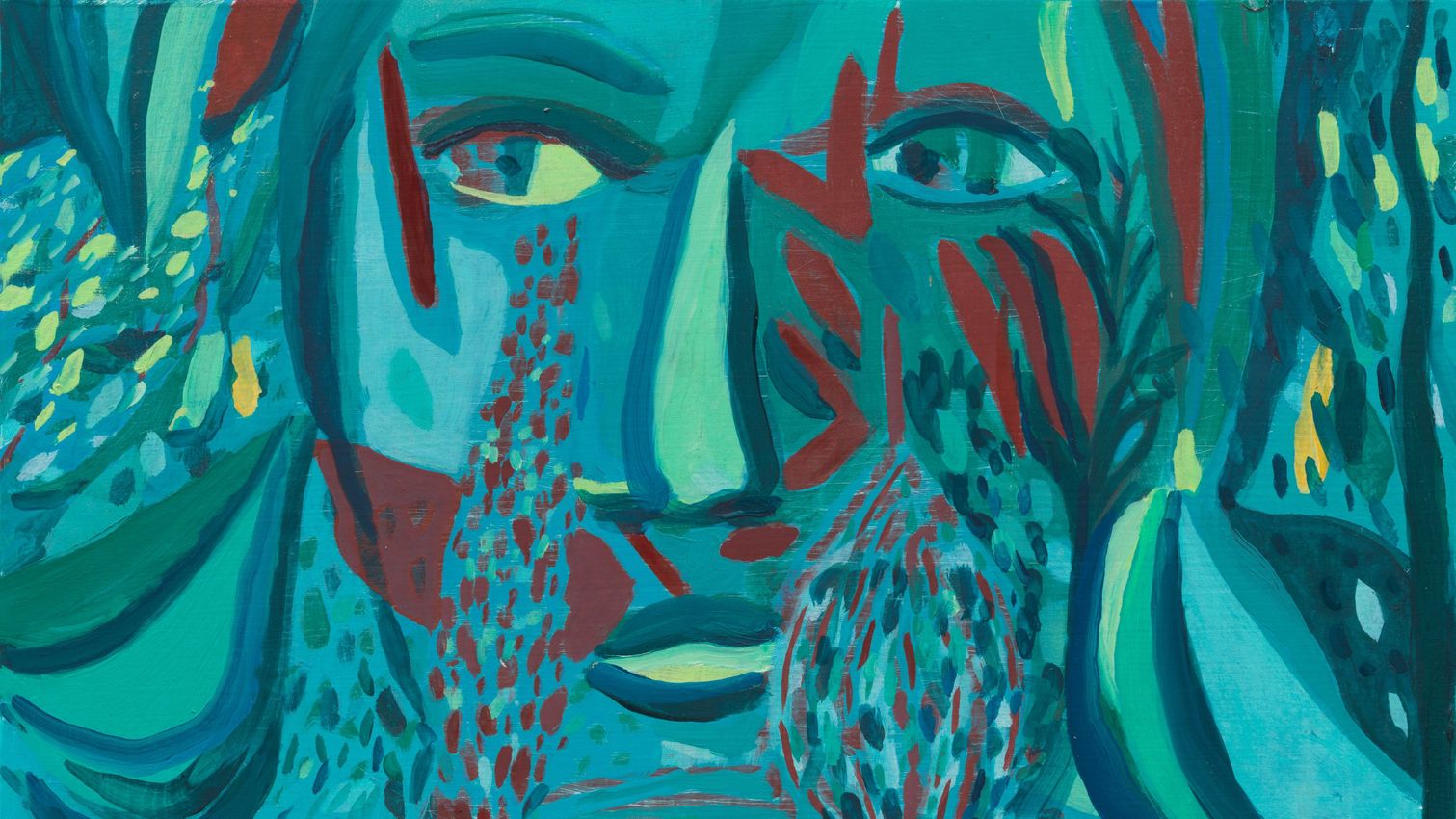
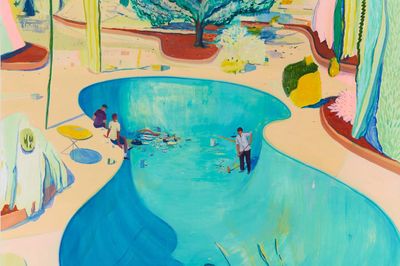
b. 1972, FranceEvoking notions of utopia and dystopia, Jules de Balincourt’s paintings investigate public and private spaces and suggest an ever-changing landscape – both physical and psychological. In the paintings for which he first became known, de Balincourt worked from the position of an outsider (the Paris-born artist has lived in the United States since childhood), questioning structures of power and influence, laying bare injustices and hypocrisies while maintaining an amused attachment to the myths through which identity – individual and national – is constructed. From big screen legends, such as celluloid cowboy Clint Eastwood (Good, Bad, Ugly, 2008) to newsreel-like pronouncements (United We Stood, 2005), in these paintings de Balincourt employs a post-Pop painterly language to signal shifting sentiments or former glories, made all the more melancholy when they appear etched in mainstream culture.
Apparent freedoms and their human cost are foregrounded in a key painting such as People Who Play and The People Who Pay, 2004, in which divisions of labour and skin colour are all too familiar. Yet, through provocative detail or disconcerting shifts of scale, often the works destabilise their own apparent narratives.
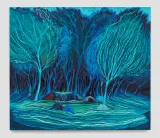
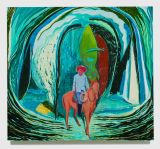
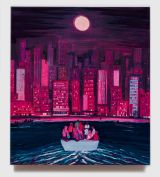
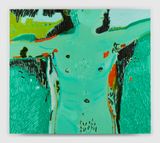
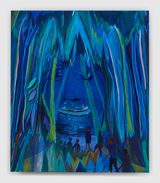
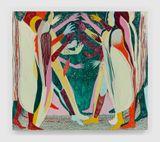
In paintings such as the cityscape High and Low, the acid-bright leisure scene BBQ sur l’herbe, Firepeople and Visionquest, all 2013, where figures come together in hopes of spiritual enlightenment, de Balincourt has moved away from direct references to current social, political or popular culture, and instead depicts a world in which indications of specific place or time are absent. More recently, as in the paintings made for his 2016 Victoria Miro exhibition Stumbling Pioneers, de Balincourt explores the frontier as a charged concept in contemporary culture. Painted on return to his hometown Los Angeles after a 20-year interval, works such as Sanctuary, Truck Stop Blues and Night Moves, all 2016, road-trip through the mythic and geographically sprawling metropolis with an eye for man’s uncertain relationship with his environment.
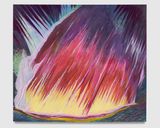
De Balincourt’s process involves various techniques – including stencilling, masking, abrading and spray painting – that, from a distance, create an apparently seamless vision. Up close, however, the eye is caused to snag over deliberate disjunctions. A sense of things breaking apart is a powerful imaginative motor that finds a particularly strong visual correlation in de Balincourt’s map paintings, including the US World Studies series, where familiar territories are organised according to various hidden, unknown or unspoken criteria. Dual intimations of creation and destruction pulse through works such as Burst Painting, 2012, an ‘explosion’ of radiating colour where cause and effect remain mysterious.
Between explosive suns and flickering screens, de Balincourt invites us to journey across territories that might be celestial or earthbound, cartoon or cyber in origin to consider the physical and metaphysical in contemporary life. He paints a restless world both in form and content.
Jules de Balincourt, born in Paris, France in 1972, lives and works in Brooklyn, New York. De Balincourt’s work has been the subject of a number of international solo exhibitions at institutions including Kasseler Kunstverein, Kassel, 2015; The Modern Art Museum of Fort Worth, Texas, 2014–2015; Rochechouart Museum of Contemporary Art, Rochechouart, 2014; Montreal Museum of Fine Arts, Montreal, 2013; Mori Art Museum, Tokyo, 2010, and Vanderbilt University Fine Arts Gallery, Nashville, 2008. His work has also been included in a number of significant group exhibitions, including L’Ange de l’Histoire, curated by Nicolas Bourriaud at le Palais des Beaux-Arts, Paris, 2013; New York Minute, Garage Center for Contemporary Culture, Moscow, 2011 and the 10th Havana Biennial, Museo Nacional de Bellas Artes, Havana, 2009.
Courtesy Victoria Miro

Works at Victoria Miro







Recently Exhibited



Works Elsewhere











Explore and Follow Artists Shaping Contemporary Art
A respected voice in contemporary art discourse.
Focusing on ambitious storytelling and insightful art-world commentary. Ocula Magazine publishes in-depth interviews, critical essays and timely analysis on the artists, exhibitions and ideas driving the global art world.
Learn more about Ocula Magazine
Showcasing the best of the art world.
Ocula partners with galleries from around the world to highlight their artists, artworks and exhibitions. Gallery membership is by application and invitation, with each member vetted by an independent panel.
Learn more about Ocula Membership
Specialises in the sale of major artworks.
Led by a team with deep ties to the world’s leading auction houses, galleries and collectors. Ocula’s advisory team offers bespoke services to high-net-worth clients from around the world who are looking to acquire the best of contemporary and modern art.
Learn more about our team and services