





KATHARINA SCHILLING
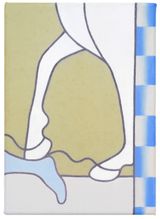
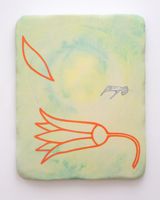
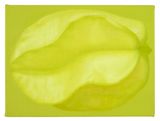
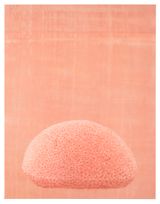
b. 1984, GermanyIn Katharina Schilling’s painting, well-known everyday objects–vases, sponges, fruits, or template-like drawings float weightlessly in images free from time and space. Shadowless and flawless, the objects stand out against reduced backgrounds and maintain their inwardness in supposed calm and order. In the images, speculation about preservation and negation is reflected in the arrangement and oscillation of objectivity and abstraction.
Katharina Schilling isolates items from their original context and emphasises them on the canvas. With an apparent lightness the objects move around the image space, either alone or in nonhierarchical clusters. In the work Rhubarb (2018), rhubarb stalks frolic in a seemingly random juxtaposition in front of a background painted with equally delicate colour pigments. Their curved form is reflected in the template-like drawing of a finger–a pawn of our world today that is shaped by information technology and the flood of images. Thrown into a new context, into a supposed state of simultaneity–without any recognisable relation to each other–the motifs evade an unambiguous interpretation. The isolation and the representation of the objects in formal perfection immediately trigger the desire to touch–as if one could grasp the objects.
The artist addresses the canvas with the same special attention. Separated from the objects in the foreground, the definitely designed canvas backgrounds tell of their own independence. Colouring, folding, or rubbing the background results in completely unique structures. This is how the work Pool (2016) captivates with its unique pattern. In addition, the rounded corners give the work an autonomous objecthood. In her most recent pictures, The Gift (2017) and Little Dark Age (2018), the artist emphasises the objectivity of the image carrier even more intensely. Like Gotthardt Graubner’s Farbraumkörper (Color Space Body), Katharina Schilling’s images gain physicality and spatial impact by use of stretcher frames and foam layers. In addition, they obtain sensual qualities through their softness and curves. In a fast-paced world in which painting has long since lost its sovereignty in terms of image generation to other, technological media, the artist knows how to use it as a true medium of deceleration.
Katharina Schilling (born 1984, Cologne) studied at the Hochschule für Grafik und Buchkunst in Leipzig under Neo Rauch, among others. Later she graduated as a master student under Heribert C. Ottersbach. In 2016 she was the recipient of the Marion Ermer Prize, and Katharina Schilling was one of the nominees for the Böttcherstrasse Art Prize 2018 in Bremen, in conjunction with an exhibition at the Kunsthalle Bremen.
Katharina Schilling lives and works in Berlin and Vienna.
Text courtesy Beck & Eggeling International Fine Art.








Explore Katharina Schilling's Exhibitions





Explore and Follow Artists Shaping Contemporary Art
A respected voice in contemporary art discourse.
Focusing on ambitious storytelling and insightful art-world commentary. Ocula Magazine publishes in-depth interviews, critical essays and timely analysis on the artists, exhibitions and ideas driving the global art world.
Learn more about Ocula Magazine
Showcasing the best of the art world.
Ocula partners with galleries from around the world to highlight their artists, artworks and exhibitions. Gallery membership is by application and invitation, with each member vetted by an independent panel.
Learn more about Ocula Membership
Specialises in the sale of major artworks.
Led by a team with deep ties to the world’s leading auction houses, galleries and collectors. Ocula’s advisory team offers bespoke services to high-net-worth clients from around the world who are looking to acquire the best of contemporary and modern art.
Learn more about our team and services