





LAP-SEE LAM
b. 1990, SwedenStockholm-based Lap-See Lam uses films, sculpture, animation and VR to explore the Cantonese diaspora and consider how perceptions of the self and cultural belonging are created and changed through space and place, mythology, popular culture, orientalisation and fiction.
Early Years
Lap-See Lam was born in Stockholm in 1990 and grew up among the Cantonese community. She remembers her family’s Chinese restaurant, Bamboo Garden, as being a comfortable, welcoming space with “a jade-green pagoda” and textiles embroidered with patterns of koi fish. Lap-See Lam gained her BFA from the Royal Institute of Art in Stockholm in 2016 and her MFA in 2020. That same year she was mentioned in Forbes magazine’s “30 under 30” list of promising arts and culture talent. Lam’s parents decided to sell Bamboo Garden in 2014 at a time when she was interested in then-emergent 3D scanning technology. Lam wanted to research the history of similar restaurants, mapping the aesthetics of the businesses and the people behind them. In a relatively small community, Lam’s parents had many contacts and drove her around Sweden to make her 3D scans.
Lap-See Lam: Artworks
Lap-See Lam uses her creative practice to investigate the Cantonese diaspora, migration and the idea of exoticising (and mistranslating) cultural symbols. She re-imagines traditional Chinese storytelling forms, including opera and shadow play. Using early 3D scanners to collect her source material from Sweden’s Chinese restaurant community, she often found that the 2010s technology was limited. She has aligned the resulting glitchy scans with the idea of the passing on of stories and knowledge from generation to generation: information becomes mutated in memory, just as the scans became deformed. Figures accidentally captured on the scans have also featured as “ghosts”.
- Mother’s Tongue (2017) uses the concept of time travel to consider the history of Chinese restaurants in Stockholm. The video installation featured the narration of fictional restaurant staff from the past, present and future.
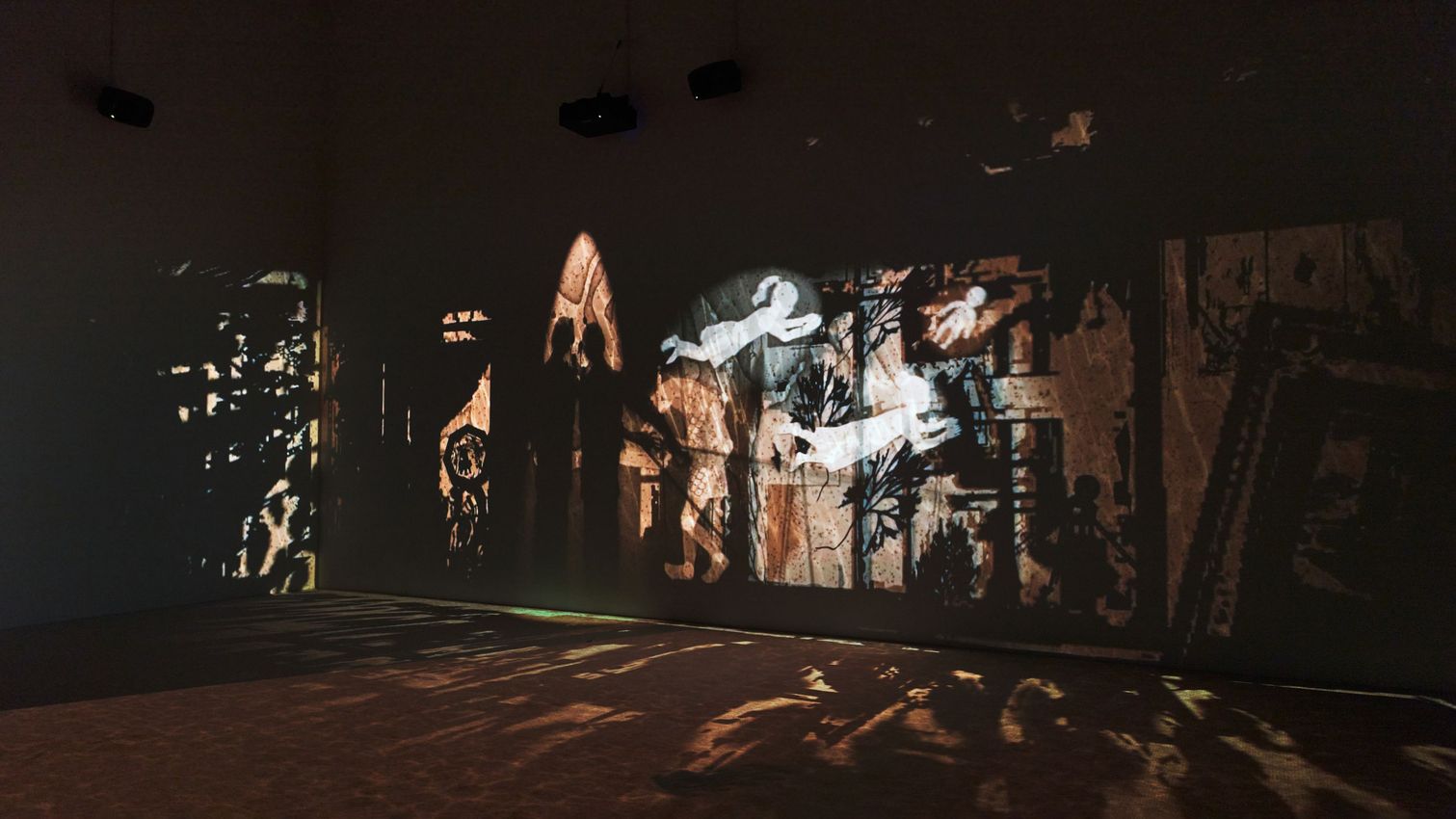
- Phantom Banquet (2020) follows the story of a waitress in 1978 who disappears through a mirror into another dimension. Lap-See Lam took recognisable restaurant essentials—a table, flower vases, chairs etc—and re-staged them into installations created from sculptural ensembles, 3D scanning, animation and VR.
- Shadow Play (2025) draws on the Chinese storytelling form of shadow theatre, which Lam reinterprets as a metaphor for diaspora, considering how migration and the passing of time can alter the parameters of tradition and information.
Lap-See Lam: Select Awards
- Lise Wilhelmsen Art Award (2025)
- Dagens Nyheter Culture Prize (2021)
- City of Stockholm Culture Prize (2021)
- Forbes 30 Under 30 Europe, Art and Culture (2021)
- Maria Bonnier Dahlin Foundation Art Prize (2018)
Lap-See Lam: Exhibitions
Select Solo Exhibitions
- Bamboo Palace, Revisited, Blindspot Gallery, Hong Kong (2026)
- Floating Sea Palace, The Power Plant, Toronto (2025)
- Hammer Projects: Lap-See Lam, Hammer Museum, Los Angeles (2025)
- Shadow Play, PHI Foundation, Montreal (2025)
- Begin Again, Begin Again, Moderna Museet, Stockholm (2025)
- Floating Sea Palace, Studio Voltaire, London (2024)
- The Altersea Opera, Nordic Pavilion, 60th Venice Biennale (2024)
- Tales of the Altersea, Portikus, Frankfurt and Swiss Institute, New York City (2023)
- Dreamers’ Quay, Buffalo AKG Art Museum, New York City (2023)
- Phantom Banquet, Lidköping Konsthall, Lidköping (2023)
- Tales of the Altersea (Prologue), Galerie Nordenhake, Berlin (2023)
- Det regnar drakfjäll (It’s raining dragon scales), Röhsska Museet, Gothenburg (2022)
- Phantom Banquet, Galerie Nordenhake, Stockholm (2020)
- Horizontal, Skellefteå Konsthall, Skellefteå and Erik Nordenhake, Stockholm (2019)
- Like the Eight Immortals, L’Ascensore, Palermo (2017)
Select Group Exhibitions
- Cutting the Puppeteer’s Strings, Sammlung Philara, Düsseldorf (2024)
- Setting the Tone of the Exhibition—The Anatomy of Exhibition Openings, Malmö konstmuseum, Malmö (2024)
- Shades of Daphne, Kasmin Gallery, New York City (2023)
- Ars Fennica 2023, Museum of Contemporary Art Kiasma, Helsinki (2023)
- Landscapes of Belonging, Kindl Centre for Contemporary Art, Berlin (2022)
- Ett hem, Thielska Galleriet, Stockholm (2022)
- Soy Dreams of Milk, Blindspot Gallery, Hong Kong (2022)
- Public Art Agency Sweden’s acquisitions 2021, Skissernas Museum, Lund (2022)
- Ghost 2565: Live Without Dead Time, Bangkok (2022)
- Future Generation Art Prize, Pinchuk Art Centre, Kyiv (2021)
- Artsy Vanguard 2021, Mana Contemporary, Miami (2021)
- Death-Ray on the Coral Island, Power Station of Art, Shanghai (2021)
- MMXX, Konstakademien, Stockholm (2020)
- Mother’s Tongue, CPH:DOX, Copenhagen (2020)
- Unhomed, Uppsala Konstmuseum, Uppsala (2020)
- Performa 19 Biennial, Jeffrey Deitch Gallery, New York City (2019)
- Metamorphosis. Art in Europe Now, Cartier Foundation, Paris (2019)
- SoftCity, Coyote, Stockholm (2019)
- Cartography of Memory, Pina, Vienna (2019)
- Luleå Biennial 2018: Tidal Ground, Luleå Konsthall, Luleå and Ájtte Museum, Jokkmokk (2018)
- Four as One and Three, Gallery Kendra Jayne Patrick, New York City (2018)
- After School Special, Landmark, Bergen (2017)
- Aperto, Fondazione Antonio Ratti, Como (2016)
- Rundgång, Royal Institute of Art, Stockholm (2016)
Further Reading
- Lap-See Lam’s official website
- Lap-See Lam’s Instagram 2024
- Interview in the Guardian Lap-See Lam wins the Lise Wilhelmsen award
Lap-See Lam FAQs
What is Lap-See Lam’s connection to European Chinese restaurants?
Some of Lap-See Lam’s installations are concerned with Chinese restaurants, because her family was involved in the restaurant trade in Europe. Her grandmother moved from Hong Kong to London during the 1960s and worked in restaurants in Chinatown for a decade. She became—rarely at the time—a chef at a Chinese restaurant in Sweden, and the rest of her family were able to follow her from Hong Kong. Lap-See Lam’s family’s restaurant, Bamboo Garden in Stockholm, was, she has said “an extension of our home”.
What materials and techniques does Lap-See Lam use?
Lap-See Lam explores the ideas of place, belonging and cultural identity using video, sculptural installation, fiction, virtual reality, 3D scanning and 3D printing.
Was Lap-See Lam inspired by a shipwreck?
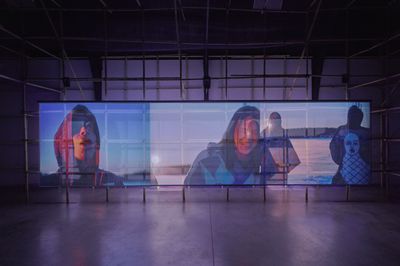
In a sense, yes. Lap-See Lam’s immersive video installation Floating Sea Palace (2023) was inspired by the view from her window in art school: a dragon-shaped ship that sailed from Shanghai to Gothenburg in 1990 with a plan to open as a restaurant in ports in the North Sea and Baltic Sea. The business did not pan out as intended, and when the ship sailed into Lam’s view, it was about to be remodelled as a haunted house at a Stockholm theme park, with its traditional loong head and tail removed. Lam’s dreamlike installation considered the folklore around the mythological half-man/half-fist figure Lo Ting, filming many scenes on board the ship itself.
Ocula

Representative Artworks

View story

View story

View story
View exhibition
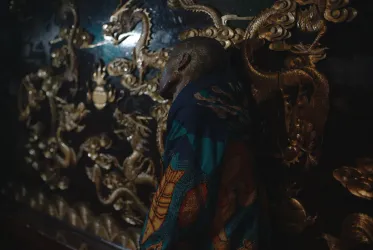
Lap-See Lam, Floating Sea Palace (2024) (still). Courtesy the artist; Galerie Nordenhake, Berlin/Stockholm/Mexico City; Moderna Museet, Stockholm; The Vega Foundation; Studio Voltaire, London; The Power Plant Contemporary Art Gallery, Toronto.

View story





Explore and Follow Artists Shaping Contemporary Art
A respected voice in contemporary art discourse.
Focusing on ambitious storytelling and insightful art-world commentary. Ocula Magazine publishes in-depth interviews, critical essays and timely analysis on the artists, exhibitions and ideas driving the global art world.
Learn more about Ocula Magazine
Showcasing the best of the art world.
Ocula partners with galleries from around the world to highlight their artists, artworks and exhibitions. Gallery membership is by application and invitation, with each member vetted by an independent panel.
Learn more about Ocula Membership
Specialises in the sale of major artworks.
Led by a team with deep ties to the world’s leading auction houses, galleries and collectors. Ocula’s advisory team offers bespoke services to high-net-worth clients from around the world who are looking to acquire the best of contemporary and modern art.
Learn more about our team and services