






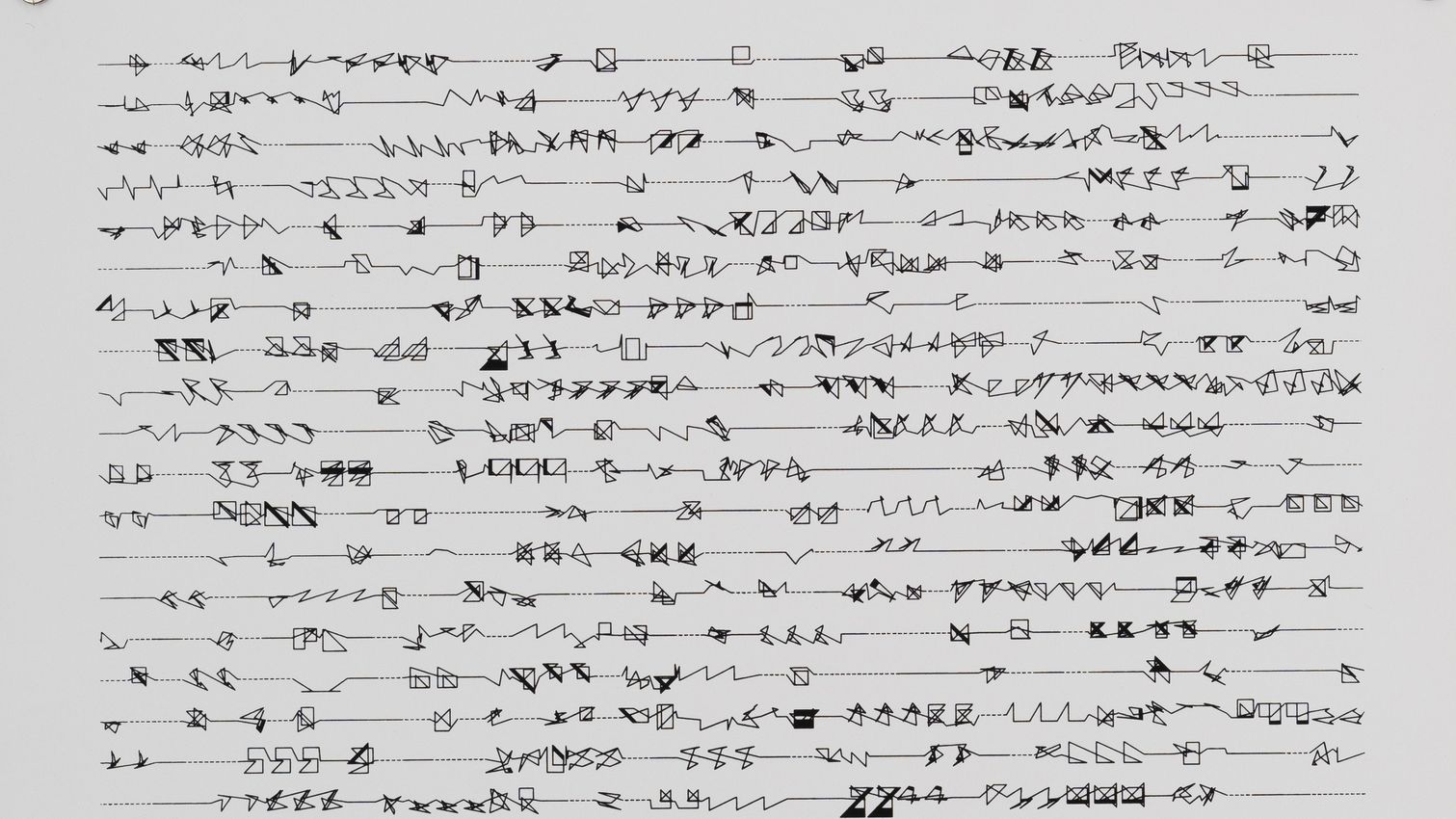
MANFRED MOHR
b. 1938, GermanyManfred Mohr is a German-born artist recognised as a pioneering figure in software and digital art. Born on June 8, 1938, in Pforzheim, Germany, Mohr’s innovative use of computers, algorithms and plotter machines has significantly influenced modern and contemporary abstract art.
Early Years and Education
Mohr’s artistic journey began with studies in painting and goldsmithing at the Kunst und Werkschule in Pforzheim in 1957. His early work was heavily influenced by abstract expressionism and his passion for jazz music, which he pursued professionally as a saxophonist. Mohr hails from a family of musicians, and he credits this immersion in music, and later jazz, to honing his abstract and improvisational way of thinking and working. In 1962, he relocated to Barcelona, earning a living as a musician before moving to Paris in 1963 to study lithography at the École des Beaux-Arts. He moved to New York in 1981, where he still lives and works.
How did Mohr incorporate computers into his work?
Max Bense’s writings on information aesthetics profoundly impacted Mohr, steering him toward a more rational and systematic approach to art and abstraction. In 1967, he met Pierre Barbaud, a pioneer in computer-generated music, who further influenced Mohr to experiment with computers and programming in his pursuit of systems-based artmaking. By 1969, Mohr created artworks using computer algorithms, marking a significant departure from traditional artistic methods.
Artistic practice and notable works
Mohr was a pioneer of using computers to create art. He taught himself programming in 1969 and used a CDC 6400 computer at the Paris Météorologie nationale algorithms to explore abstraction and the complexities of interdimensionality. His early computer-generated pieces focused on rhythm and repetition, reflecting his musical background.
In the 1970s, he began an in-depth exploration of the cube and hypercube structures, leading to works such as Cubic Limit (1973) and Divisibility (1980–84). These works explore the visual representation of four-dimensional and higher-dimensional objects, challenging perceptions of space and form.
Exhibitions and retrospectives
Mohr’s groundbreaking contributions have been showcased worldwide in numerous solo exhibitions and retrospectives. Notably, in 1971, a solo exhibition of the artist’s work was shown at the Musée d’Art Moderne de la Ville de Precognisedgnized as the first museum exhibition featuring entirely computer-generated works. Other significant solo exhibitions include:
- Manfred Mohr: broken symmetry / Computer Works 1969 - 2007, Kunsthalle Bremen (24 April–1 July 2001).
- Der Algorithmus des Manfred Mohr, 1963- Present, ZKM | Media Museum in Karlsruhe (8 June–Sun September 2013).
- Manfred Mohr, A Formal Language: Celebrating 50 Years of Artwork and Algorithms, bitforms gallery, New York (7 September–3 November 2019).
What awards has Manfred Mohr won?
Throughout his career, Mohr has received numerous accolades, reflecting his status as a leading figure in digital art. In 1990, he was awarded the prestigious Golden Nica at the Ars Electronica festival in Linz, Austria. He also received the Camille Graeser Prize in Zürich the same year. In 2006, he was honored with the d.velop digital art award [ddaa] in Cologne for his pioneering work. In 2013, he received the ACM SIGGRAPH Distinguished Artist Award for Lifetime Achievement in Digital Art.
Collections
Mohr’s works are part of numerous prestigious public collections, including the Centre Pompidou in Paris, the Whitney Museum of American Art in New York, the Victoria and Albert Museum in London, the Kunstmuseum Stuttgart, ZKM | Media Museum in Karlsruhe, and the Stedelijk Museum in Amsterdam.
Website
More about Manfred Mohr’s work can be found on his official website. He can also be found on Instagram.
Manfred Mohr FAQs
Who is Manfred Mohr?
Manfred Mohr is a German-born artist and a pioneer of software and digital art. His use of computers, algorithms, and plotter machines has shaped modern abstract art.
How did Manfred Mohr start using computers in his art?
Inspired by Max Bense’s theories and Pierre Barbaud’s computer-generated music, Mohr began using programming for art in 1969. This marked a shift from traditional artistic methods to algorithm-driven abstraction.
What are some of Manfred Mohr’s most famous works?
His key works include Cubic Limit (1973) and Divisibility (1980–84), which explore hypercubes and multidimensional space. His art reflects a deep connection between algorithmic processes and abstraction.
Where has Manfred Mohr exhibited his work?
Manfred Mohr has exhibited worldwide, including a historic 1971 solo show at the Musée d’Art Moderne de la Ville de Paris, the first museum exhibition of entirely computer-generated art. Other major shows include retrospectives at ZKM and bitforms gallery.
Hazel Ellis| 2025








Explore and Follow Artists Shaping Contemporary Art
A respected voice in contemporary art discourse.
Focusing on ambitious storytelling and insightful art-world commentary. Ocula Magazine publishes in-depth interviews, critical essays and timely analysis on the artists, exhibitions and ideas driving the global art world.
Learn more about Ocula Magazine
Showcasing the best of the art world.
Ocula partners with galleries from around the world to highlight their artists, artworks and exhibitions. Gallery membership is by application and invitation, with each member vetted by an independent panel.
Learn more about Ocula Membership
Specialises in the sale of major artworks.
Led by a team with deep ties to the world’s leading auction houses, galleries and collectors. Ocula’s advisory team offers bespoke services to high-net-worth clients from around the world who are looking to acquire the best of contemporary and modern art.
Learn more about our team and services