






MAURICE UTRILLO
1883-1955, FranceMaurice Utrillo (1883–1955) was a French painter celebrated for his cityscapes, particularly those depicting the Montmartre district of Paris. Born in Montmartre, he was one of the few renowned artists native to the area. Throughout his life his style evolved from sombre, muted tones to luminous, textured cityscapes, capturing the atmosphere of early 20th-century Paris.
Who was Maurice Utrillo?
Born on 26 December 1883, Utrillo was the son of artist Suzanne Valadon, who had modelled for prominent painters such as Renoir and Toulouse-Lautrec before establishing her artistic career. The identity of his biological father remains uncertain; however, the Catalan painter and critic Miquel Utrillo legally recognised Maurice as his son in 1891. Encouraged by his mother, Utrillo turned to painting in his late teens as a therapeutic outlet to manage his struggles with alcoholism, marking the beginning of his journey into the Parisian art world.
What characterises Maurice Utrillo’s style?
Utrillo was essentially a self-taught artist despite his proximity to painters through his mother and stepfather. While not formally associated with any of the avant-garde movements of the time, his work is often linked to post-impressionism, likely due to the shared subject matter of urban landscapes. Yet his work is notably architectural, often featuring Montmartre’s streets and buildings.
Utrillo’s oeuvre is often divided into distinct periods. His White Period (1906–1914) is notable for its use of white tones, and he incorporated materials like plaster to achieve a unique texture and luminosity. ****His later colourful period (1914 onwards) marked a return to more vibrant colours while still maintaining a focus on urban scenes.
What are Maurice Utrillo’s most famous works?
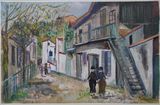
- Le Passage Cottin (c.1910). This oil on cardboard captures a quintessential slice of Montmartre street life. The paint is thickly applied, and the white pigment especially has a plaster-like quality, apt for the density of the buildings depicted. Shopfront signs feature in the foreground, while figures are suggested further afield, perhaps making their way to the Basilique du Sacré-Cœur, whose spectral dome is visible just above the rooftops.
- La Maison Bernot (1924) features another street scene from Montmarte, yet this work is notable in that it was created while Utrillo was living in the department of Ain, far away from Paris. This work was likely created by combining the artist’s vivid knowledge of the area with a postcard image. Much like other works from this period, the pigments used by Utrillo are richer and bolder than in past works.
What were Maurice Utrillo’s most notable exhibitions?
Throughout his career, Utrillo’s paintings were showcased in numerous exhibitions, both solo and group, across Europe and beyond.
- Collection Jean Walter-Paul Guillaume, Musée de l’Orangerie, Paris (1966).
- Renoir to Picasso: Masterpieces from Musée de l’Orangerie, National Gallery of Victoria, Melbourne (10 August–30 September 2001).
- Group show, Works on Paper, Bailly Gallery, Paris (1 April–31 May 2022).
His unique portrayal of Parisian life garnered him significant acclaim, which led to his decoration with the Cross of the Légion d’honneur in 1929. Today, his works are held in several esteemed collections, including the Musée de l’Orangerie in Paris and the Tate in London.
Hazel Ellis | Ocula | 2025



Explore and Follow Artists Shaping Contemporary Art
A respected voice in contemporary art discourse.
Focusing on ambitious storytelling and insightful art-world commentary. Ocula Magazine publishes in-depth interviews, critical essays and timely analysis on the artists, exhibitions and ideas driving the global art world.
Learn more about Ocula Magazine
Showcasing the best of the art world.
Ocula partners with galleries from around the world to highlight their artists, artworks and exhibitions. Gallery membership is by application and invitation, with each member vetted by an independent panel.
Learn more about Ocula Membership
Specialises in the sale of major artworks.
Led by a team with deep ties to the world’s leading auction houses, galleries and collectors. Ocula’s advisory team offers bespoke services to high-net-worth clients from around the world who are looking to acquire the best of contemporary and modern art.
Learn more about our team and services