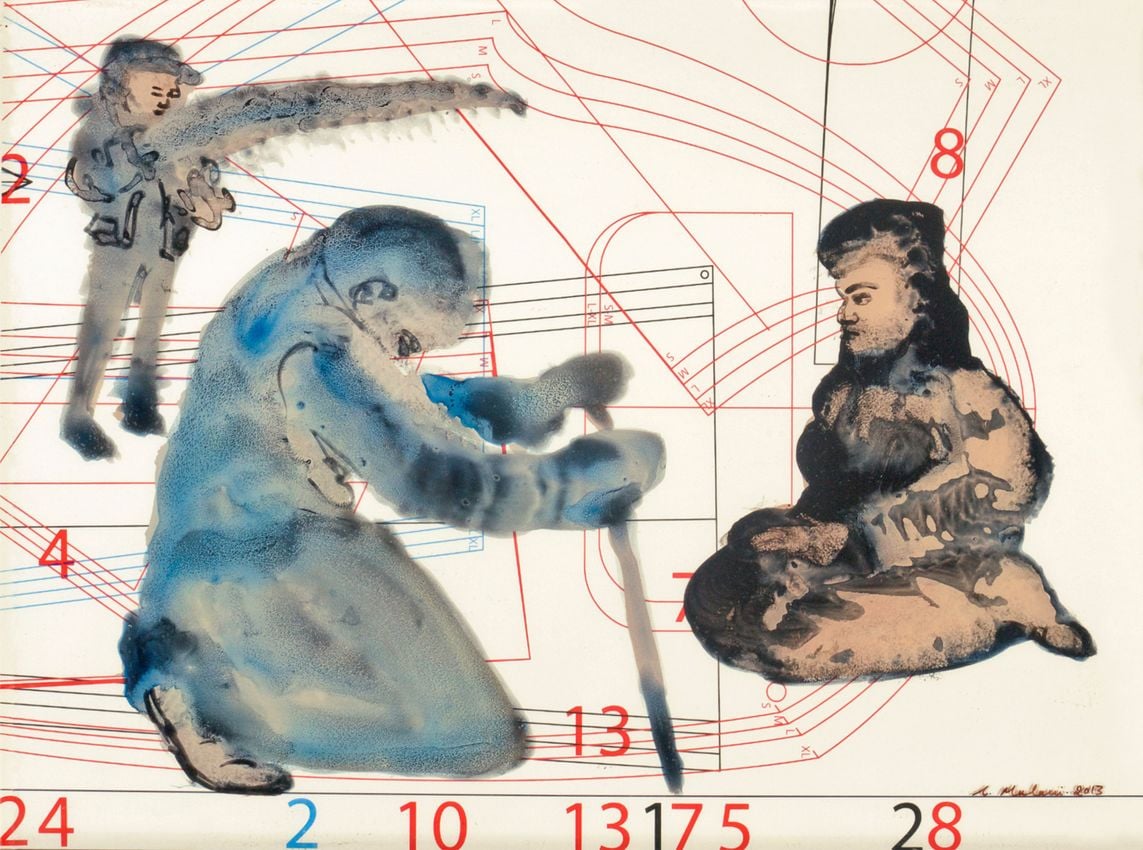
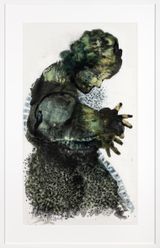
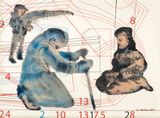
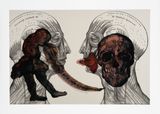
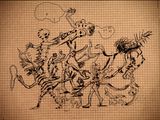
Malani’s politically charged works are inspired by the experiences of those on the margins, drawing from her own life and those around her. She has previously referred to the Indian partition as ‘a shadow over [her] life.’ Malani’s work often integrates current news and reportage with Greek and Hindu mythology, creating massive installations and video works that she refers to as ‘video plays’ for their relationship to theatre. Her personal political affiliations as a feminist, social activist, and environmentalist bleed through her work and extend past the confines of the white cube.
In Mother India: Transactions in the Construction of Pain (2005), Malani touches upon shared experiences faced by women in India. This five-channel video play combines archival footage with Malani’s painted frames, exposing the cyclical nature of violence against women while referencing both the Indian Partition and the 2002 Gujarat riots, which resulted in assaults against Muslim women.
Immersive Installations
Malani’s installations began with her ‘Wall Drawing/Erasure Performances’ (1992—ongoing) series. Originally created as a means to subvert art as a commodity, these works involved Malani etching charcoal drawings on the gallery’s walls, creating an immersive experience that she would eventually erase. The piece City of Desires (1992) responded to the rise of Hindu right-wing nationalism. In this work, Malani would erase and re-draw several elements, creating ghostly images littered across the walls of Mumbai’s Chemould Gallery.
Malani has also played with light and shadow in her work In Search of Vanished Blood (2012) by projecting videos through hand-painted motorised Mylar cylinders suspended from the ceiling. This work, originally featured in Documenta 13, is a multi-layered installation that integrates cultural and historical iconography with various literary texts, and explored the complexities of intermingling traditions.
The artist’s first U.K. commission, Can You Hear Me? (2020), involves 88 projected animations created between 2017 and 2020. Malani’s illustrations include everyday notes, quotes, and hand-drawn images. These animations flicker at high speed, depicting quick horrific stories and frames of violence as a means to discuss national trauma and global social issues. Can You Hear Me? takes cues from writers such as Hannah Arendt, Bertolt Brecht, and Milan Kundera, among others.