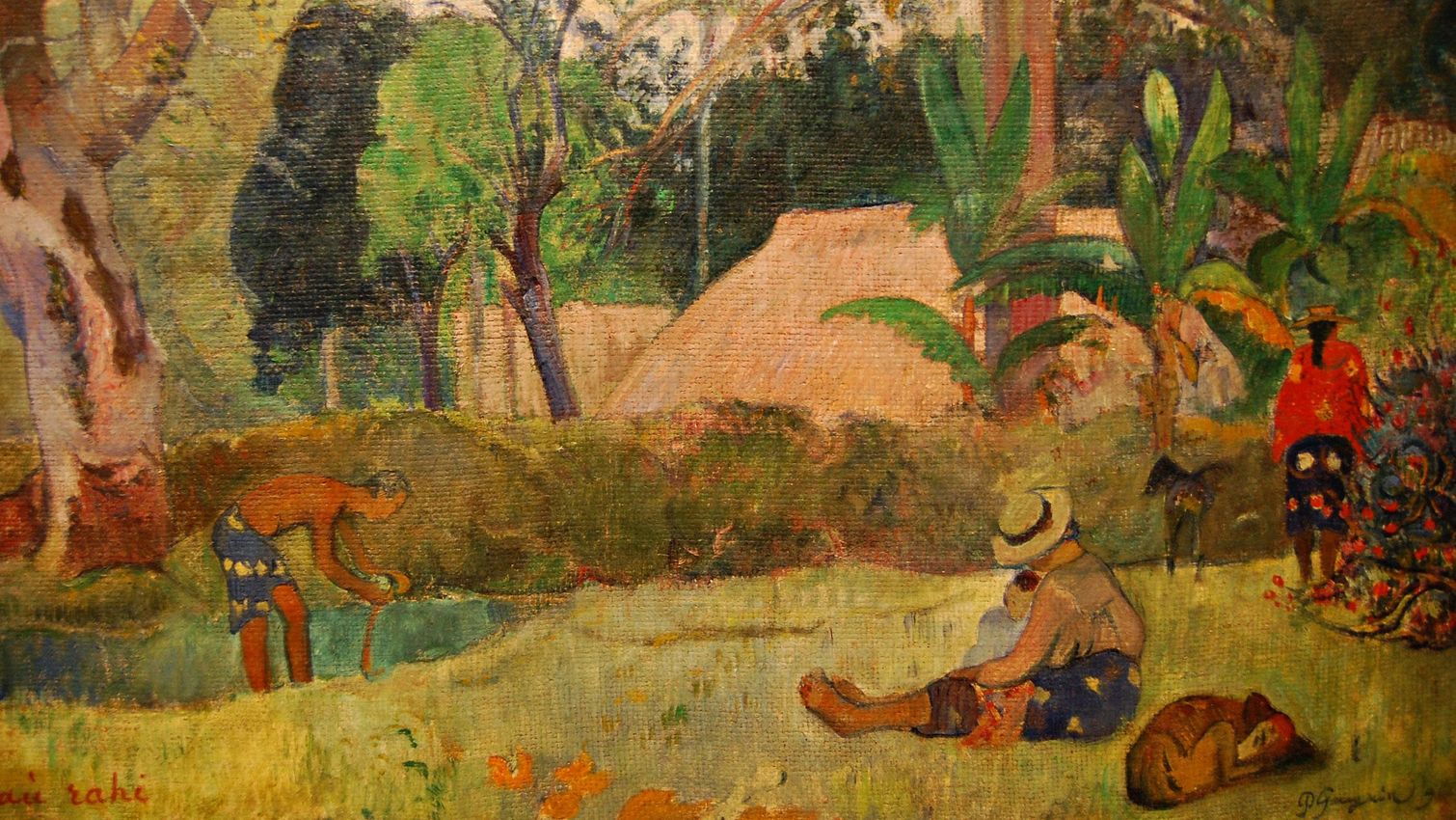
Paul Gauguin was a Post-Impressionist painter and woodcut printmaker, but it is as a Symbolist that he became hugely influential on the early Cubists, Fauves, Nabis, and early Expressionists. What excited them were his formal innovations, mixed with a passionate interest in South Pacific tribal culture—and with the woodcuts, a calculated technical crudity.
Born in Paris in 1848, Gauguin spent part of his early childhood in Lima, Peru, where his family fled amid political unrest. This early exposure to non-European cultures left a lasting mark on his imagination. Returning to France, Gauguin initially pursued a career in the merchant navy, and later as a stockbroker, while painting in his spare time.
By the late 1870s, he was exhibiting alongside the Impressionists, including Camille Pissarro, with whom he formed a close friendship. However, dissatisfied with Impressionism’s focus on naturalistic light and modern life, Gauguin began to seek deeper, symbolic meaning in art. By the mid-1880s, he abandoned his financial career entirely to dedicate himself to painting.
Paul Gauguin’s artworks are known for their vivid colour palettes, simplified forms, and spiritual symbolism. His search for an authentic and unspoiled environment led him to Brittany, Martinique, and ultimately Tahiti and the Marquesas Islands, where he developed his mature style. His works challenge colonial narratives and Western ideals of beauty and civilisation.
In the early 1880s, Gauguin rejected the impressionist palette and brushwork in favour of bolder colour and stylised forms. Works such as Vision after the Sermon (1888), painted during a stay in Pont-Aven, mark this departure. The painting uses flat areas of red and green to frame a biblical scene seen through the mind’s eye—a clear move toward Symbolism.
In October 1888, Gauguin travelled to Arles in southern France at the invitation of Vincent van Gogh, who dreamt of creating a collaborative artist community—the so-called ‘Studio of the South’. For nearly two months, the two artists lived and worked side by side in Van Gogh’s ‘Yellow House’, exchanging ideas, challenging each other’s methods, and painting the Provençal landscape with renewed intensity. Although short-lived, the Arles period was one of great artistic productivity and mutual influence. Gauguin’s The Painter of Sunflowers (1888) is both a portrait of Van Gogh and a commentary on his singular obsession with colour and light.
In 1891, Gauguin left France for Tahiti in search of what he called a ‘pure’ and ‘primitive’ culture. The resulting paintings, including Where Do We Come From? What Are We? Where Are We Going? (1897–98) and Spirit of the Dead Watching (1892), reflect his complex engagement with Polynesian belief systems, colonialism, and myth. Using bold outlines, flattened perspective, and lush colours, he created dreamlike scenes that blend reality with imagination.
While these works are among his most celebrated, Gauguin’s time in Tahiti and the Marquesas Islands has become a subject of significant ethical and scholarly critique. He engaged in sexual relationships with underage Tahitian girls, and often portrayed Polynesian subjects through a colonial gaze that romanticised and objectified the people and culture.
In recent decades, museums and scholars have re-examined Gauguin’s legacy in light of these troubling aspects of his life. While his formal innovations remain influential, his personal conduct and the colonial context of his work continue to prompt critical reassessment.
Paul Gauguin has been the subject of both solo and group exhibitions at important institutions.
Paul Gauguin is best known for his colourful, symbolic paintings created during his time in French Polynesia. Works such as Where Do We Come From? What Are We? Where Are We Going? (1897–98) and Spirit of the Dead Watching (1892) are widely regarded as defining examples of his mature style. He is also recognised for his influence on modern art movements including Primitivism, Symbolism, and Fauvism.
Gauguin’s artworks often explore themes of spirituality, mythology, memory, and identity. He was deeply interested in the idea of the ‘primitive’ as a counterpoint to modern industrial life, though his interpretation was shaped by colonialist thinking. His compositions blend symbolic content with vivid colour and flattened forms, creating dreamlike narratives rooted in both real and imagined worlds.
Gauguin’s personal life, including relationships with young Tahitian girls and his exoticised portrayal of Polynesian culture, has prompted ongoing critical debate. His work is now read both for its aesthetic innovations and its colonial entanglements.
Ocula | 2025
A respected voice in contemporary art discourse.
Focusing on ambitious storytelling and insightful art-world commentary. Ocula Magazine publishes in-depth interviews, critical essays and timely analysis on the artists, exhibitions and ideas driving the global art world.
Learn more about Ocula Magazine
Showcasing the best of the art world.
Ocula partners with galleries from around the world to highlight their artists, artworks and exhibitions. Gallery membership is by application and invitation, with each member vetted by an independent panel.
Learn more about Ocula Membership

Specialises in the sale of major artworks.
Led by a team with deep ties to the world’s leading auction houses, galleries and collectors. Ocula’s advisory team offers bespoke services to high-net-worth clients from around the world who are looking to acquire the best of contemporary and modern art.
Learn more about our team and services