






PEGGY WEIL
b. 1953, United StatesPeggy Weil is an American artist and designer whose multimedia practice spans digital media, data visualisation, virtual reality and large-scale public installations, and is best known for immersive works that make climate change and deep geological time perceptible as lived experience.
Based in Los Angeles and working across art, technology and environmental science, Weil develops what she calls Extended Landscapes: video installations, projections and interactive works that visualise the “invisible” infrastructures and strata beneath our feet, above our heads and back in time.
Weil’s recent projects include the climate-focused video works 88 Cores and 18 Cores, brought together in the Museum of Modern Art‘s 2026 exhibition Peggy Weil: Core Memory.
Early Life and Career
Weil studied at Harvard University, graduating in 1976, before completing a master’s degree at the Massachusetts Institute of Technology in 1982. At MIT she joined Nicholas Negroponte’s Architecture Machine Group—later the MIT Media Lab—where she worked on pioneering interactive design and telepresence projects that positioned her at the forefront of early digital media art. In the late 1980s and 1990s she became a key figure in multimedia design, creating award-winning CD-ROM titles for companies including The Voyager Company, Broderbund, Electronic Arts, Von Holtzbrinck and Ravensburger Interactive, projects that helped shape emerging interfaces for digital storytelling. Alongside her studio practice, Weil has taught widely and is an adjunct faculty member at the USC School of Cinematic Arts, where she contributes to the development of experimental media production.
Works, Series and Methods
By the early 2000s Weil’s work shifted from commercial multimedia towards experimental artistic research, extending into online environments, games and virtual worlds. Her collaborations with journalist Nonny de la Peña on projects such as Gone Gitmo (2007), a virtual reconstruction of the Guantánamo Bay detention camp within Second Life, have been widely cited as foundational for immersive journalism, a genre that uses VR to communicate complex sociopolitical realities. This trajectory from interface design to critical, research-led practice underpins her later investigations into climate, landscape and planetary memory.
A through line in Weil’s practice is the use of digital systems to frame human and non-human subjects, from early experiments with artificial intelligence to slow, durational portraits of environmental data. Her long-running online bot MrMind, launched in 1998, conducts what she calls The Blurring Test—a reverse Turing test that asks visitors “Can you convince me that you are human?”, collecting transcripts that she later reworked into the song cycle The Blurring Test: Songs of MrMind, premiered in 2023 at Roulette Intermedium in Brooklyn. This interest in conversational interfaces and machine perception links her early digital portraiture to her later Extended Landscapes, which treat data streams and geological cores as subjects with their own temporalities.
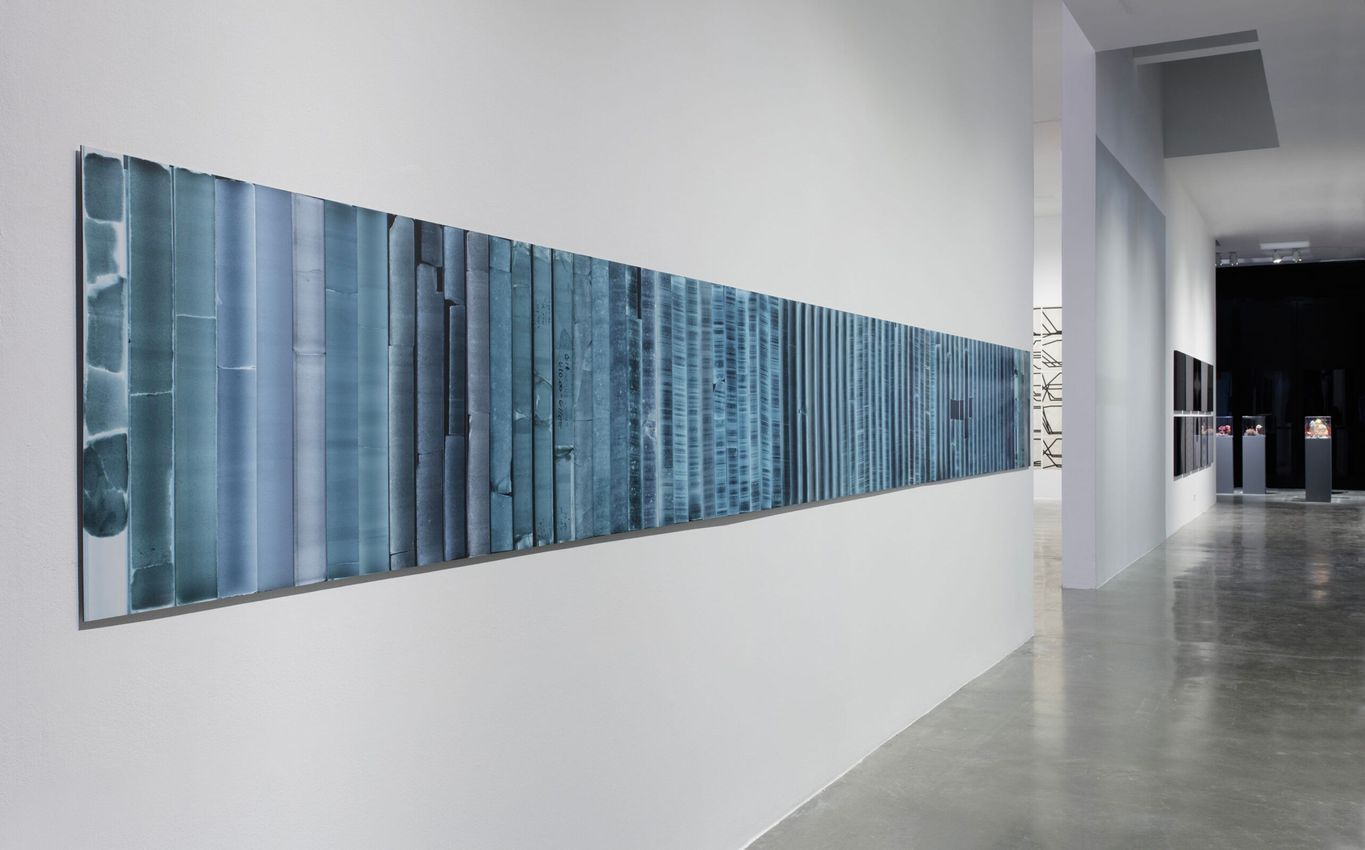
Central to Weil’s recent practice is the series of Extended Landscapes, begun around 2011, which she describes as landscape portraits of unseen but critical processes of climate change. 88 Cores (2013–2016) is a four-and-a-half-hour video that scrolls down through images of 88 ice cores drilled from the Greenland Ice Sheet between 1989 and 1993, effectively staging a two-mile descent that reaches back 110,000 years in climatic history. Presented in installations such as the Climate Museum’s 2018 exhibition In Human Time and later at MoMA, the piece turns scientific samples—normally encountered in laboratory archives—into a slowly moving image that makes glacial time and atmospheric change sensorially legible.
Its companion work 18 Cores (2016–25) shifts from polar ice to geothermal heat by assembling vertical strands of rock cores extracted from California’s Salton Sea in the mid-1980s. In the MoMA exhibition Peggy Weil: Core Memory (2026), 18 Cores is installed alongside 88 Cores, bringing together these visualisations of Earth’s climatic and geological histories for the first time. Here the sedimentary bands of shales, siltstones and sandstones function as a subterranean archive, extending Weil’s portraiture from human faces to the strata that record Pleistocene environments. Her large-scale digital presentation of Core Memory on Hyundai Card’s MoMA Digital Wall in Seoul, which mirrors the New York installation, underscores how these works operate both as museum pieces and public-facing media facades.
Weil’s Extended Landscapes also unfold across urban sites and mass media screens. UnderLA (2016), commissioned for the Bloomberg-sponsored CURRENT:LA Water biennial, projected the Los Angeles aquifer onto the banks of the LA River, revealing the city’s buried water infrastructure as a moving image. Earlier, in HeadsUP! (2012), she transformed global groundwater depletion data into a scrolling visualisation displayed on digital billboards in Times Square, aligning the rhythms of environmental extraction with one of capitalism’s most iconic visual landscapes. Together with VR and app-based projects, these works use the language of advertising, gaming and cinema to stage climate data in everyday viewing environments.
Themes and Context
Weil’s work is frequently described as bridging digital portraiture, environmental art and data visualisation, using technological tools not as ends in themselves but as means to reframe planetary processes. Her Extended Landscapes treat ice cores, rock cores, aquifers and groundwater tables as repositories of memory, suggesting that the planet functions as a recording device in which climatic events and human activity are inscribed over deep time. By slowing down the viewer’s experience through durational video scrolls and large-scale projections, she responds to what she sees as the mismatch between the imperceptible pace of climate change and the speed of human perception and media cycles.
Situated within broader conversations around new media art, post-internet practices and eco-critical aesthetics, Weil’s work is distinctive for how it aligns technical literacy with environmental advocacy. Her background in interface and game design informs an approach that is accessible and visually direct, even as it deals with abstract scientific data and complex geopolitical questions. Projects like Gone Gitmo and her immersive journalism collaborations point to a consistent interest in how virtual environments can make distant conflicts and infrastructures—whether prisons or aquifers—viscerally present, aligning her with a generation of artists who treat digital media as a tool for both empathy and critical reflection.
Exhibitions, Collections and Recognition
Weil’s work has been exhibited internationally across museums, biennials and media arts platforms. In 2016 she was commissioned, with Refik Anadol, by the City of Los Angeles for CURRENT:LA Water, where UnderLA projected the LA Aquifer from the First Street Bridge and at the origin of the LA River, establishing her as a key voice in urban-scale environmental installation. Her video installation 88 Cores featured prominently in the Climate Museum’s inaugural exhibition In Human Time in 2018, and her Extended Landscapes have been shown at MMOMA in Moscow, LABoral Centro de Arte in Spain, LACMA and in the Fulcrum Festival’s programmes in Los Angeles.
In 2026 the Museum of Modern Art in New York opened Peggy Weil: Core Memory (7 March–4 October 2026), the artist’s first solo exhibition at the institution, curated by Paula Vilaplana de Miguel in the Department of Architecture and Design. The show, which also appears on Hyundai Card’s MoMA Digital Wall in Seoul, has been widely covered as a landmark in climate-related media art, highlighting Weil’s role as a pioneer of digital media whose current focus on Earth’s climatic histories expands the remit of new media into geologic and planetary timescales. Beyond institutional recognition, her contributions to immersive journalism and interactive design are frequently cited in media studies and art-and-technology discourses, reinforcing her position at the intersection of contemporary art, environmental science and digital culture.
Peggy Weil FAQs
What is Peggy Weil best known for?
Peggy Weil is best known for her Extended Landscapes series, particularly the video installations 88 Cores and 18 Cores, which visualise deep climatic and geological time through scrolling portraits of ice and rock cores. These works, brought together in MoMA’s 2026 exhibition Peggy Weil: Core Memory, have made her a reference point for climate-focused digital media art.
What is ‘Peggy Weil: Core Memory’ at MoMA?
Peggy Weil: Core Memory is a 2026 exhibition at the Museum of Modern Art in New York that presents 88 Cores and 18 Cores together for the first time, framing them as complementary visualisations of Earth’s climatic histories. The show emphasises Weil’s shift from early digital portraiture to portraits of the planet itself and extends onto Hyundai Card’s MoMA Digital Wall in Seoul.
How does Peggy Weil use digital media in her art?
Weil uses digital video, projection, VR and data visualisation to transform scientific datasets and environmental records into immersive visual experiences. From MrMind’s conversational reverse Turing test to the slow vertical scrolls of 88 Cores, her projects treat code, interfaces and screens as tools to render invisible processes—like climate change, groundwater depletion or carceral architectures—newly legible.
Where can I see Peggy Weil’s work?
In 2026 Weil’s Core Memory is on view at MoMA in New York and on Hyundai Card’s MoMA Digital Wall in Seoul, while her Extended Landscapes also appear in programmes such as LA WATER and exhibitions at LACMA and MMOMA. She has previously exhibited at The Climate Museum in New York, LABoral in Spain and in citywide biennials like CURRENT:LA Water, and her work continues to circulate across museums, festivals and public screens.
What is Gone Gitmo and why is it important?
Gone Gitmo is a virtual reconstruction of the Guantánamo Bay prison created within Second Life in 2007 by Peggy Weil and Nonny de la Peña. The project is widely credited as a foundational work of immersive journalism, demonstrating how virtual environments can be used to convey the spatial and psychological dimensions of human rights issues beyond traditional news formats.
Ocula | 2026


Explore and Follow Artists Shaping Contemporary Art
A respected voice in contemporary art discourse.
Focusing on ambitious storytelling and insightful art-world commentary. Ocula Magazine publishes in-depth interviews, critical essays and timely analysis on the artists, exhibitions and ideas driving the global art world.
Learn more about Ocula Magazine
Showcasing the best of the art world.
Ocula partners with galleries from around the world to highlight their artists, artworks and exhibitions. Gallery membership is by application and invitation, with each member vetted by an independent panel.
Learn more about Ocula Membership
Specialises in the sale of major artworks.
Led by a team with deep ties to the world’s leading auction houses, galleries and collectors. Ocula’s advisory team offers bespoke services to high-net-worth clients from around the world who are looking to acquire the best of contemporary and modern art.
Learn more about our team and services