



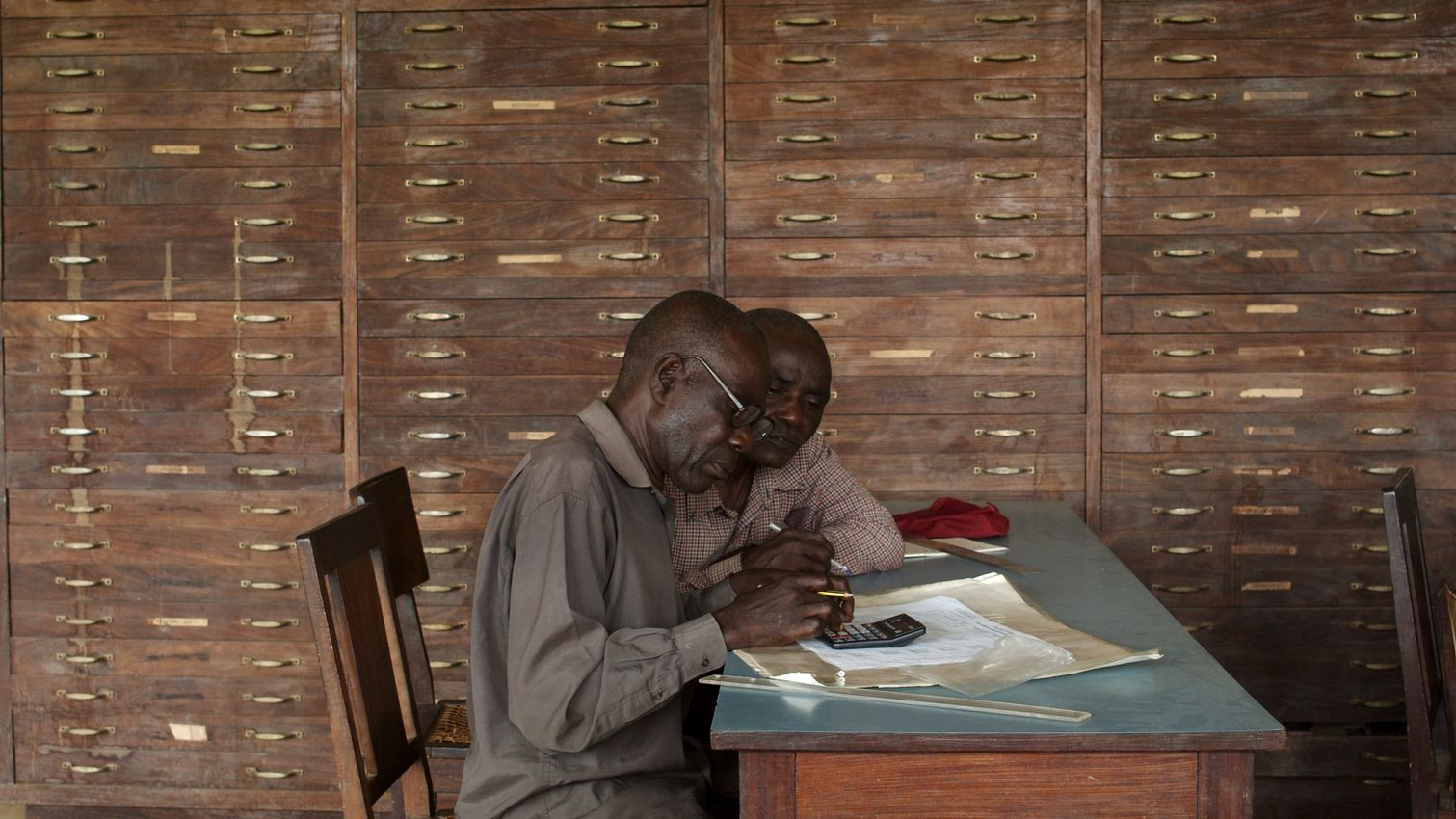
Goldsmiths CCA presents a solo exhibition by Sammy Baloji (b.1978, Lubumbashi). Comprising two new commissions and important recent works, all of which will be on display in the UK for the first time, this major exhibition presents interconnected strands of Baloji’s artistic research on climate, tropical architecture, Belgian Art Nouveau, and extraction from the Democratic Republic of Congo. Baloji’s 2023 film, Aequare.
The Future that Never Was, focusses on the rainforest around the town of Yangambi and illuminates the legacy of colonialism and the ecological destruction it has caused. The tropical rainforest region in the Congo is the second largest in the world and has a central role to play in the regeneration of the planet’s atmosphere.
However, Baloji’s film shows that, as Sandrine Colard has argued, these possibilities are impeded by ‘the disequilibrium caused by old imperial networks and their vestiges.’ The juxtaposition of different types of footage – archival film clips of a climate study centre from the colonial period and recent shots of its contemporary successor – and intricate work on the soundtrack combine to offer a powerful critique of science’s allegiance to capitalism and colonialism.
This important intervention will be shown on Goldsmiths CCA’s first floor, alongside works in other galleries, such as ...and to those North Sea waves whispering sunken stories (II), an installation comprising a terrarium containing tropical plants and an audio recording of Albert Kudjabo (1896 – 1934), a Congolese soldier who fought for the Belgian Army during the First World War and was captured and interrogated by the German Army.
Finally, a newly commissioned work will consider the connections between extraction and Belgian Art Nouveau, an art movement that, at the time of its emergence, was known as ‘Style Congo’ and utilized both Congolese motifs and materials. The film and print-based works selected for the basement galleries are key examples of Baloji’s ongoing research on the cultural, architectural and industrial heritage of the Katanga region. Shinkolobwe’s abstraction (2022), a work comprising 15 screenprints, recomposes the crystallographic geologic studies of the region into coloured abstracted forms and superimposes them on top of images of a nuclear explosion.
In so doing, the work addresses the period in which the major Cold War powers, the Soviet Union and the United States, wanted to gain access to uranium, of which Shinkolobwe mine was the largest resource in the world. Tales of the Copper Cross Garden (2017), a 43 minute video, reveals how colonialism and the Catholic Church are, in the artist’s own words, ‘linked in their impositions to the local Katanga culture.’ ‘For me,’ Baloji said, ‘nothing less than the copper crosses held in front of the hearts of the choir children suggest how the missionaries tried to steal their souls while exploiting the local copper resource for the benefit of Europeans.’
Sammy Baloji was born and raised in Lubumbashi, in the contested and mineral-rich Katanga province of the Democratic Republic of Congo (DRC, formerly the Belgian Congo and Zaire). Sammy’s work juxtaposes architecture, industrial ruins, and vast slag heaps with images of the people—workers, villagers, urbanites—to explore identity, social history, and memory. For his Fellowship year, Sammy will focus on the Gendarmes Katangais, a rebel resistance group from the copper-rich Katanga province of DRC. The Katangese Gendarmes have influenced political landscapes in Central Africa since the Cold War and are likely to continue to do so. Defeated in their battle for the succession of Katanga from Congo/Zaire during the 1960s, the Katangese Gendarmes based themselves in neighbouring Angola among communities that shared their mostly Lunda ethnicity. In precolonial times, a Lunda kingdom had ruled this cross-border region.

Located on the campus of Goldsmiths, University of London, Goldsmiths Centre for Contemporary Art is London’s newest contemporary arts institution, and open to everyone. Hosting world-class exhibitions by international artists, and providing a space for established and emergent practices, the institution aims to enhance Goldsmiths’ reputation for excellence and innovation in the arts. Curatorially ambitious, the exhibition programme has been devised to encompass a wide-range of exhibition-making, including new commissions, historical presentations, survey exhibitions, and long-term research projects. These are iterated in response to the spaces that make up the institution, ranging from top lit white cubes to a converted iron-lined Victorian water tank.

A respected voice in contemporary art discourse.
Focusing on ambitious storytelling and insightful art-world commentary. Ocula Magazine publishes in-depth interviews, critical essays and timely analysis on the artists, exhibitions and ideas driving the global art world.
Learn more about Ocula Magazine
Showcasing the best of the art world.
Ocula partners with galleries from around the world to highlight their artists, artworks and exhibitions. Gallery membership is by application and invitation, with each member vetted by an independent panel.
Learn more about Ocula Membership

Specialises in the sale of major artworks.
Led by a team with deep ties to the world’s leading auction houses, galleries and collectors. Ocula’s advisory team offers bespoke services to high-net-worth clients from around the world who are looking to acquire the best of contemporary and modern art.
Learn more about our team and services