Press Release

With works by: Basel Abbas & Ruanne Abou-Rahme, Sammy Baloji, Lothar Baumgarten, Teresa Burga, Maria Eichhorn, Dani Gal, General Idea, Kiluanji Kia Henda, Eva Kot’átková, Susan Hiller, Zahra Malkani, Teresa Margolles, Senga Nengudi, Uriel Orlow, Elodie Pong, Ed Ruscha, Munem Wasif

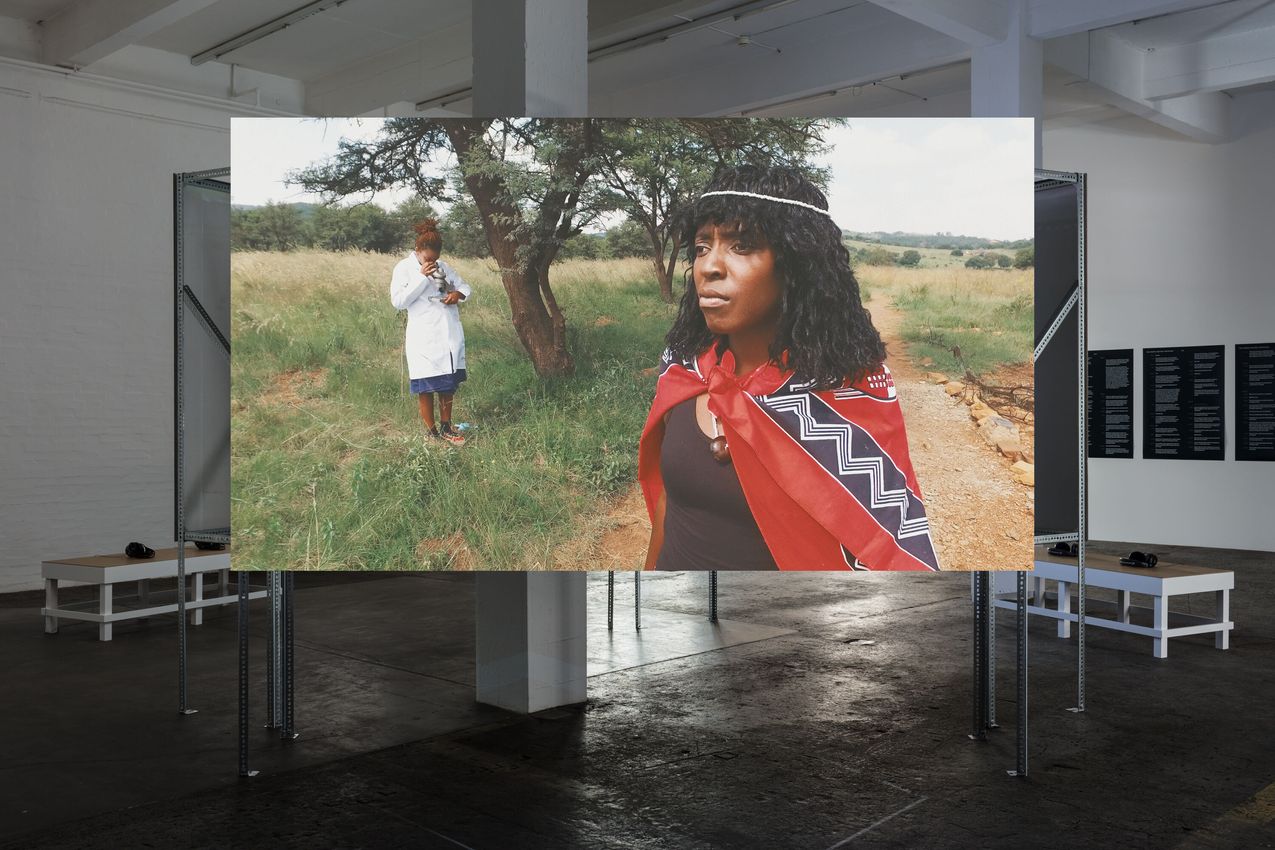
What possibilities emerge when we see knowledge, which is presumably fixed, as something growing? The title of the exhibition, Knowledge Is a Garden, derives from an African proverb: “Knowledge is like a garden: if it’s not cultivated, it cannot be harvested.”

Taking this saying as his starting point, Uriel Orlow unpacks the question of what a garden of knowledge could be and what this cultivation and growth means. In keeping with his interests, the artist sets up a dialogue between his own works and those of the museum collection, which for their part raise questions around the production of knowledge. This selection is expanded by loans—artists from parts of the Global South, who expand the previous geographical focus of the collection on Europe, USA and Latin America, and who engage with suppressed history and traditional knowledge in their artistic practice.

Knowledge Is a Garden is an artistic engagement with the repression of knowledge, the unjust appropriation of the same, and ultimately with new forms of producing and varying knowledge. Knowledge does not consist of neutral facts and information—and is never all-encompassing. Rather, it is always located, historical, and, above all, contested and vulnerable. The question of who gets to speak and whose voice is silenced is as urgent as ever—and marked by global inequality. The three loose thematic threads of the exhibition open up illustrative spaces for conceptualisation: the concern is with the entanglement of knowledge and language, and their loss; with the acquisition of knowledge and exploitation of raw materials in the Global South by countries of the Global North; and with wilfully not wanting to know and consciously looking away. Both Uriel Orlow’s own works and the pieces in the museum’s collection and loans can be related to one or several of these broader themes.

Curatded by Uriel Orlow and Nadia Schneider Willen; Curatorial Assistant: Louisa Behr

Read More

Artists Exhibiting

About the Gallery
Since its founding in 1996 the Migros Museum für Gegenwartskunst sees itself as a site of reflection as well as production. The moving in together with other art institutions and galleries in the spaces of a former Zurich brewery, the Löwenbrau-Areal, was at the same time the birth of the museum in its present-day form. The active cooperation in the process of art production and continual furthering of it with exhibition activities linked to the collection has determined the history of the museum.

Through a processual lightness the Migros Museum für Gegenwartskunst sets itself apart from its larger, more venerable colleagues. The museum focuses more on large-scale productions in close cooperation with the artists and less on that which is already tried and tested. In this manner the term contemporary art is understood as having a dynamic temporal purpose, of which the permanent exploration of peering forwards and backwards in time is inherent. Simultaneously the term embedment in a societal context and participation in a process of exchange and production of art is implied. The exhibitions at the Migros Museum für Gegenwartskunst formulate art history as a moving process, which is open to investigations, corrections and variations. The integration of the collection into a lively environment contiguous and supporting contemporary art production directed at an open-minded public is a further concern of the museum.
View Gallery Profile
Address
Limmatstrasse 270
Zurich
Switzerland
(1)
Zurich Limmatstrasse 270
Migros Museum für Gegenwartskunst
Limmatstrasse 270, Zurich, Switzerland
The art world in focus