



Somewhere in the corner of serene slowness, he pondered restlessness, his days drifting like a film without a narration.
He cherished the way you passed him the pebble, as if nothing had happened at all. You turned into flowers, shyly retreating from the sun, never fading away.
Because you spoke the word “because,” a “therefore” followed. Silence and smiles share a kinship; smiles are wary of narcissism, and silent smiles feel it, too.
After all, you don’t quite understand, guilt reveals more about yourself than you know. The grievances he glimpsed when he turned away came in waves, high and low, piece by piece, like days that slip easily off the tongue.
As summer unfolds in 2026, TKG+ unveils Slow Motion Picture Soundtrack, a new solo exhibition by Lee Kit.
Continuing his sustained inquiry into the subtle emotional textures of the everyday, Lee Kit turns his focus to the delicate theater of social interaction. He examines the residual feelings that linger in our daily exchanges— emotions never fully processed. Unspoken words, prolonged silences, and recurring waves of guilt and grievance do not simply fade with time. Instead, they coalesce into a nearly inaudible psychological noise: a slow, ambiguous score playing on a subtle loop deep within the psyche, gradually hardening into the suppressed emotional bedrock of modern life.
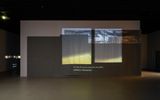
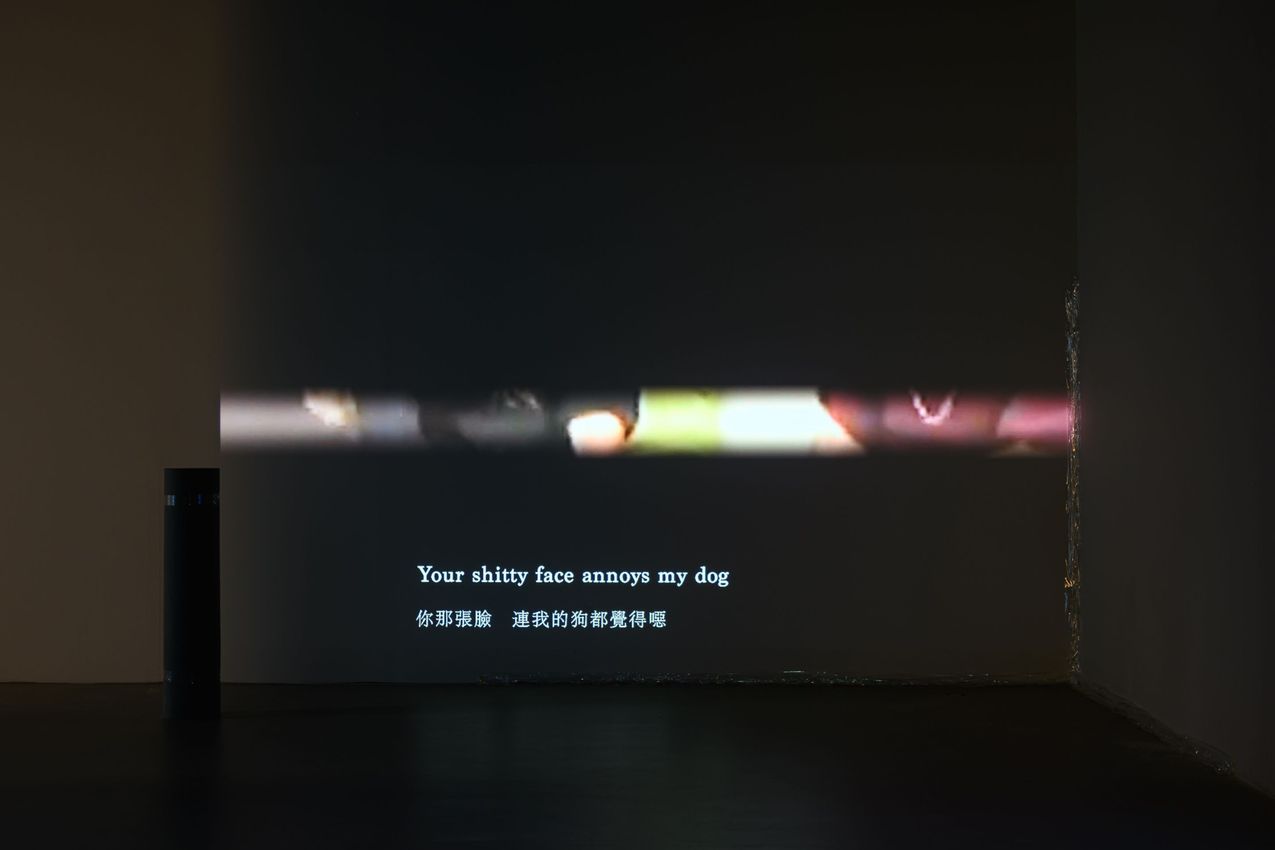
The exhibition weaves a private, semi-open space through the interplay of projection, music, and painting. Lee Kit casts selected images upon the surfaces of readymade objects and the surrounding space, causing light and shadow to wander and overlap. Resembling ephemeral slides that might vanish at any second, they leave a faint afterglow of fractured light. The phrases of text that appear throughout the works carry a detached but piercing romanticism. These seemingly effortless compositions allude to the carefully constructed psychological barriers of social interactions.
Inside the gallery, Lee Kit projects a collage of his own footage and collected clips, interspersed with phrases, onto semi-transparent veils crafted from painter’s tape. This industrial material, typically used for shielding and covering, is suspended in vast sheets to form a liminal plane. The translucent surface blurs the projected images without fully concealing them, evoking a state of guarded vulnerability. Stirred by the gallery’s airflow, the veils shiver with a delicate, discreet tremor, an almost involuntary response at the edge of perception. As visitors navigate the space, they are immersed in a mode of spectatorship that is at once profoundly intimate and subtly unsettling.
A soundscape woven from electronic textures reverberates through the space. Built on a looping structure, it unfolds with almost no discernible dynamic shifts, like a form of ambient, melodic static. This steady, unobtrusive rhythm lulls the listener into a state of ‘hypo-arousal’—a physical calm that belies a mind still idling at low speed, incapable of genuine rest. This auditory experience, caught between solace and exhaustion, serves as an analogy for the intricate performance of modern social life. Beneath the gloss of hyper-refined manners, we reflexively conceal ourselves, coexisting with our civilized anxieties through an elegant poise. And in this prolonged, slow attrition, sensation itself begins to numb.
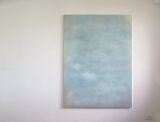
On stainless steel plates, layers of spray-painted color accumulate, forming atmospheric washes of varied opacity. A desaturated palette and a lustrous, pearl-like finish evoke a polished sense of detachment. Yet where the pigment yields, the raw steel beneath catches the light, casting back fractured reflections that dance in response to the viewer’s movement. The spectator’s own silhouette flickers into view, subtly superimposed upon the painting. And so, the act of looking outward quietly transforms into an inward journey.
When a frankness of feeling seems out of place, we learn to sheathe our emotions beneath a veneer of propriety.
In Slow Motion Picture Soundtrack, Lee Kit makes no attempt to expose or resist this repression. He chooses instead to trace the contours of those daily moments where ‘anxiety is refined into grace, and depletion is masked as ease,’ distilling them into a tangible atmosphere, a texture that can be felt.
Through the long discipline of social life, our psychological defenses have become a second skin, an internalized armor. This work offers no promise of comfort. Instead, should a viewer feel a flicker of confinement or doubt, it serves as a dim mirror, reflecting the inner territories we habitually overlook or consciously avoid. With his translucent screens, cyclical soundscapes, and muted paintings, Lee Kit fashions a sanctuary: a space both private and permeable. Here, he invites us to linger, and grant ourselves permission to finally acknowledge the feelings we have held so long in hiding.


Born in Hong Kong and now based in Taipei, the trans-disciplinary practice of Lee Kit (李杰) incorporates painting, moving-image and readymade objects along with other intangible elements such as light and sound to create poetic reflections on his everyday surroundings and experiences.

A forerunner of Taiwanese modern art, the Tina Keng Gallery hinges upon the philosophy that art is a reflection of the times. The Tina Keng Gallery has its roots in the Lin & Keng Gallery (1992–2009) based in Taipei, Taiwan and Beijing, China. Delving into Western painting and Chinese art history, Lin & Keng tirelessly promoted the work of Asian classical masters, cultivating a critical thought on Greater Chinese modern art. The Tina Keng Gallery has continued this tradition by centering its focus on Asia, further excavating art history and rediscovering modern aesthetics. Upon this foundation, the Tina Keng Gallery is steadfast in nurturing Taiwanese modern and contemporary art, with hopes to capture the changing states of art through writings of history, in so doing highlighting the cultural underpinnings of its worldview. Art arises from culture, and culture mirrors the times. The Tina Keng Gallery endeavors not only to support Greater Chinese modern and contemporary art, but to shape a perspective that is elementally Asian.

A respected voice in contemporary art discourse.
Focusing on ambitious storytelling and insightful art-world commentary. Ocula Magazine publishes in-depth interviews, critical essays and timely analysis on the artists, exhibitions and ideas driving the global art world.
Learn more about Ocula Magazine
Showcasing the best of the art world.
Ocula partners with galleries from around the world to highlight their artists, artworks and exhibitions. Gallery membership is by application and invitation, with each member vetted by an independent panel.
Learn more about Ocula Membership

Specialises in the sale of major artworks.
Led by a team with deep ties to the world’s leading auction houses, galleries and collectors. Ocula’s advisory team offers bespoke services to high-net-worth clients from around the world who are looking to acquire the best of contemporary and modern art.
Learn more about our team and services