





The Rising Women Artists Re-Enchanting Our Relationship to the World
Tara Anne Dalbow brings specificity to the term ‘Surreal’ to consider how the work of four women artists is grounding our fantasies of the physical world. Save to My OculaIn recent years, the term ‘Surreal’ has emerged as one of the most prevalent descriptors of contemporary work by women artists. It can be found in press releases and curatorial statements, criticism and catalogues, describing everything from abstract paintings to figurative sculptures. Like ‘spiritual’ and ‘alchemical,’ the ubiquity of the word ‘surreal’ has rendered its meaning convoluted at best and irrelevant at worst. What do we mean when we call something surreal?
Historically, the word refers to the international literary movement defined by the French writer and poet André Breton in 1924. According to his famous Manifeste du surréalisme, Surrealism sought ‘to resolve the previously contradictory conditions of dream and reality into an absolute reality, a super-reality.’
According to Breton’s definition, surreal art is art concerned with making sense of the world by plumbing the depths of the unconscious and evoking the irrational and the fantastical. Think disembodied lips, chimerical animals, melting clocks, and impossible landscapes.
Today, ‘surreal’ seems to be applied to anything that presents familiar objects and images in unconventional ways, even when the artist doesn’t necessarily draw their means of estrangement from the tenets of the 20th-century movement. Rather than focusing primarily on psychoanalysis or spiritualism, their references are syncretic, spanning a range of disciplines, including biology, computer programming, science fiction, and medieval studies. One significant departure is the tendency of contemporary artists to turn outward toward the world, rather than inward, in their search for forms and ideas capable of conveying the unreality of our current moment defined by the looming threat of ecological collapse, total digitalisation of communication, breakneck pace of technological advancements, and the dismantling of a common or shared truth.

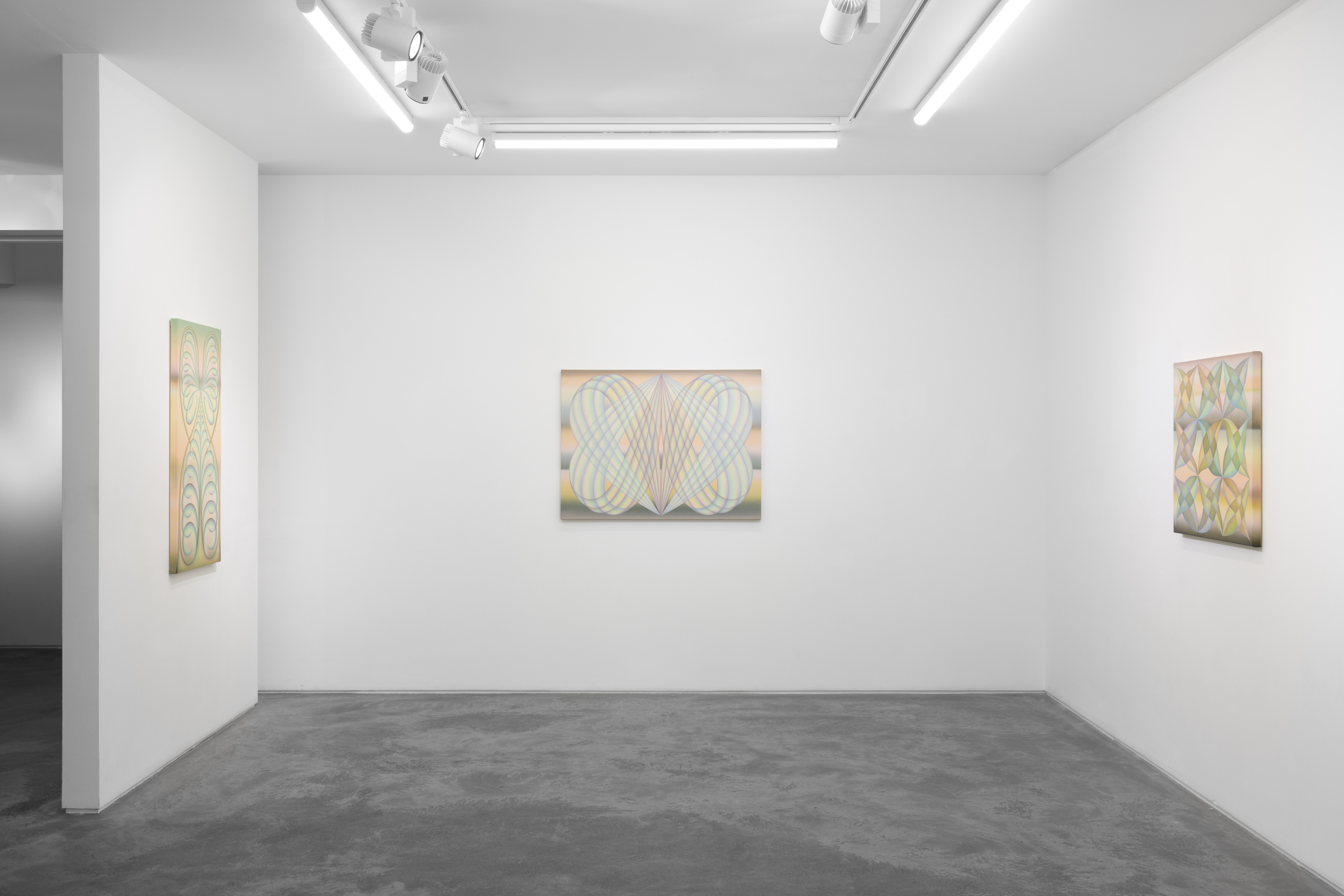
Take, for example, Los Angeles-based painter Molly Greene’s luminous pastel-hued paintings of plant life, which draw inspiration from botanical diagrams and scientific data.
‘People calling my work surreal always feels a bit anachronistic and not totally accurate,’ Greene says. ‘The alternative reality I’m interested in isn’t distorted by dream matter but consciously engineered and guided by science and politics.’
Her recent exhibition in London with Huxley-Parlour, Pseudopodia (18 April–25 May 2024), titled after the ancillary appendage that amoebic cells extend and reabsorb to navigate their surroundings, explores the porous nature of living bodies. The airbrushed acrylic forms that reflect the crenellation of shells, the spirals of furled ferns, and the venation of leaves are all depicted on gradated planes, blurring boundaries between subject and surroundings, land and sky, self and other. Even the prismatic patterns that initially appear decorative are derived from the material world, merging naturally occurring geometric shapes, such as succulent fractals, with references to biological processes like cell division through the use of symmetry.
By situating her biomorphic images between recognisable forms and abstractions, Greene conveys a deep attentiveness to her subjects while acknowledging their ultimate unknowability. Meanwhile, the sleek, air-brushed aesthetic nods to the use of technological diction to describe recent discoveries in plant cognition, such as how trees communicate through fungal systems called common mycorrhizal networks.
‘I’m interested in what happens when the human brain is no longer necessary for intelligence or intelligent action,’ Greene says, explaining that when attempting to visualise these concepts she turns to science-fiction writers like Octavia Butler and Ursula K. Le Guin.

Los Angeles-based painter Audrey Leshay also draws inspiration from science fiction, as well as geology, archaeology, and physics.
‘For me, science fiction, especially time travel, is a way of accessing all these alternative realities, like the end of the world, in a way that’s grounded in the real,’ she says. In Leshay’s meticulously rendered paintings of everyday objects like an apple in a cardboard box, devotional artefacts like the Shroud of Turin, and geological oddities like a mysterious dig site, the past, present, and future intertwine to complicate the nature and condition of the subject. Not unlike Schrödinger’s cat, the apple is both ripe and rotten to its core before you lift the box’s flap.
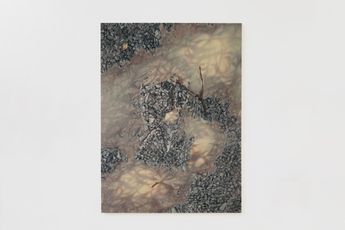
Leshay’s current exhibition at Chris Sharp Gallery, The Terminal Beach (17 May–28 June 2025), is chock-full of time loops and warps, as exemplified by a pair of paintings of dogs.
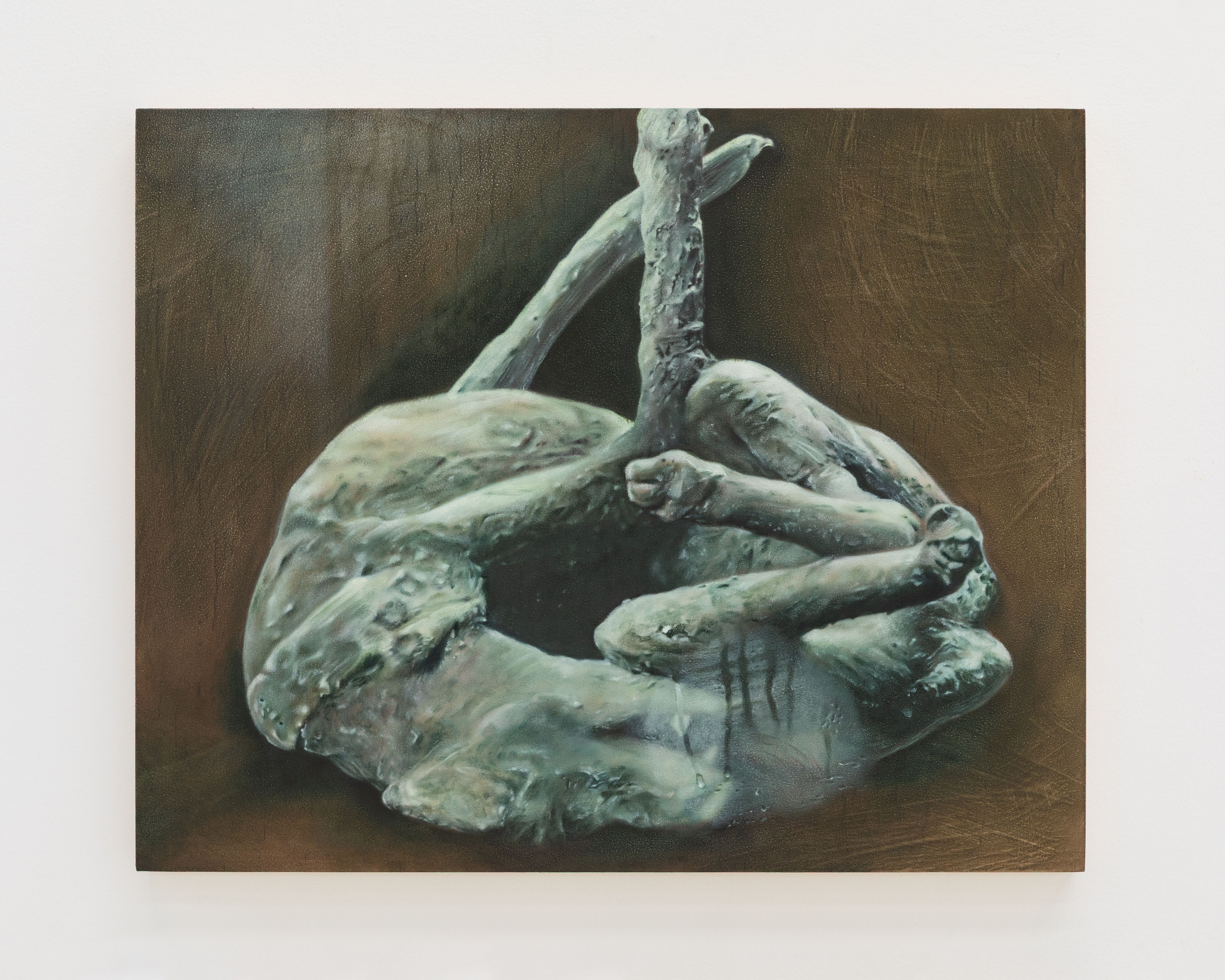
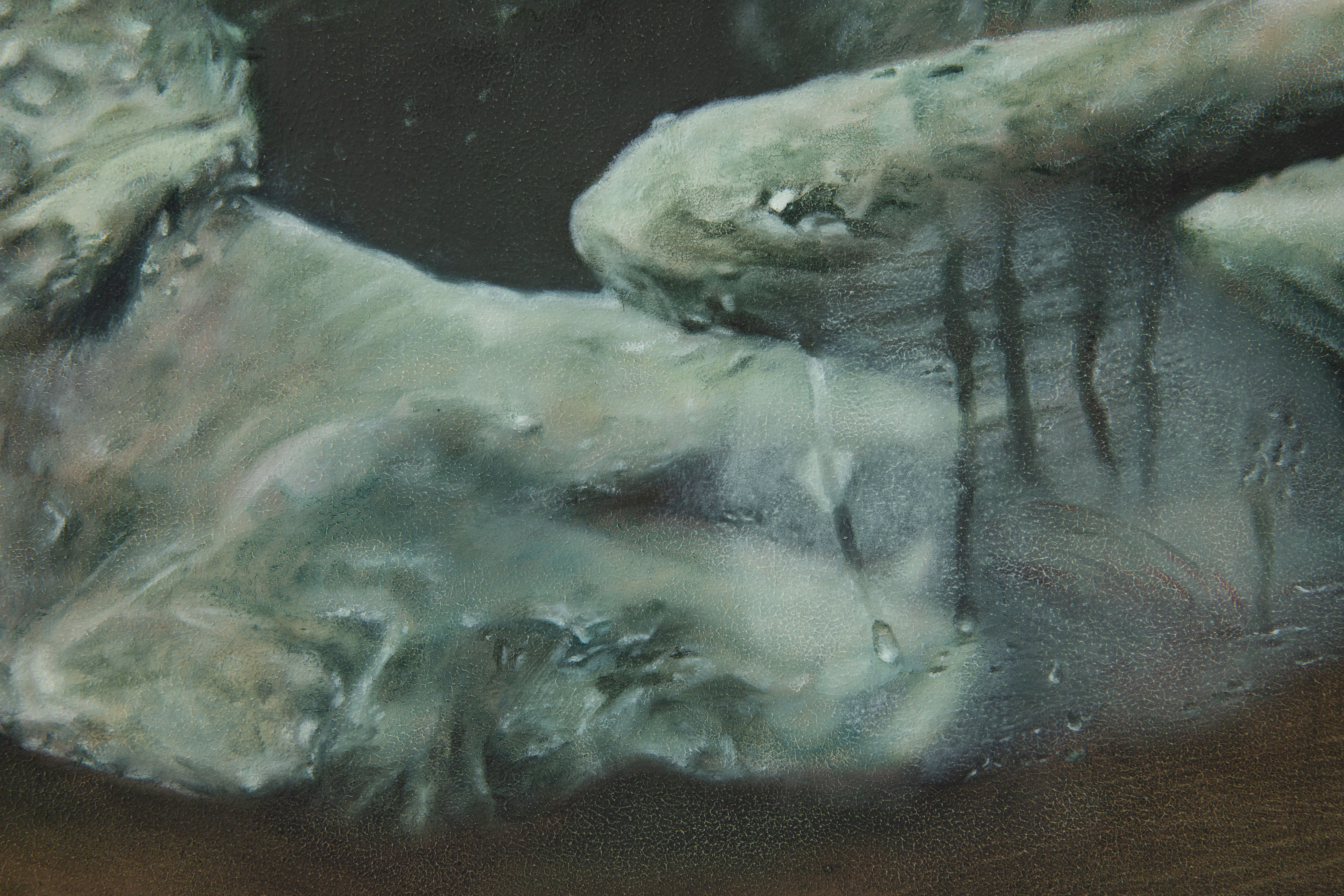
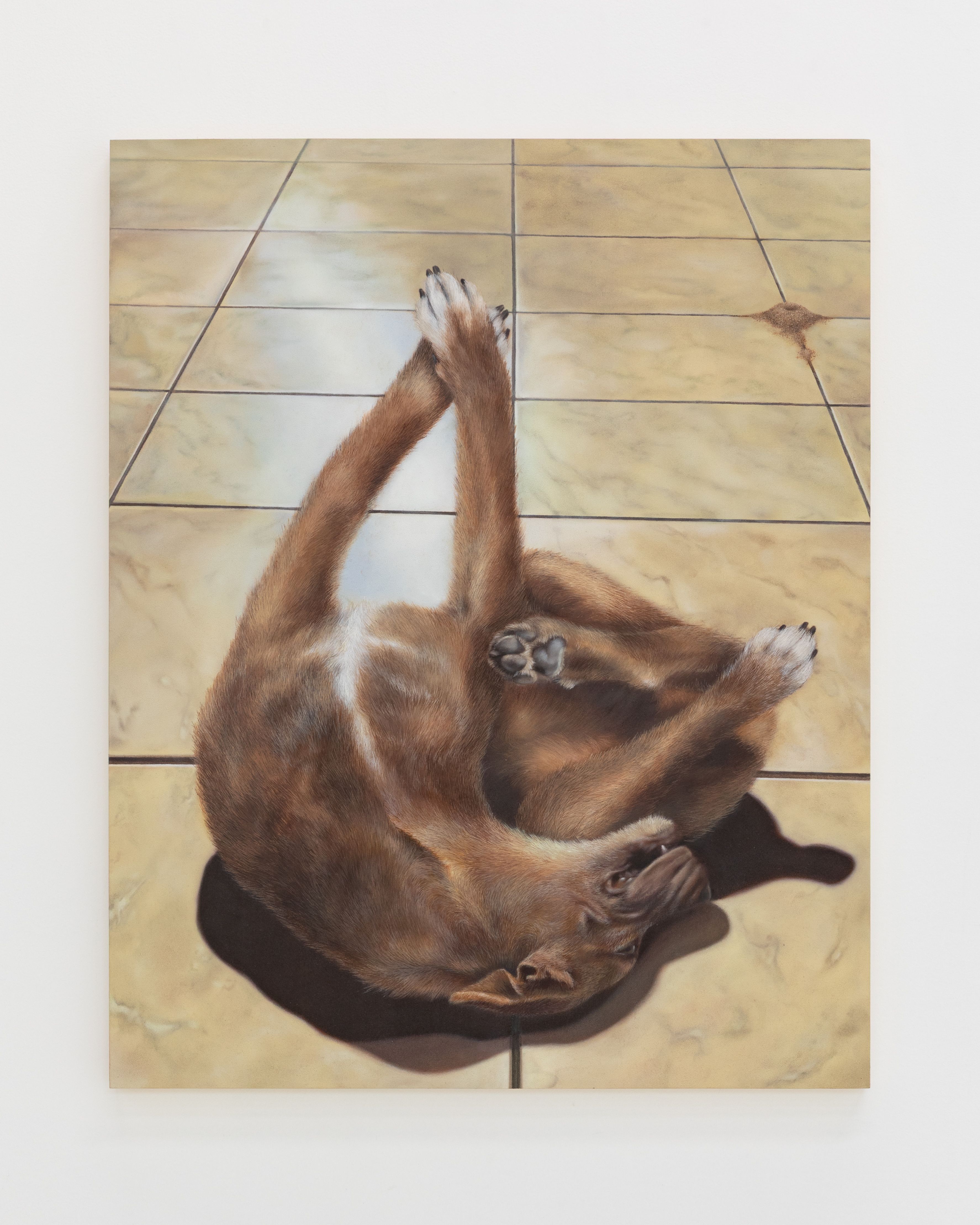
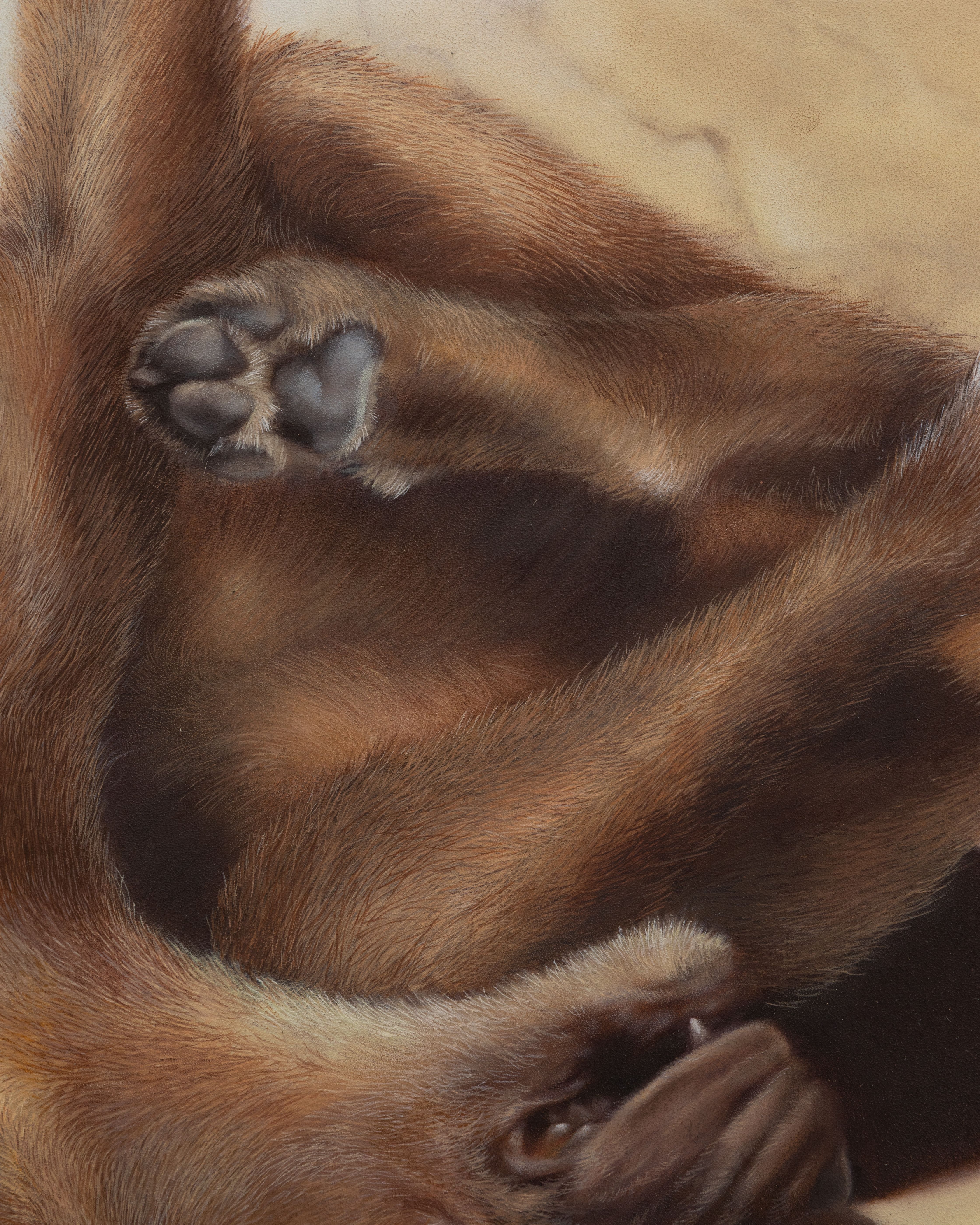
Cave Canem: A Circular Highway (2025) depicts the cast of a dog from Pompeii, his body contorted in an ouroboros, inside a glass vitrine. The haunting posture and mysterious sculptural material are further estranged by the ring of condensation presumably left by the animal’s breath upon the glass. Then, in Cave Canem: The Volcano (2025), a furry brown dog assumes the same position atop a polished tile floor beside an emergent anthill—a nod to the ancient explosion and a future where human infrastructure is overtaken by nature. The verisimilitude of the dog’s velvety muzzle, the lustrous sheen of the stone, and the diaphanous water droplets trailing down the pane render the paintings entirely uncanny.
Highly realistic representations of surface texture, reflectivity, and other material qualities that almost appear unreal—especially when combined with abstract or painterly gestures—is another common motif amongst this new crop of painters often categorised as surrealists. For Leshay, rendering something in exacting detail imbues the object with the gravity of the real and is a testament to the amount of research that goes into her paintings. ‘It’s a persuasion technique, a bid for people to consider the existence of an object that exists or will exist in the future,’ Leshay says.
Meanwhile, for Michigan-based painter Rae Klein, it’s all about immediacy: ‘surface texture is all I think about these days!’
Klein superimposes realistic depictions of objects she finds in vintage stores or on eBay, like candelabras, cutlery, toy airplanes, and fountains, atop oversized images of women’s faces, cloud-swept skies, and vibrant colour fields. A master at recreating the effects of light on glass and metal, she fills her varnished compositions with illusory reflections, lens flares, and shimmering shadows.
‘I’m using very tangible, concrete things to paint ideas about fear and power as they operate in our real world,’ she says. ‘As opposed to painting imagined things to visualise a dream world.’ For Klein, the key difference between her work and that of her Surrealist predecessors is the fact that her process follows a less inclusive and accommodating logic. ‘There’s a lot that wouldn’t fit or function in my paintings,’ she adds.
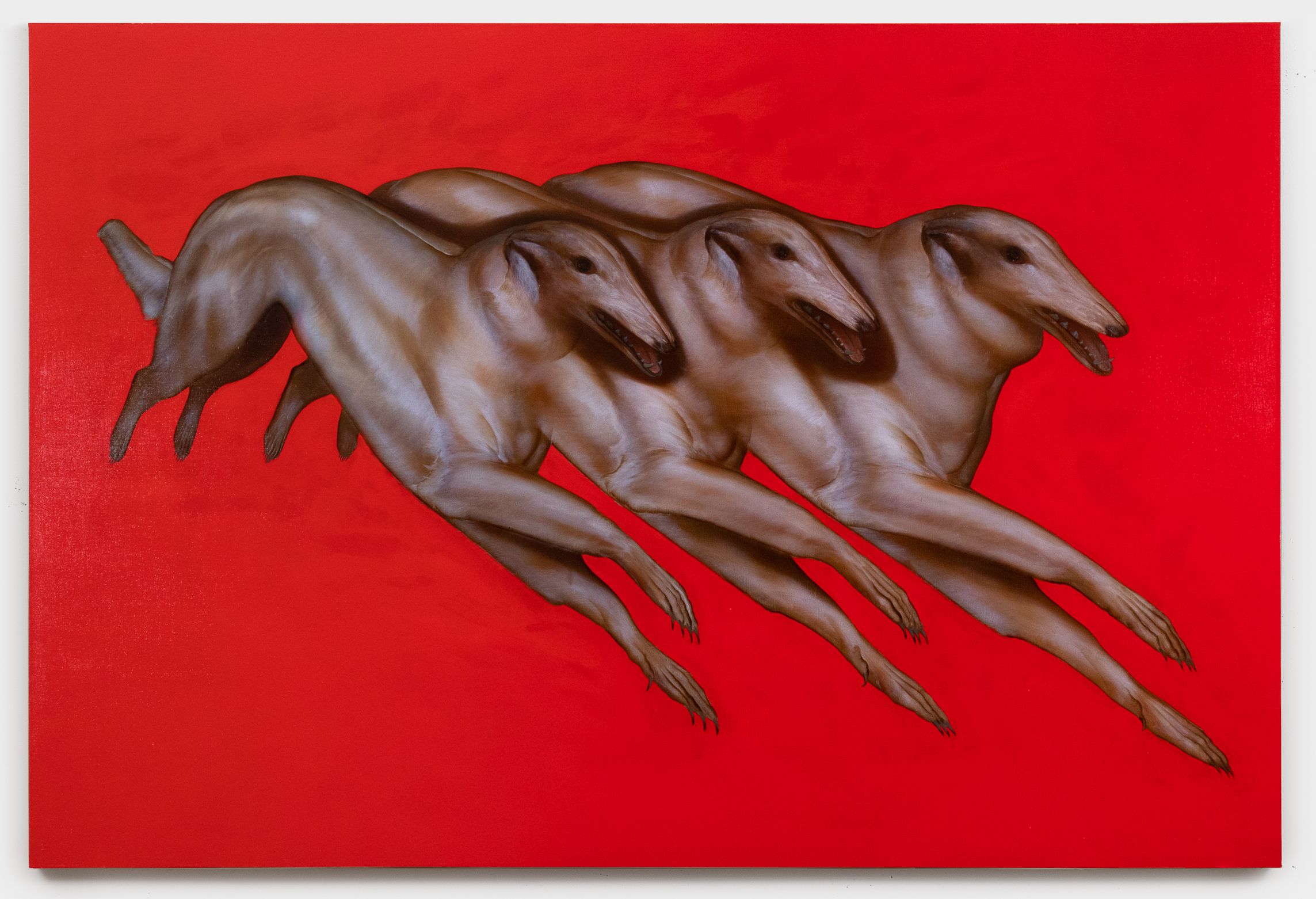
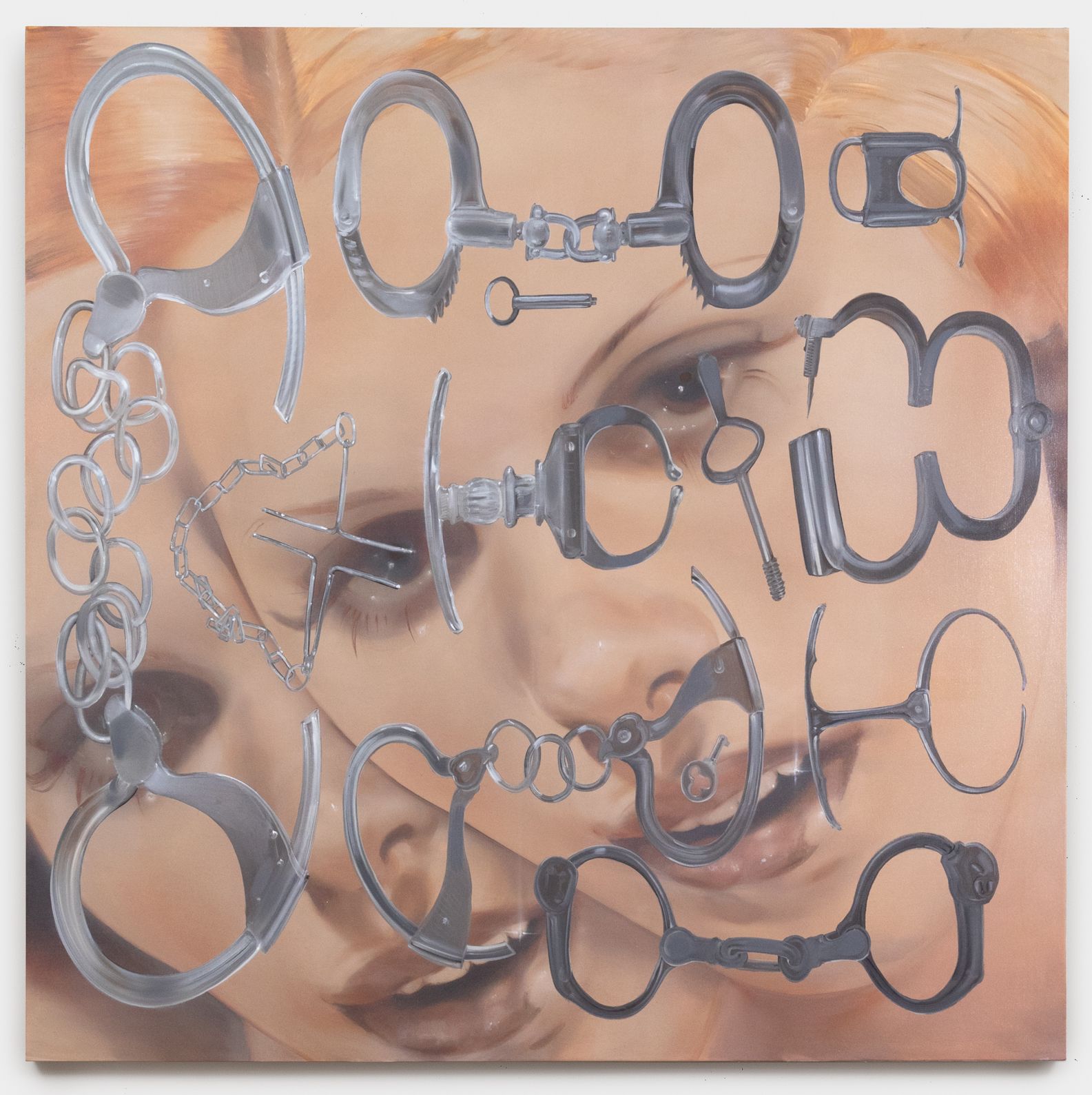
Klein’s recent exhibition at Nicodim Los Angeles, DOUBLECROSS (18 February–19 April 2025), explored lyrical ideas of heaven and hell, and the moment one tips toward the other. Klein often marshalls repetition to conjure a sense of uncanny and disquiet, as in Triple Dog (2024), where the three Borzois stacked one atop the other appear to lunge out of the frame toward the viewer, lucent coats gleaming against a brilliant crimson backdrop. In Bodyguard (2024–2025), instead of one metallic handcuff, which might have seemed erotic, there are four along with a host of enigmatic instruments that lend the composition its distinct air of danger, an imbalance in power between the objects and the female figure behind them.
Despite a penchant for mid-century modern source imagery, Klein views her work as existing outside of time, engaging with enduring questions about the human condition: How does fear corrupt perception? Are we what we desire? What precedes a shift from benevolence to malignity?
Theodora Allen’s paintings address similarly elemental themes and symbols, which contributed to her confusion during the early years of her career when people struggled to relate to her indigo-tinged compositions on linen.
‘Thanks to the recent surge of interest in a new spiritualism and surrealist artists like Leonora Carrington, people now have a way of contextualising my paintings,’ Allen explains. ‘I’m grateful for that, but I definitely don’t view my practice in terms of the occult, New Age, or esoteric.’
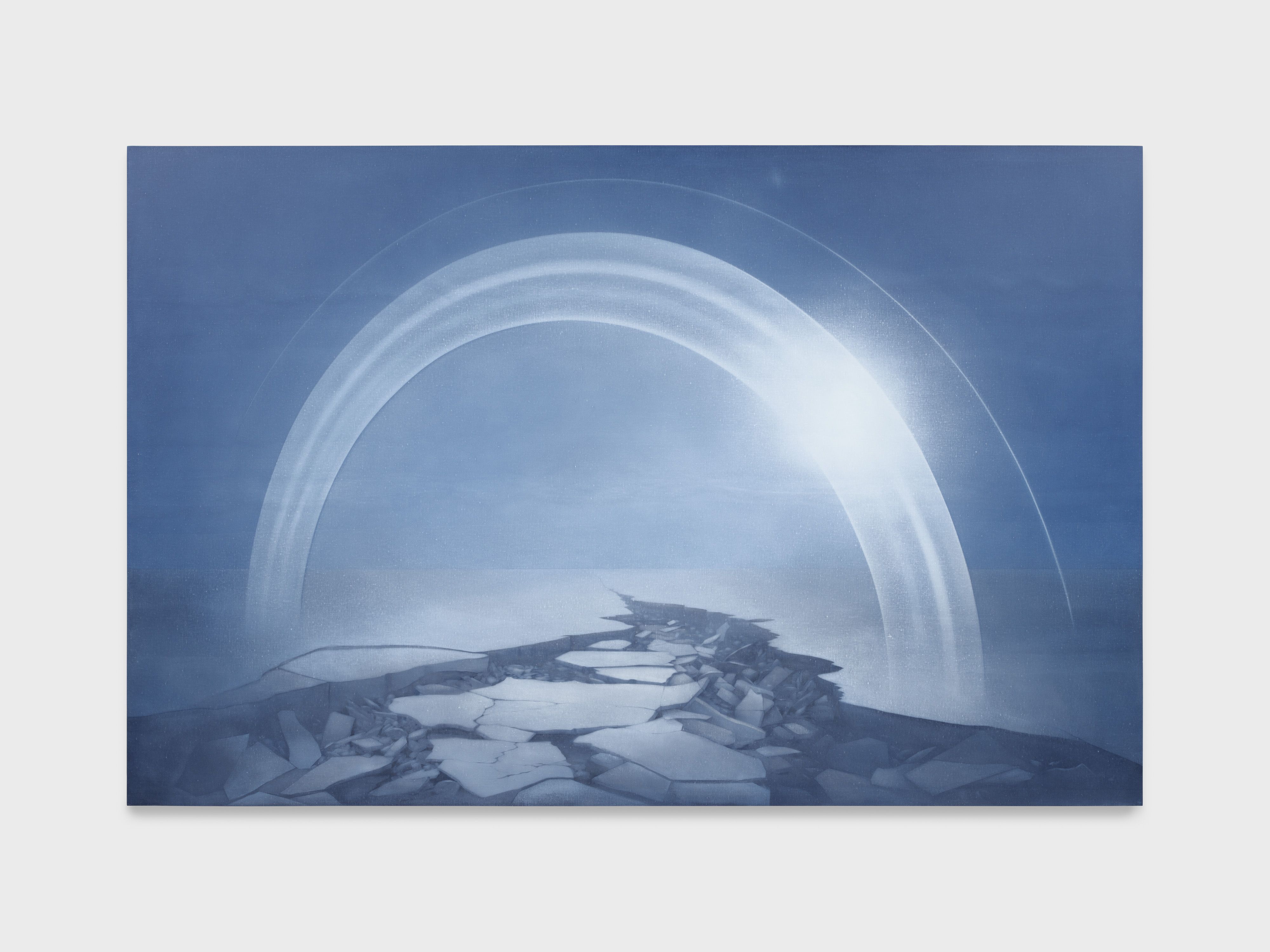
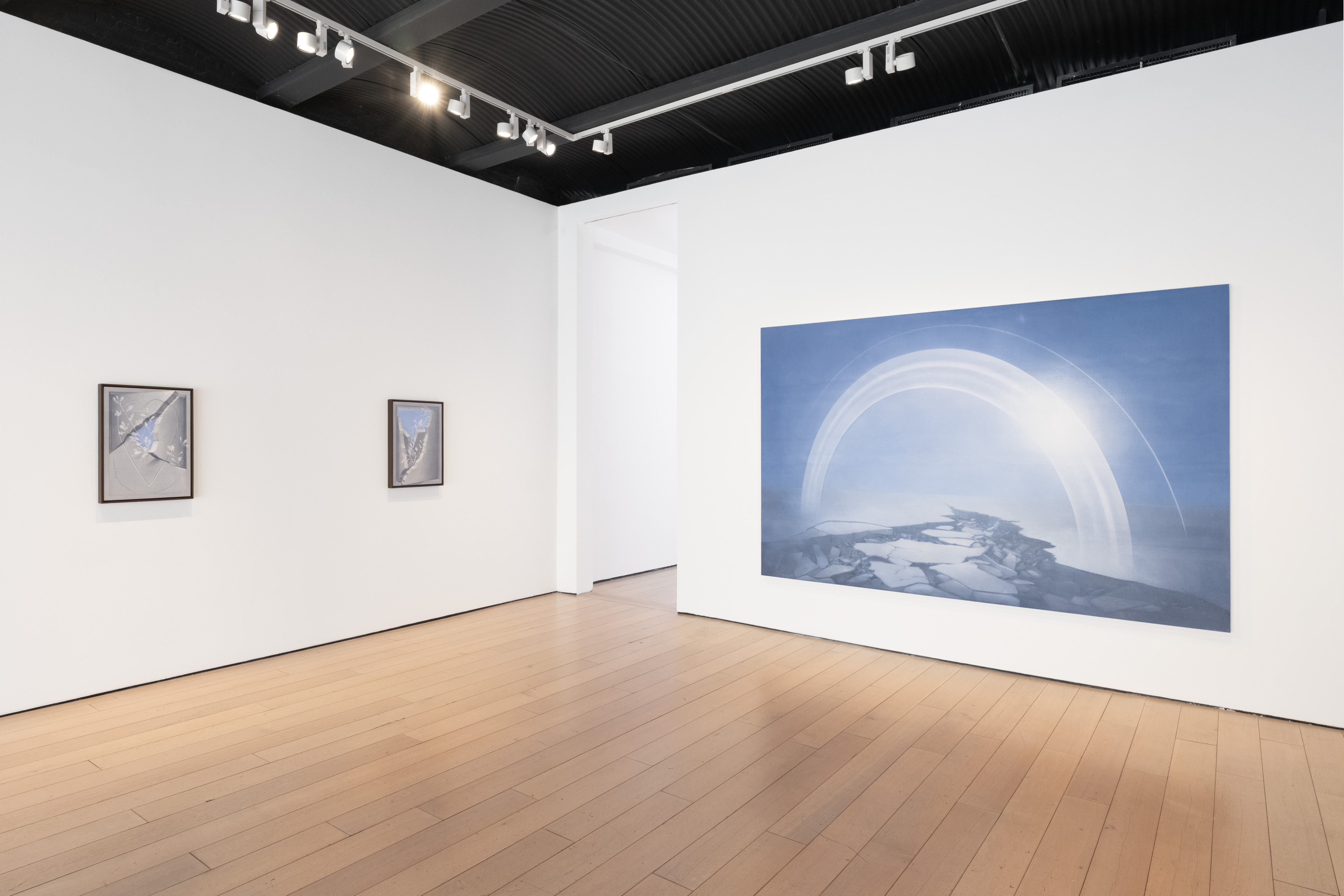
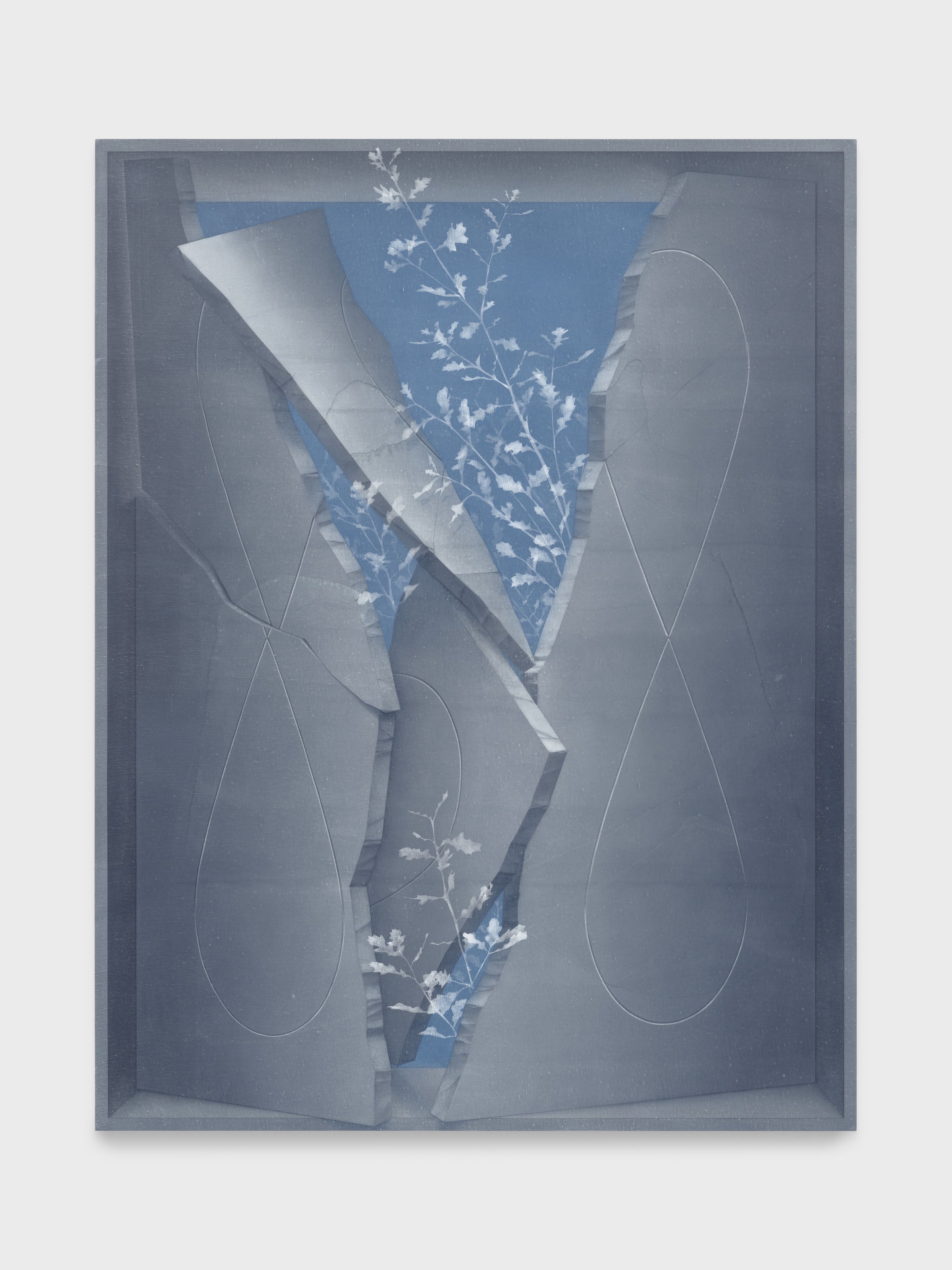
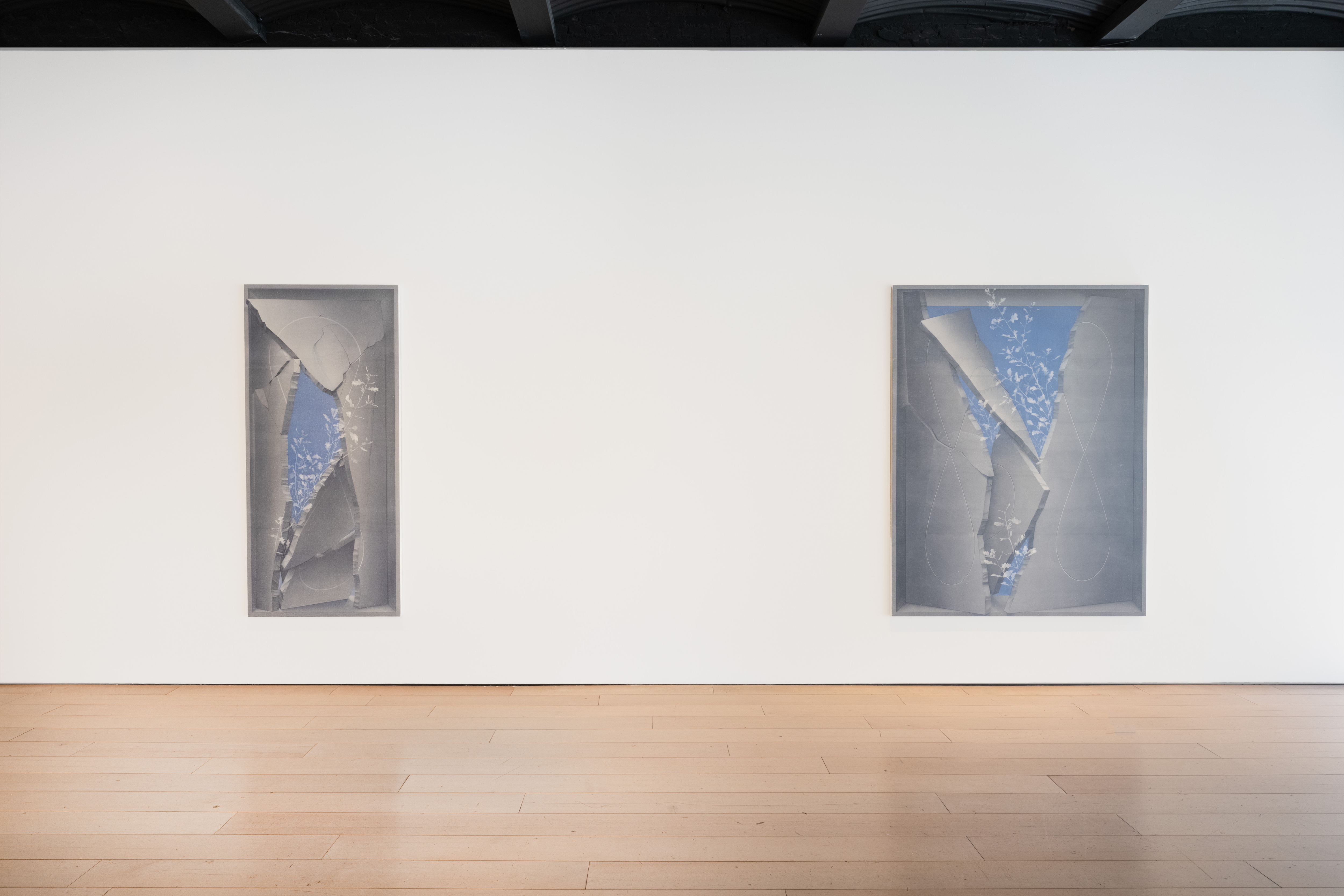
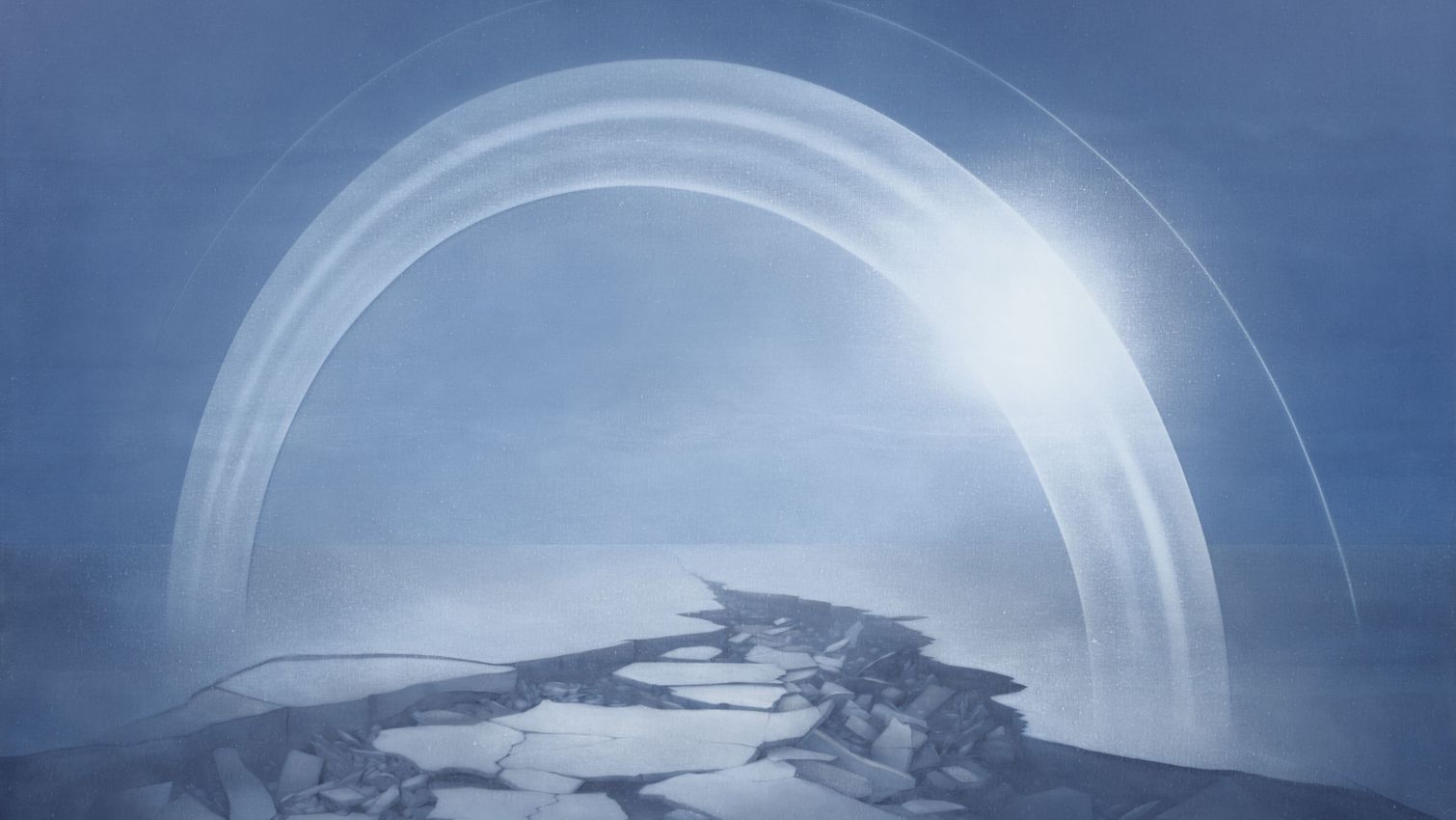
Transcending matters of internal searching, her work engages with Arthur Rackham, the Pre-Raphaelite Brotherhood, and William Blake to explore fundamental laws of nature, like the inextricable link between creation and destruction.
Allen’s formal and conceptual concerns are bound in the distilled natural imagery found throughout medieval art. The artist’s gossamer butterflies and jimsonweeds emerge through a process of subtraction and alteration, absence and presence: after stripping off paint to reveal the gessoed canvas, she gradually adds back in translucent layers of pigment. Reducing natural phenomena into potent, emotionally resonant symbols like shooting stars and serpentine flames, she conveys the essential yet enigmatic relationship between humans and their natural surroundings.
‘We’re so disconnected from nature, because we’ve commodified it,’ Allen says. ‘That’s the only reason we can destroy it as we do.’
Much of Allen’s work imagines humans enmeshed with nature in an effort to remind us of our place as living beings amongst other equally alive plants, animals, and insects. In her exhibition at Kasmin New York, Oak (7 May–25 July 2025), this takes the form of stone ruins inscribed with pictographs like hearts and infinity signs, overtaken by leafy oak saplings extending upward in search of light. The possibility of repair and restoration for the manmade structure lies in the trees filling in the cracks in the cloven slabs.
For Allen, as for Greene, Leshay, and Klein, the world doesn’t require enchantment; rather, it is we who need to be re-enchanted with the world. By portraying plants, animals, rocks, and inanimate objects as they are, these artists disabuse the notion that the physical world requires human intervention to appear surreal. —[O]
Main image: Theodora Allen, The Divide (2025) (detail). Oil on linen. 198.1 x 304.8 cm. © Theodora Allen. Courtesy the artist and Kasmin, New York. Photo: Marten Elder.



A respected voice in contemporary art discourse.
Focusing on ambitious storytelling and insightful art-world commentary. Ocula Magazine publishes in-depth interviews, critical essays and timely analysis on the artists, exhibitions and ideas driving the global art world.
Learn more about Ocula Magazine
Showcasing the best of the art world.
Ocula partners with galleries from around the world to highlight their artists, artworks and exhibitions. Gallery membership is by application and invitation, with each member vetted by an independent panel.
Learn more about Ocula Membership
Specialises in the sale of major artworks.
Led by a team with deep ties to the world’s leading auction houses, galleries and collectors. Ocula’s advisory team offers bespoke services to high-net-worth clients from around the world who are looking to acquire the best of contemporary and modern art.
Learn more about our team and services