





Holly Herndon and Mat Dryhurst’s Call and Response
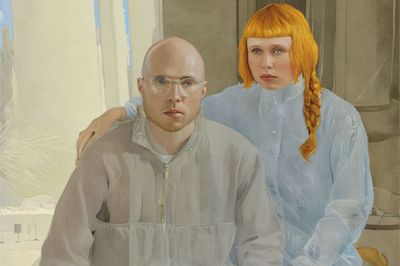
Portrait of Holly Herndon and Mat Dryhurst (detail). Courtesy Herndon Dryhurst Studio.
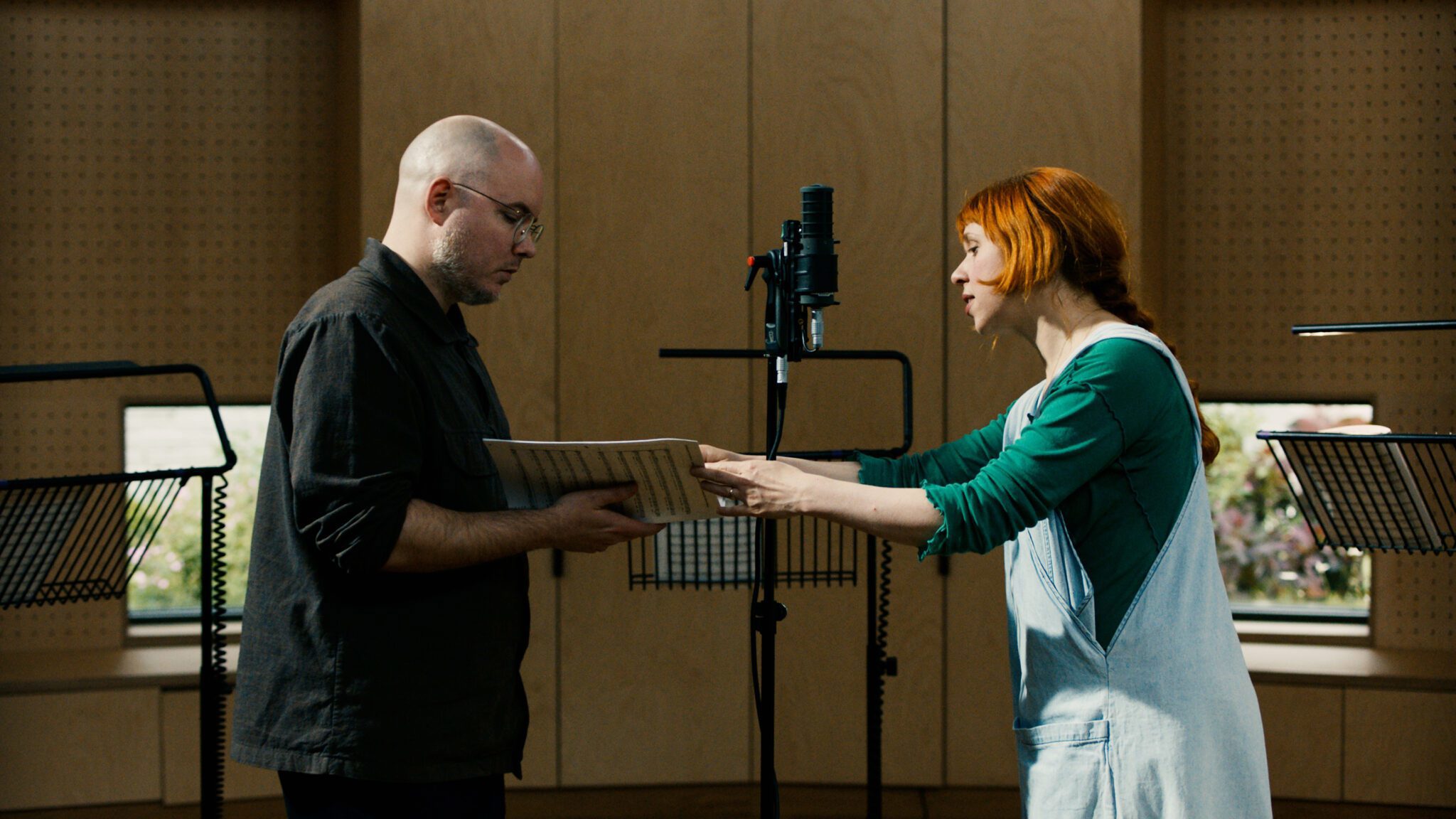
At London’s Serpentine, artist-musicians Holly Herndon and Mat Dryhurst merge the beauty of choral traditions and liturgical art to explore the potential of ethical AI.
Berlin-based Herndon and Dryhurst are best known for their work with machine learning. In 2023, TIME magazine named Herndon in its list of ‘100 Most Influential People in AI’, citing her shared projects with Dryhurst. Their innovative projects include Holly+ (2021), an online tool described as Herndon’s ‘digital vocal twin’, which allows users to upload a piece of audio and have it reproduced in the artist’s voice. For their first solo exhibition in the U.K.—presented at Serpentine North Gallery in London—the duo continues their investigations into sound and AI. Except this time, the focus is not on a single voice but on the collective voices of choral ensembles.
Herndon and Dryhurst describe their practice as ‘protocol art’. It’s a term that evokes Systems Art’s first wave of the late 1960s and early 1970s conceptualism, along with the closely related fields of cybernetics, process art, and Sonia Landy Sheridan’s Generative Systems programme, launched in 1969 at the School of the Art Institute of Chicago. What these art-historical precedents have in common with Herndon and Dryhurst’s work, among other things, is the desire to highlight systems and the processes that determine their functions, directing the audience’s focus beyond the exhibited object. Meeting with them as The Call opens in London, Herndon explains that ‘each part of the [AI] model-making process is an artwork in and of itself’ and ‘a moment for human creativity and collaboration’. In-person, the duo is affable, and they speak intelligibly about the project, volleying from one person to the other in quick succession.
The challenge with a project like The Call is to make its complex processes and methods appealing to non-specialist gallery visitors. With the help of sub—the Niklas Bildstein Zaar-led architecture studio perhaps best known for devising Balenciaga’s scenographies—Herndon and Dryhurst set out to distil, into material and visual form, three core parts of the AI-making process: the computation phase, the data creation phase, and the model interaction phase. In a judicious move, the show illustrates the above without a screen in sight, drawing instead on mediaeval liturgical art and architecture for its visual language. The result is a curious but compelling vision of new rituals for the machine-learning age.

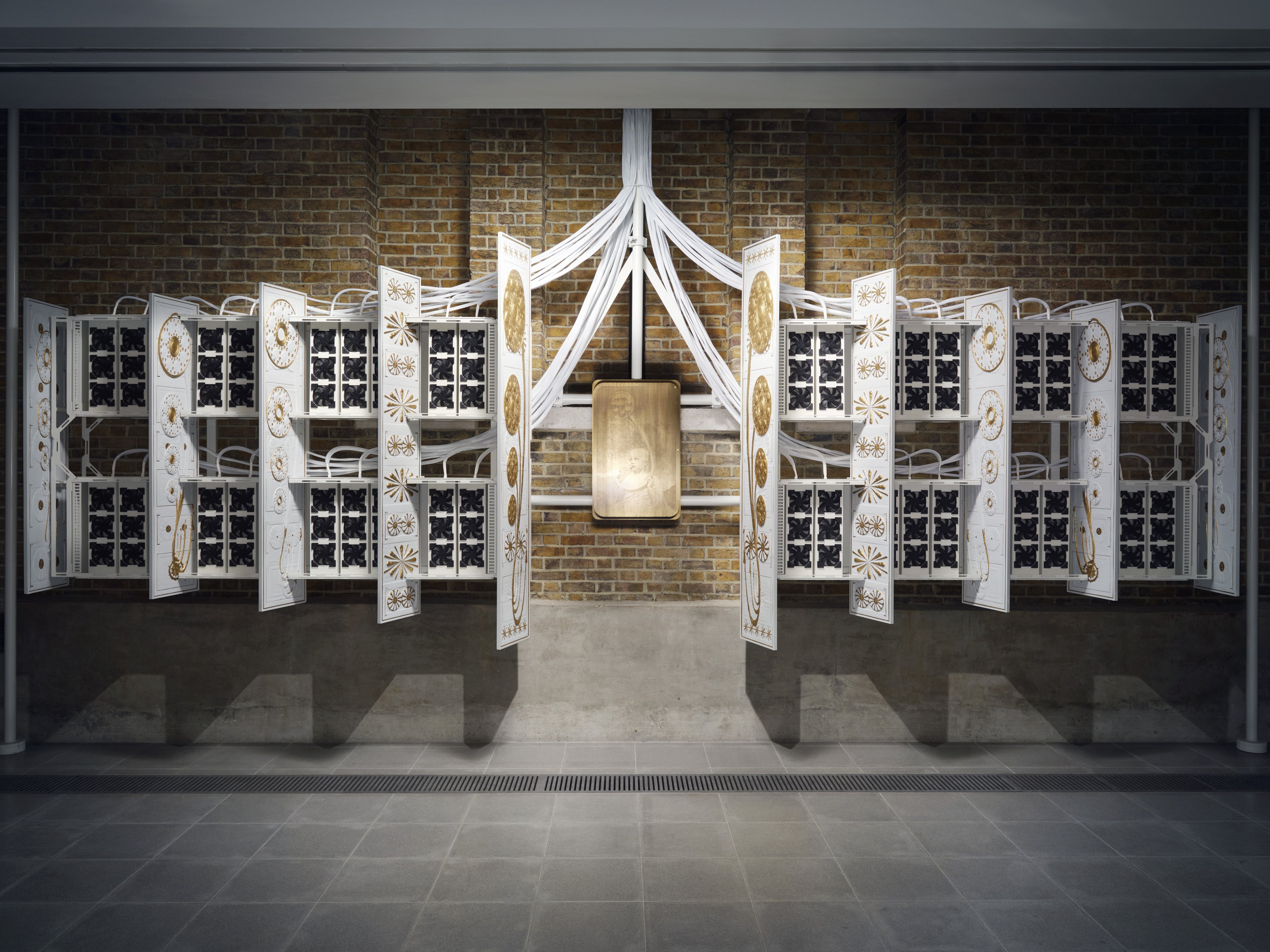
The Call opens dramatically with The Hearth (all works 2024)—a cluster of fans commonly used to cool the graphics-processing units that enable large-scale computation by AI models. Herndon and Dryhurst have arranged the fans like a pipe organ, whirring away and filling the room with hymns they composed. At the organ’s centre is an engraving of an infant blowing a lur, an ancient wind instrument. I read this mix of object and image as signalling history’s encounter with the future, setting the tone for the rest of the exhibition.
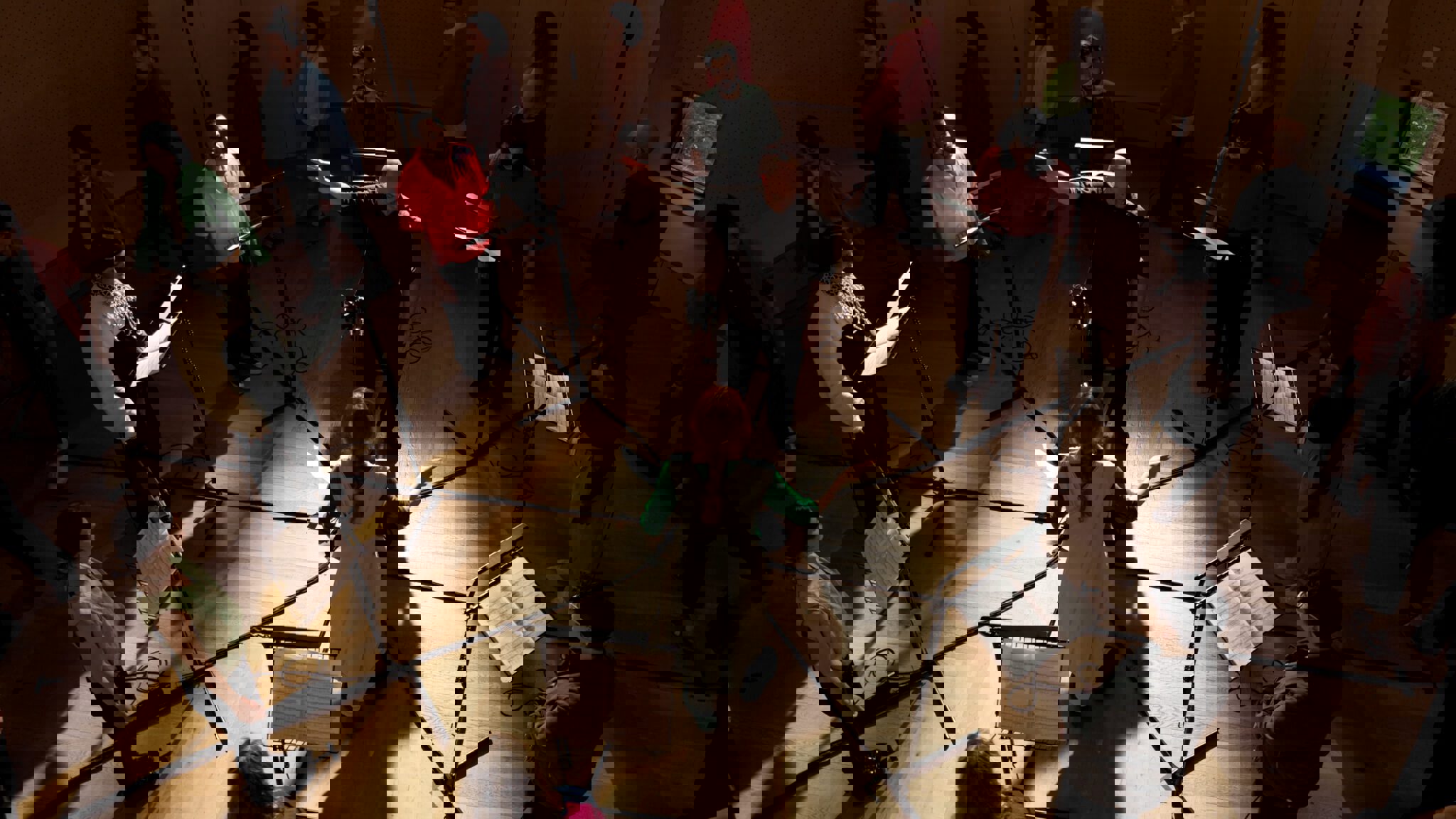
The show’s central concern with collective voices finds its most direct expression in Herndon and Dryhurst’s collaboration with 15 musical ensembles from across the U.K. An age-old medium for coordinating groups of people and providing a mode of communication, and the choir has some parallels to AI. Inspired by the U.K.‘s choral traditions, the artists created new vocal datasets from which choral AI models were trained.

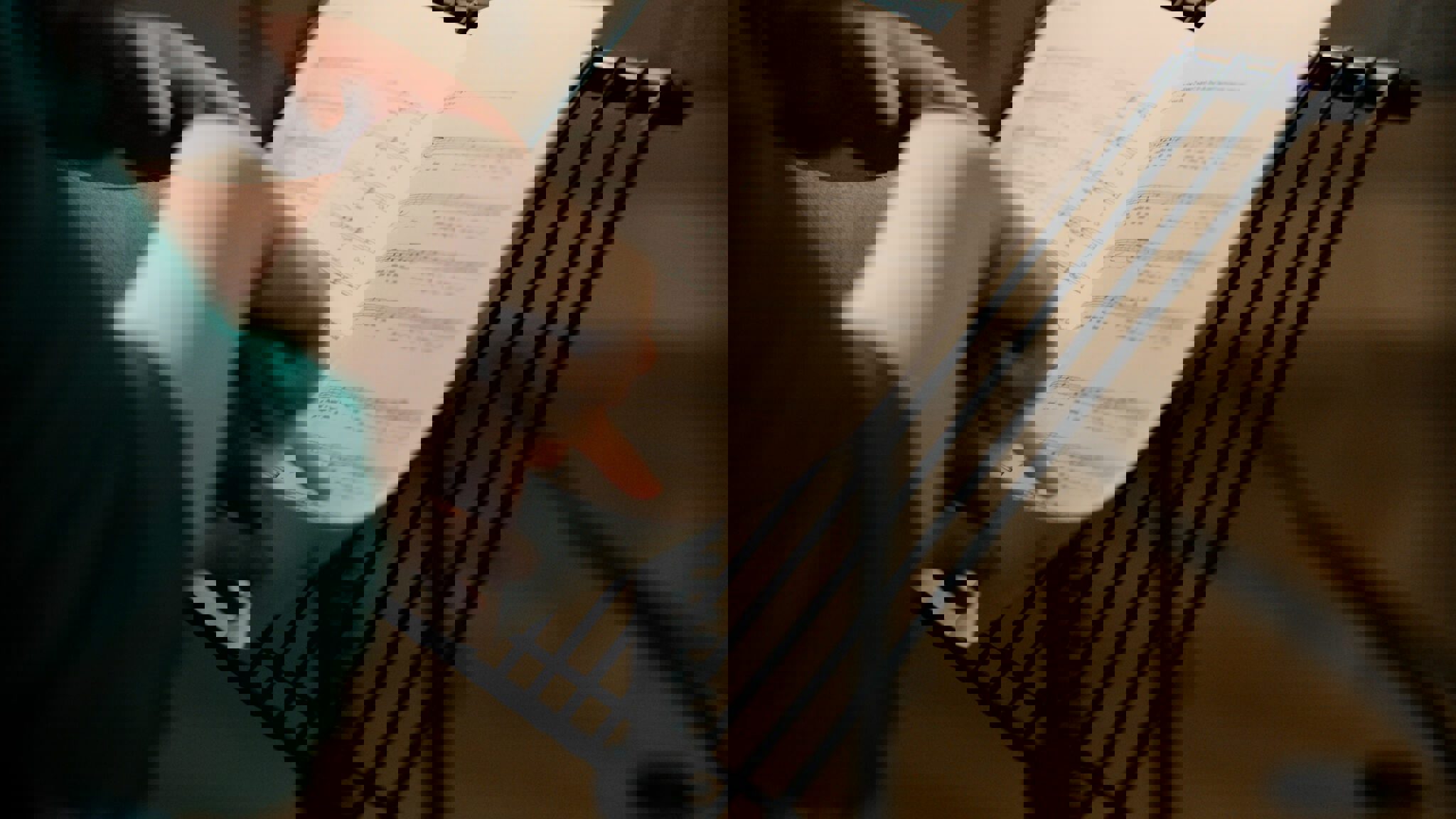
In the gallery’s South Powder Room, visitors will find a large chandelier—The Wheel—which represents the positions of the choristers and microphones during the recording process, with images from the recording tour depicted on gilded panels. All around its perimeter, hymn books are distributed as a call for creating new versions of each song.
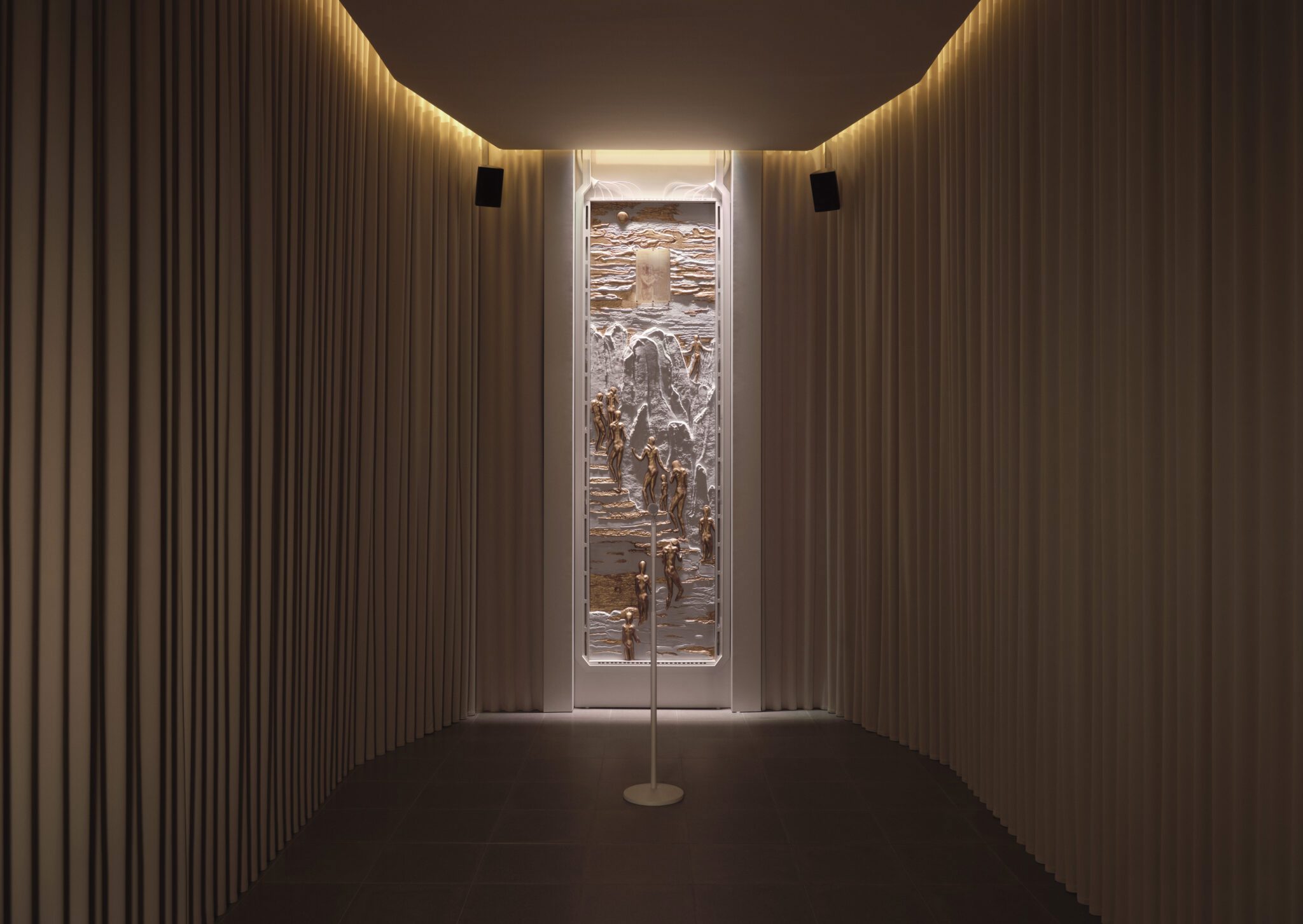
This participation thread carries over into the beautiful, chapel-like space constructed in the North Powder Room, where The Oratory offers visitors the opportunity to engage with a playful gimmick—albeit with little more than a moment’s reward. Stepping behind a curtain, I made my way sheepishly toward the microphone. Fortunately, the sound I uttered was returned as a wave of polyphonic choral harmonies, my mediocre singing voice indiscernible from a synthetic mass of others.
As the exhibition literature notes, The Oratory was conceived as a homage—in the form of an exquisite, gilded relief—to a painting by the Lebanese-American writer and poet Kahlil Gibran, titled Purified Humanity Rising towards the Infinite (1920–1923), which builds on his notion of ‘individual human experiences transcending the finite when such experiences link to eternal, collective processes’.
However, the overall sonic experience of The Oratory pales in comparison to Linked Diffusion, a suite of models installed around the gallery’s perimeter, which Herndon and Dryhurst created by applying the choral dataset to their entire archive. The sound is lushly spectral—an uncanny mix of novel and familiar, human and synthetic.
With so much talk of ‘the infinite’, ‘protocols’ and ‘models’, not to mention the argot of submission and nods to religious iconography, it’s easy to feel as though you are being initiated into a cult of mystical technocrats. But I found the exhibition quietly amusing in its eccentricity. Like so many of Herndon and Dryhurst’s previous collaborations, The Call‘s strength lies in creating a mood that piques curiosity while putting the pair’s values to work or, to use Herndon’s words during our conversation, ‘test[ing] the thesis out in the wild’.
One such value is consent, which the artists previously explored in Have I Been Trained (2022)—a web-based tool that allows users to opt in or out of the vast data sets used to train AI models for generative art. A year later, Herndon and Dryhurst launched Kudurru, a data-defence network that can block AI scrapers from your website; it’s a tool founded on the basis that we should all have a choice regarding whether and how we appear in AI models.
Their latest venture into collective data governance, conceived as part of The Call, is the Data Trust Experiment, led by Serpentine’s Future Art Ecosystems. As part of the experiment, a data intermediary has been appointed to help consider how all participating choir members can exercise greater agency in determining, among other concerns, whether the dataset created using their performance recordings and the models derived from it could be made available to others.
It’s an ambitious undertaking—part-bureaucratic, part-educational—the ongoing development of which will involve a series of events whose findings will be recorded as open-access online resources. Against the growing chorus of AI boosterism and opposing catastrophism, Herndon and Dryhurst propose their surprisingly pragmatic yet imaginative response with this project. —[O]
‘The Call’ is a collaboration between artists Holly Herndon and Mat Dryhurst, and Serpentine Arts Technologies, showing at Serpentine North Gallery in London until 2 February 2025.
Main image: Portrait of Holly Herndon and Mat Dryhurst (detail). Courtesy Herndon Dryhurst Studio.




A respected voice in contemporary art discourse.
Focusing on ambitious storytelling and insightful art-world commentary. Ocula Magazine publishes in-depth interviews, critical essays and timely analysis on the artists, exhibitions and ideas driving the global art world.
Learn more about Ocula Magazine
Showcasing the best of the art world.
Ocula partners with galleries from around the world to highlight their artists, artworks and exhibitions. Gallery membership is by application and invitation, with each member vetted by an independent panel.
Learn more about Ocula Membership
Specialises in the sale of major artworks.
Led by a team with deep ties to the world’s leading auction houses, galleries and collectors. Ocula’s advisory team offers bespoke services to high-net-worth clients from around the world who are looking to acquire the best of contemporary and modern art.
Learn more about our team and services