






Three Madrid Exhibitions to Visit This Autumn
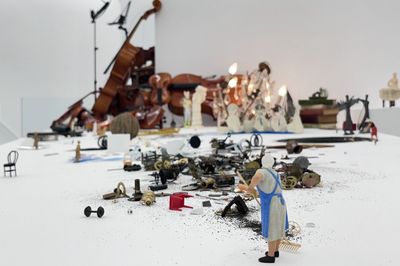
Liliana Porter, La barrendera (2023) (detail). Figures, objects, sand, instruments, lamp. Dimensions variable. Courtesy Espacio Mínimo, Madrid.
‘The bad weather arrives with Christmas,’ my taxi driver explains as we cart from the Reina Sofía down to the Carabanchel district in the south of Madrid, which has shifted from industrial zone to cultural hub over the past few years.
We’re in Spain’s capital for Apertura Madrid Gallery Weekend: a three-day event to mark the end of the summer, with a fresh round of exhibitions opening up around the city. Having flown from positively bleak conditions in London into 30-degree heat, I can confirm that the seasonal celebrations were rather premature, but provided balmy temperatures to roam around some of Europe’s best contemporary galleries. Here are our top three shows to see this autumn.
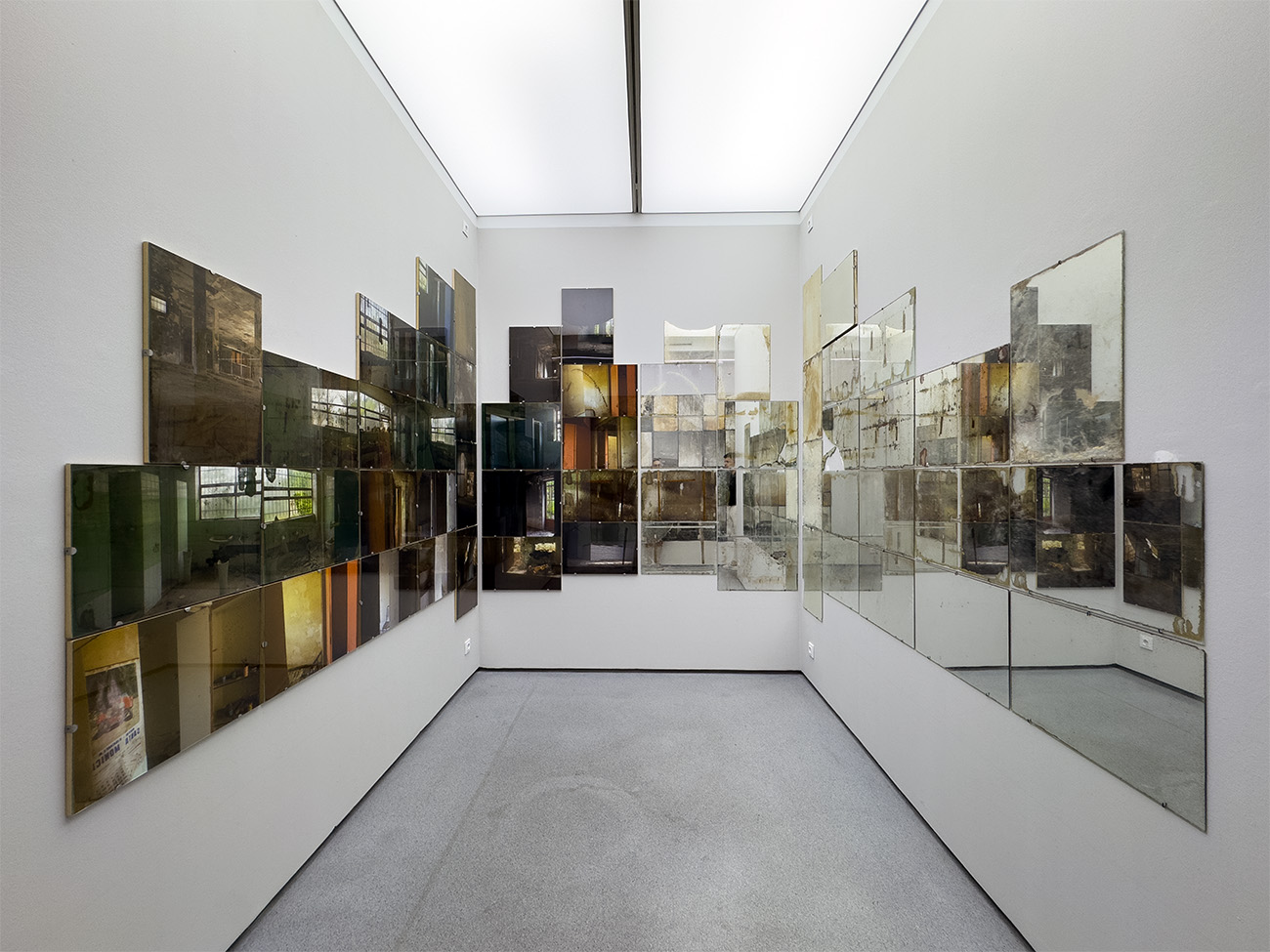
Patricia Gómez and María Jesús González: ESPEJO DEL MUNDO
1 Mira Madrid, Argumosa 16, bajo dcha.
12 September–2 November 2024
Expect: an installation recovering the history of patients condemned to the now-decommissioned Padre Jofré psychiatric hospital in Bétera, Valencia, formerly one of the largest facilities of its kind in Europe.
The Valencia-based artist duo Patricia Gómez and María Jesús González have long been interested in the traces of memory and time left behind in abandoned architectural structures. Their collaborative projects have centred on a wide range of places, beginning in 2002 with an abandoned country house in Viveros, Albacete, to various prisons, convents, and museums, among other sites.
For their debut in Madrid, the pair focus on a 1,200-bed psychiatric institution, conceived in the late-Francoist period and opened in 1974. It later became the subject of journalistic reports exposing the horrors that took place within its walls.
On one wall of the gallery hangs a densely packed series of photographs of the hospital rooms, with deteriorating walls and moss-covered window frames. Facing the photographs on the opposite wall is a collection of mirrors from the hospital walls: some intact, others in varying states of decay, whether oxidised, rusted, or scratched and cracked.
Further into the gallery are large-scale rectangular canvases which bear a process of extraction, or strappo, where the imprint of each wall is transferred onto a stretch of fabric. The result is a textile sculpture that inhabits the positive mould of the architectural space, similar to Swiss artist Heidi Bucher’s architectural ‘skinning’ productions of the 1970s and 80s.
The artists’ hope for this project—part of a wider documentary series titled ‘Mirror of the World’ (2017–ongoing)—is to platform irrefutable truths and shed light on the individuals who may otherwise disappear in the rubble of history.

Liliana Porter: Other Unfinished Tales
Espacio Mínimo, Doctor Fourquet, 17
12 September–8 November 2024
Expect: an elaboration of the installation of miniature figures that the Argentine artist brought to the Venice Biennale in 2017.
A plastic woman around two inches tall is the protagonist of Porter’s large installation, La barrendera, at Espacio Mínimo. She is seen sweeping miscellaneous objects—bronze cogs, miniature chairs, balls of string—along a large white platform that runs diagonally across the gallery floor.
The installation has its origins in the artist’s ‘Forced Labour’ series, a body of work Porter began in the 1990s with a miniature man shovelling a comparatively enormous pile of dirt. The series has since diversified in composition and dialogue; for the 57th Venice Biennale, Porter presented the installation Man with Axe (2017), in which a miniature man is frozen with his axe in mid-air at the tail end of a string of debris.
In La barrendera, broken shards of delft china, miniature plastic chairs, and a pile of toy train tracks are dwarfed by contents on the far end of the white podium: a collection of cellos, violins, and a glass chandelier propped on its side.
Porter explained at the opening: ‘I am concerned with the subject of representation versus reality. One moment, there will be a table fit for a doll’s house, the next there will be a violin: not a representation, but the real thing.’

:mentalKLINIK: GENERATED DREAMS
Sabrina Amrani, Sallaberry, 52
12 September–9 November 2024
Expect: a playground of paintings, metal truss sculptures, and lifelike silicone figures slumped on chairs in the light-filled industrial space.
Turkish artists Yasemin Baydar and Birol Demir founded their collaborative practice :mentalKLINIK in 1998 as an experimental laboratory to explore the nature of our contemporary world.
Despite having worked together for a long time, the pair find ways to keep their relationship fresh. ‘Every time we get up, that day starts anew,’ Demir once stated. ‘We try to find a road again, as if we never worked together.’
Their work marries seductive glamour with dark humour in hyper-stimulating exhibition spaces—kitted out with projected light, glitter, and neon—to examine how life, art, and entertainment morph into one another.
When entering Sabrina Amrani’s light-filled industrial space, visitors are met with a playground of paintings, metal truss sculptures, and lifelike silicone figures sitting slumped on a monoblock chair, with long heads of hair masking their expression.
Lining the walls are a series of ‘WET PAINTINGS’ depicting abstract blocks of colour—fuschia pinks, deep blacks, midnight blue, and shimmering metallics—smothered across a darkened, anodised aluminium surface. At each end of the gallery hangs a series of AI-generated images of cigarettes, ring-laden hands, and close-up portraits that towards the corners appear to have a smudged finish.
Amrani was one of the first gallerists to open in Madrid’s Carabanchel district in 2019. Now, the neighbouring streets are home to VETA, Galería Formato Cómodo, and Belmonte, among many other young contemporary galleries. Amrani’s flagship gallery in Malasaña is currently showing an exhibition of recent paintings by South African artist Alexandra Karakashian, also worth a visit. —[O]
Main image: Liliana Porter, La barrendera (2023) (detail). Figures, objects, sand, instruments, lamp. Dimensions variable. Courtesy Espacio Mínimo, Madrid.





A respected voice in contemporary art discourse.
Focusing on ambitious storytelling and insightful art-world commentary. Ocula Magazine publishes in-depth interviews, critical essays and timely analysis on the artists, exhibitions and ideas driving the global art world.
Learn more about Ocula Magazine
Showcasing the best of the art world.
Ocula partners with galleries from around the world to highlight their artists, artworks and exhibitions. Gallery membership is by application and invitation, with each member vetted by an independent panel.
Learn more about Ocula Membership
Specialises in the sale of major artworks.
Led by a team with deep ties to the world’s leading auction houses, galleries and collectors. Ocula’s advisory team offers bespoke services to high-net-worth clients from around the world who are looking to acquire the best of contemporary and modern art.
Learn more about our team and services