






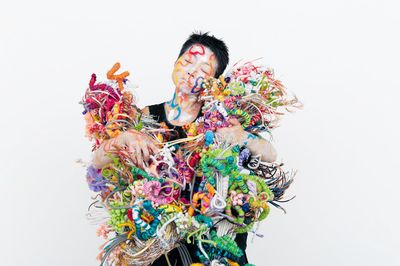
Hiromi Tango, Electric Human Chromosomes 3 (2017). Pigment print on paper. 80 × 114 cm. Edition of 6 plus 2AP. Courtesy the artist and Sullivan+Strumpf, Singapore/Sydney.
There is a luminescence to Hiromi Tango’s art practice that is perhaps a brightness born out of darkness; a mysterious, beguiling playfulness that hints at more serious matters. Her art is distinctive for the bowerbird-like use of brightly coloured cloth, cord, rope, neon lighting, mirrors and other man-made detritus of the contemporary world. Tango weaves her life into her sculptures, installations, photographs and performances, often reflecting on ideas to do with disease, disability and mental health—the latter being something that has personally affected the artist.
Her practice also looks outwards to engage with the scientific community and the general public on subjects that everyone can relate to. This fascination with science provides a natural starting point to engage with various communities and explore concerns such as the consequences of technology and the high-speed, high-stress nature of human existence today.
Originally from Japan, Hiromi Tango currently lives in Tweed Heads, Australia, where she finds the slower pace of life suits her. She has taken part in a number of community development and mental-health-oriented art projects, and has exhibited widely throughout Australia and in Asia, both in commercial and institutional venues.
Your work is extravagant, vibrant, surreal. The colours are garish or sickly; the artificial hues of candy and plastic. Looking at them can make one feel quite uncomfortable or even claustrophobic. Do you want the viewer to have a very basic, visceral response to your work?
One work in particular, Amygdala (Scissors/Fireworks) (2016), a performance installation that I staged during Art Basel in Hong Kong [24–26 March 2016], may be read as the expression of a panic attack, a sense of primal fear that arises from the part of the brain that is buried deep, beyond the realm of rational thought. The work also reflects my personal feelings of panic in response to our high-speed society and the daily overload of information, and how I was struggling to find my own speed of existence.
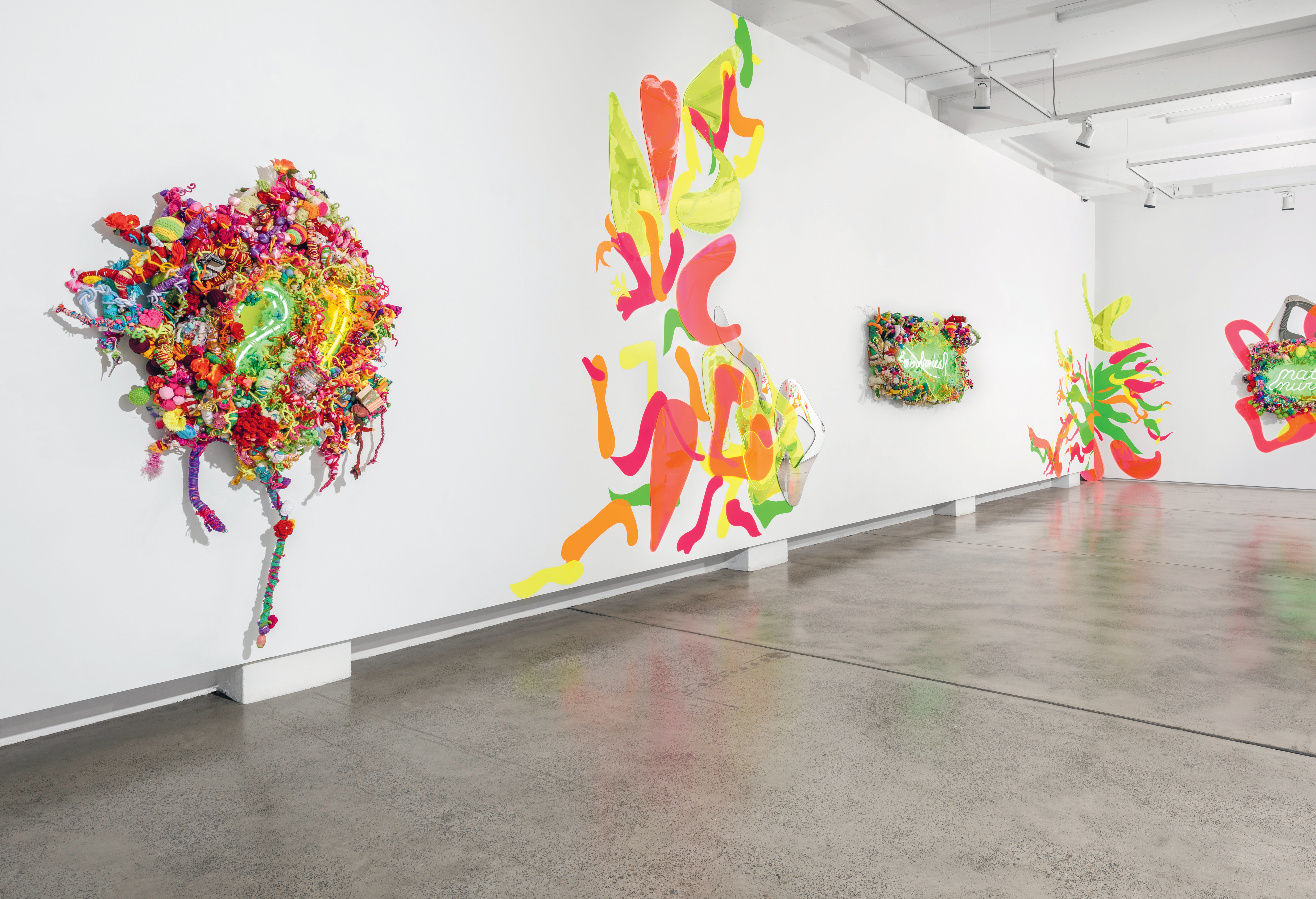
My more recent works have been developed with the healing aspects of colour in mind, using principles from colour psychology and mindfulness for healing and calming. I use elements such as colour, light, mirrors and Perspex to create multi-sensory brain responses, but all of these aim for brain health and well-being, and allow us to be in touch with our emotions rather than making us anxious.
There is often a feeling of entrapment in your work—self-entrapment or the entrapment that is created by societal expectations. Are you responding to the pressures of everyday urban life?
I don’t see my work as a self-entrapment, but certain works represent the state of anxiety, a condition that I have lived with throughout my life. I now live in Tweed Heads, in regional New South Wales, where I have more space and am surrounded by the natural environment, which—along with the slower pace of living—is definitely helping my anxiety.
I am interested in how many aspects of modern society, such as the information overload we experience and the expectation that we deal with information at a high speed, contribute to high levels of stress. I am really interested in how arts engagement can enhance mental health and well-being. I am particularly interested in the impact of brain health for children, and how we can nurture empathy and social connectedness through art.
For example, a recent work, 46 Healing Chromosomes (2017), features many tightly wound and some unravelling cables, creating a metaphor for our state of mind. I wanted to explore questions about how our children’s constant connectivity to devices might be affecting their mental health. I also wanted to explore how we might unplug and recharge our minds and bodies.
Your practice has become increasingly focused on exploring neuroscientific concepts. You are particularly interested in how conditions such as ageing, dementia, brain injury and special learning needs affect people and how these conditions are impacted by scientific research. Could you elaborate on how these concerns are played out in your practice?
Science is an inspiration, and researchers are often quite poetic and philosophical. For me, science is the starting point, and as an artist I am free to push boundaries and ask questions without the burden of proof. I get to ask ‘what if?’ and let my imagination take over. Over the years, the marriage between science and the arts has become the foundation of my art practice, and I hope to further develop formal partnerships and collaborations with scientists, health professionals and artists who are dedicated to using arts engagement for brain health and medical purposes, including in hospitals or mental health settings.
Each of my works explore a particular idea or concept. I often consult with specialists such as neuropsychiatrists, psychologists, neurologists and colour specialists to choose the materials and colours, for example, that will create a particular beneficial effect for the specific need or developmental outcome that I am investigating.
‘Fluorescence’ (2015) is a series that uses specifically selected colours and light sources to provide beneficial stimulation for people whose colour perceptions have been impacted by the optical degeneration that can accompany dementia. The work is designed specifically to engage older people and is based on research that shows that those with optical degeneration respond differently to colours and shapes. I read that fluorescent colours provide brain stimulation even when the brain’s response to primary colours has become muted, and I became fascinated by the idea of fluorescent hues evoking an emotional response.
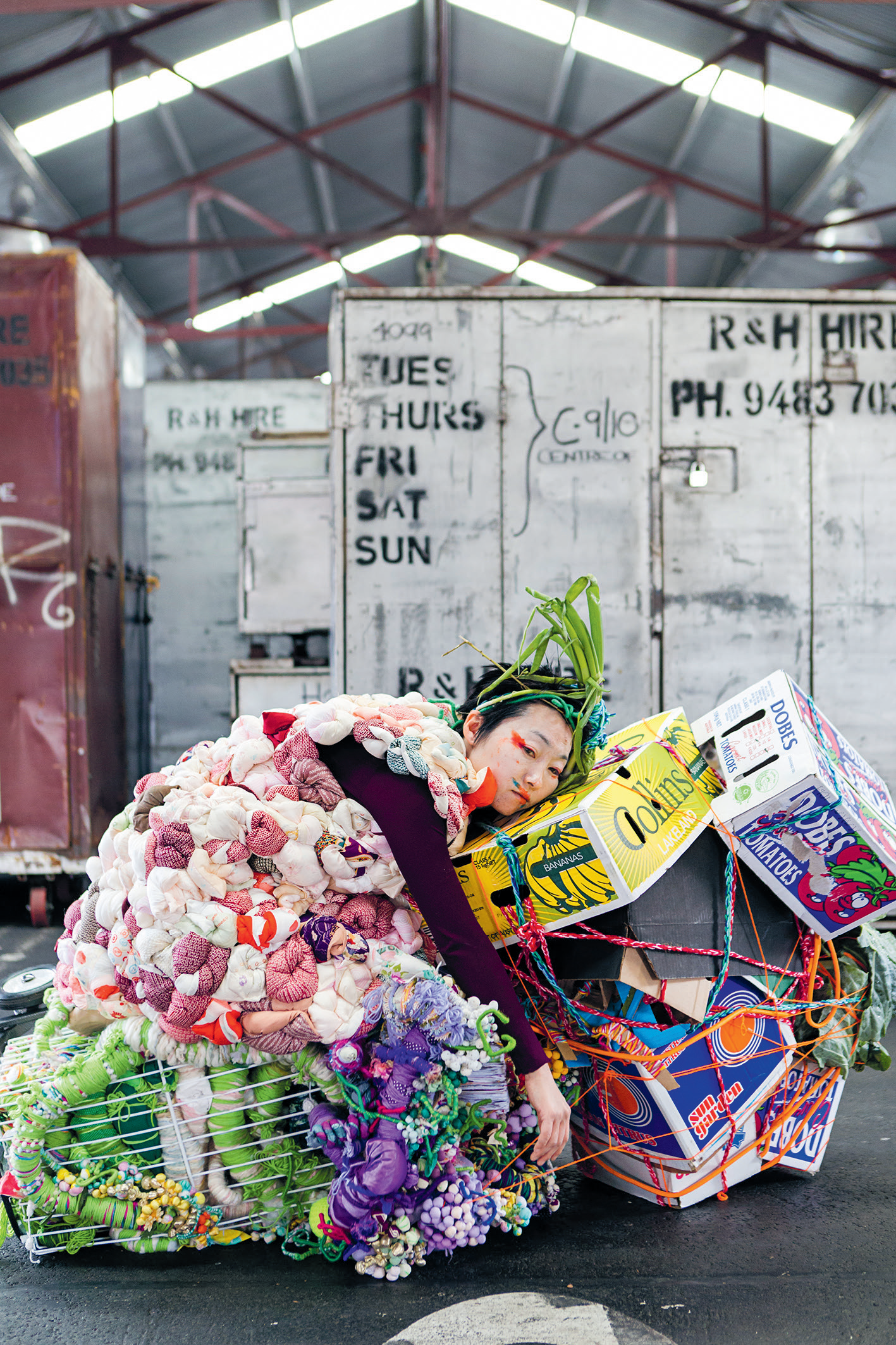
You often collaborate with researchers and scientists in your projects. Can you tell us about your recent project Wrapped (2016), and working with psychiatrist Dr Patricia Jungfer and neuroscientist Dr Emma Burrows as part of the 2016 Public Art Melbourne Biennial Lab (17–23 October 2016)?
I had a wonderful experience working with Dr Burrows, who generously shared her expertise on brain development and helped me to reimagine the Queen Victoria Market as a living brain. We explored the many ways that the market experience—from healthy food to sensory experiences and social engagement—can promote healthy brain development. Dr Burrows wrote an essay and also informed the development of the performative sculptural installation entitled Wrapped, which took place at the market. I created sculptural costumes from the hessian that the market stalls are wrapped in overnight, and moved around the market engaging with visitors and stallholders, talking about their experiences. The work culminated in a performance with dancers, as well as a talk by Dr Burrows on the relationship between market life and a healthy brain.
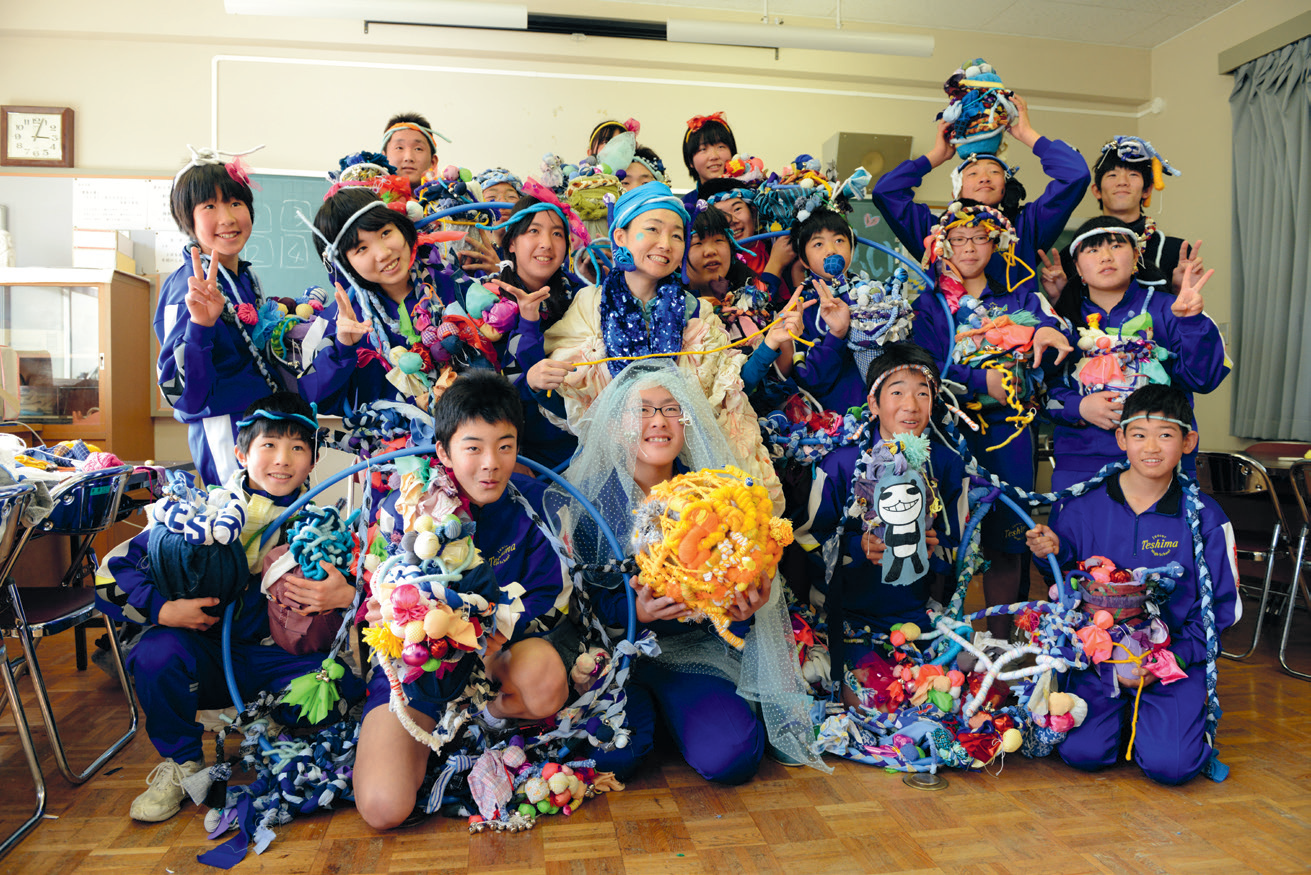
You also involve individuals and communities in your artworks. How did Traces—Blue (2013), a work you made for the Setouchi Triennale on Teshima Island in Japan (20 March–4 November 2013), interact with the local community? Does engaging a human element change the outcome of a piece?
Each work is unique and reflects the stories that community participants bring to it. Traces—Blue was a project that I did in collaboration with my husband Craig Walsh. We worked with community members on Teshima, a small island where fishing has traditionally been their main source of livelihood. The community was concerned with the dwindling population, as many young people were moving away to seek opportunities in larger towns. A major goal of the project was to engage multiple generations in a work that celebrates the unique strengths and culture of the island and to foster dialogue around the future of their villages in a changing world. I chose fishing rope as a symbolic material for the work, which also provided an anchor point between the indoor sculptural work and a mirrored boat floating in the harbour that was part of Craig’s work. We worked with young schoolchildren, the elderly and everyone in between, creating a work that reflected their stories, hopes and aspirations. There was also a celebratory performance with community members, which further referenced aspects of traditional culture and the local industry. At a more general level, I am interested in the relationship between the patient and therapist and how I might simulate the same kind of safe environment between the artwork, viewers and creators, where being listened to and guided safely in a trusting environment can make you feel better. When I am making artwork in a collaborative way, I feel a shift in the energy—sometimes even just by being quiet, without talking much—and there is comfort and trust demonstrated in that space.
Does your Japanese heritage impact your work?
I am not consciously demonstrating Japanese heritage through my artwork. However, I have noticed after living in Australia for nearly 20 years that I am more appreciative of the values and aesthetics that my grandparents, family, teachers and friends have taught me.
Some materials and techniques that I use, such as incorporating Japanese kimono silk, or the way of making otedama [a traditional children’s game of tossing small bean bags] or even wrapping, are obviously reflective of my Japanese heritage. But these choices are more about using tools and methods to create an effect, rather than being a conscious choice to create something that is inherently Japanese.
When I was young, I wanted to go as far away as possible from Japan. I grew up in regional Japan, in a very traditional and religious culture, and was constantly being trained to be a traditional Japanese woman, which was a heavy burden for me. I just wanted to be human, a more universal being—beyond gender, age and cultural background—and to experience life beyond very strict traditional customs and expectations. Now that I reside in Australia and have friends and family who share similar values and beliefs, I am learning to accept who I am, which includes both my genetic make-up and the environment around me.
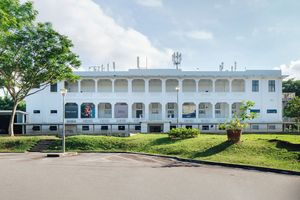
This interview was first published in Art-In-Sight by Gillman Barracks, and it is now reproduced here in full with the permission of National Arts Council of Singapore (NAC). In 2017 Ocula was pleased to partner with NAC to produce the print publication Art-In-Sight to mark the fifth anniversary of Gillman Barracks. Gillman Barracks is a visual arts cluster that was set up to present and generate discourse on international and especially Southeast Asia art. Art-In-Sight features interviews with key figures involved with Gillman Barracks, including artists, collectors and gallerists, alongside wide-ranging essays that survey Gillman Barracks through various lenses. You can view the full book online by visiting Gillman Barracks website here.
Main image: Hiromi Tango, Electric Human Chromosomes 3 (2017). Pigment print on paper. 80 × 114 cm. Edition of 6 plus 2AP. Courtesy the artist and Sullivan+Strumpf, Singapore/Sydney.


A respected voice in contemporary art discourse.
Focusing on ambitious storytelling and insightful art-world commentary. Ocula Magazine publishes in-depth interviews, critical essays and timely analysis on the artists, exhibitions and ideas driving the global art world.
Learn more about Ocula Magazine
Showcasing the best of the art world.
Ocula partners with galleries from around the world to highlight their artists, artworks and exhibitions. Gallery membership is by application and invitation, with each member vetted by an independent panel.
Learn more about Ocula Membership
Specialises in the sale of major artworks.
Led by a team with deep ties to the world’s leading auction houses, galleries and collectors. Ocula’s advisory team offers bespoke services to high-net-worth clients from around the world who are looking to acquire the best of contemporary and modern art.
Learn more about our team and services