

MARTHA JUNGWIRTH
b. 1940, Austria“Drawing and painting are a movement that runs through me,” Austrian artist Martha Jungwirth has said. Her abstract works are created using the rhythms of her body, translating personal experience into visual forms including splatters, stains, brushstrokes and “constellations of blotches”.
Early Years
Martha Jungwirth was born in Vienna in 1940 and grew up in the Kaisermühlen neighbourhood. She was brought up by her mother and grandmother—it was important to Jungwirth’s gran that her granddaughter had an education and gave her books to read coloured pencils for drawing. She studied at the Academy of Applied Art in Vienna, graduating in 1963. In 1968 she became the only female member of the Wirklichkeiten (Realities) group of artists, who were united by their interest in traditional methods of art production. Jungwirth is considered one of the most innovative of the Neue Wilde painters of the 1970s.
Martha Jungwirth: Artworks
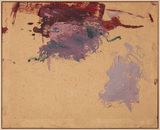
Jungwirth channels the body and the self to create her abstract pieces, using oils and watercolours to paint on paper, canvas, cardboard and even previous paintings. Her highly gestural pieces incorporate scratches, fingermarks and footprints, and she explores the properties of her paints (the transparency of watercolour, the compactness of oil). She has previously likened her creative process to a diary that plots her own physical engagement with the artwork, allowing lines, marks and blotches to emerge. Jungwirth’s practice has continued to evolve, finding inspiration in current affairs, self-portraits and landscapes, among other subjects.
- In 1975, Jungwirth visited New York City and saw an exhibition of Mies van der Rohe’s large-scale charcoal drawings at MoMA. This inspired her to temporarily leave watercolours behind and work instead in charcoal, graphite and pastel dust, creating the Indesit (1974–1976) series of drawings, which were shown at documenta 6. She likened the structural nature of everyday items—such as kitchen appliances... hence the name of the series—to NYC’s architectural landscape.
- In 1988, Jungwirth wrote der affer in mir (the ape in me), a poem-essay describing her approach to making art: “colourful streaks and blotches in tangled relation, swiftly spontaneous, blindly immeasurable”. The 2021 painting Der Affe (The Ape) references the written work.
- La Grande Armée (2021) was inspired by animal-shaped funeral beds discovered as part of the excavation of Tutankhamun’s tomb. A lion, a cow and a third, undetermined, creature—painted in oil on paper—line up facing the same direction.
Martha Jungwirth: Select Awards
- Otto Mauer Preis, Vienna (1961)
- Theodor Körner Prize (1964)
- Joan Miró Prize, Barcelona (1966)
- Print Biennial Prize, Florence (1974)
- City of Vienna Prize for Graphic Art (1986)
- Austrian Decoration for Science and Art, Vienna (2012)
- Grand Austrian State Prize, Vienna (2021)
Martha Jungwirth: Select Exhibitions
Select Solo Exhibitions
- Martha Jungwirth: Don’t Leave the Room, Thaddaeus Ropac, Paris (2026)
- Martha Jungwirth: The Last Day is the Worst, Thaddaeus Ropac, Salzburg (2025)
- Martha Jungwirth, Guggenheim Museum Bilbao (2024)
- Martha Jungwirth: Looking the Goat in the Eye, Thaddaeus Ropac, Seoul (2023)
- Martha Jungwirth: All Will Fall, Thaddaeus Ropac, London (2022)
- Martha Jungwirth: Recent Paintings, Thaddaeus Ropac, Paris (2021)
- Martha Jungwirth, Fergus McCaffrey, Tokyo (2020)
- The Trojan Horse (Theatre Safety Curtain), Wiener Staatsoper, museum in progress, Vienna (2019)
- Martha Jungwirth—New Works, Galerie Krinzinger, Vienna (2018)
- Martha Jungwirth, Modern Art, London (2017)
- Martha Jungwirth: Retrospective, Kunsthalle Krems (2014)
- Martha Jungwirth, Galerie 422, Gmunden (2012)
- Martha Jungwirth. On Paper, St Peter an der Sperr, Wiener Neustadt (2006)
- Martha Jungwirth. Painting Perspectives, Landesgalerie Burgenland, Schloss Esterházy, Eisenstadt (2000)
- Martha Jungwirth. Bali, Galerie Contact, Vienna (1996)
- In Honour of Alfred Schmeller, Museum der Moderne Salzburg (1991)
- Martha Jungwirth. Watercolours and Oil Paintings, Galerie Tanglberg, Vorchdorf (1986)
- Martha Jungwirth. Construction Sites. New Watercolours, Kulturhaus der Stadt Graz, Graz (1980)
- Martha Jungwirth. From the Black Kitchen and Other New Drawings, Landesgalerie Burgenland, Schloss Esterházy, Eisenstadt (1976) (and touring)
- Martha Jungwirth. Drawings, Modern-Art Galerie, Vienna (1971)
- Twenty-six Drawings from Martha Jungwirth, Galerie im Griechenbeisl, Vienna (1968)
Select Group Exhibitions
- PREMIERE!, Leopold Museum, Vienna, Austria
- Woman in a Rowboat, Olivia Foundation, Mexico City (2025)
- The High Yellow Note, Fondation Vincent Van Gogh Arles, Arles (2024)
- The Beginning. Kunst in Österreich 1945–1980, Albertina Modern, Vienna (2020)
- In Light of Shade, Fergus McCaffrey, New York City (2019)
- Rendezvous. Masterpieces from the Essl Collection, Essl Museum of Contemporary Art, Klosterneuburg (2016)
- Martha Jungwirth, Albert Oehlen, Mathias Schaufler, Galerie Hammelehle and Ahrens, Cologne (2012)
- Martha Jungwirth, Xaver Bayer Horn (2007)
- Best of Burgenland, Cselley Mühle, Oslip (2003)
- Perspektiven: Kunst und Virtual Reality: Bilder aus der Sammlung der Bank Austria, Palais Harrach, Vienna (1998)
- Austria Kunstforum, Vienna (1991) (and touring)
- Wirklichkeiten, Galerie Altenöder, Salzburg (1986)
- documenta 6, Kassel (1977)
- Jungwirth, Pongratz und Ringel, Galerie auf der Stubenbastei, Vienna (1970)
Further Reading
- Artist profile page at Thaddeus Ropac
- 2022 interview in Apollo
- 2024 interview with Laure Adler (via Thaddeus Ropac)
- 2024 interview in Artforum
Martha Jungwirth FAQs
Who are Martha Jungwirth’s influences?
Martha Jungwirth has cited JMW Turner’s paintings as an example of how “amazing” watercolour works can be. In 2024, she explained how she is inspired by existing art, explaining her love for Goya’s depictions of war, and Manet’s 1880 work L’Asperge. She said in 2022 that the only painting by another artist in her studio was Eugène Leroy’s Le Vieil Homme (The Old Man) (1988).
What materials and techniques does Martha Jungwirth use?
Jungwirth predominately paints in watercolour, although she also enjoys playing with the consistency of oils. However, some paints she dislikes—in a 2024 interview, she said: “Acrylic... is so vulgar. You can’t even paint park benches with it.” She eschews canvas in favour of paper, cardboard, packing paper and found papers (including pages from old account books). Always beginning with a layer of primer, she then draws from a vivid colour palette, often including reds and pinks. For watercolour painting, she uses sable-hair brushes, and wider brushes for oils. Her marks are made through her body’s physical responses to moments or emotions—scratches, handprints, and famously “constellations of blotches”.
Was Martha Jungwirth’s work criticised because she was a woman?
To a certain extent, yes. When she became the only woman to join the Wirklichkeiten group in 1968, she immediately stood out in the masculine Austrian art scene of the time. Her work received further scrutiny when she married Alfred Schmeller, a well-known museum director, in 1969.
Ocula






Explore and Follow Artists Shaping Contemporary Art
A respected voice in contemporary art discourse.
Focusing on ambitious storytelling and insightful art-world commentary. Ocula Magazine publishes in-depth interviews, critical essays and timely analysis on the artists, exhibitions and ideas driving the global art world.
Learn more about Ocula Magazine
Showcasing the best of the art world.
Ocula partners with galleries from around the world to highlight their artists, artworks and exhibitions. Gallery membership is by application and invitation, with each member vetted by an independent panel.
Learn more about Ocula Membership
Specialises in the sale of major artworks.
Led by a team with deep ties to the world’s leading auction houses, galleries and collectors. Ocula’s advisory team offers bespoke services to high-net-worth clients from around the world who are looking to acquire the best of contemporary and modern art.
Learn more about our team and services